SKIM: Making Frozen LLM Parameters 'Remember' Conversations Without External Storage

SKIM uses a closed-form method to write conversations into frozen model parameters, enabling dialogue recall without external storage.
The article introduces an arXiv study, SKIM (Self-Keyed In-Parameter Memorization), which addresses the storage bloat and model "memorylessness" caused by current LLMs relying on external storage such as prompts or vector databases to maintain conversational context, proposing to write conversations directly into the parameters of frozen language models. Its core is the "self-keyed" design: the model automatically generates many diverse questions for each dialogue turn as retrieval keys, then writes them into parameters via a closed-form method without gradient updates, so that even when users phrase questions differently, alignment and recall of the corresponding turn's content can still occur. The study evaluated five language models and showed that most stored turns can be recalled from subsequent questions, with answers coming entirely from the parameters themselves. The article argues that this method challenges the default assumption that external memory is a necessity for dialogue systems, but multi-turn writing interference, long-conversation stability, and failure case characteristics still require verification.
Why We Need "External-Memory-Free" Dialogue Recall
Current LLMs maintain conversational context almost exclusively through external storage outside the model—dialogue history is continually appended to prompts or vector databases, growing with each turn. While effective, this paradigm brings two fundamental problems: storage costs grow linearly with the conversation, and the model itself knows "nothing" about past dialogues, with all memory hanging outside its parameters.
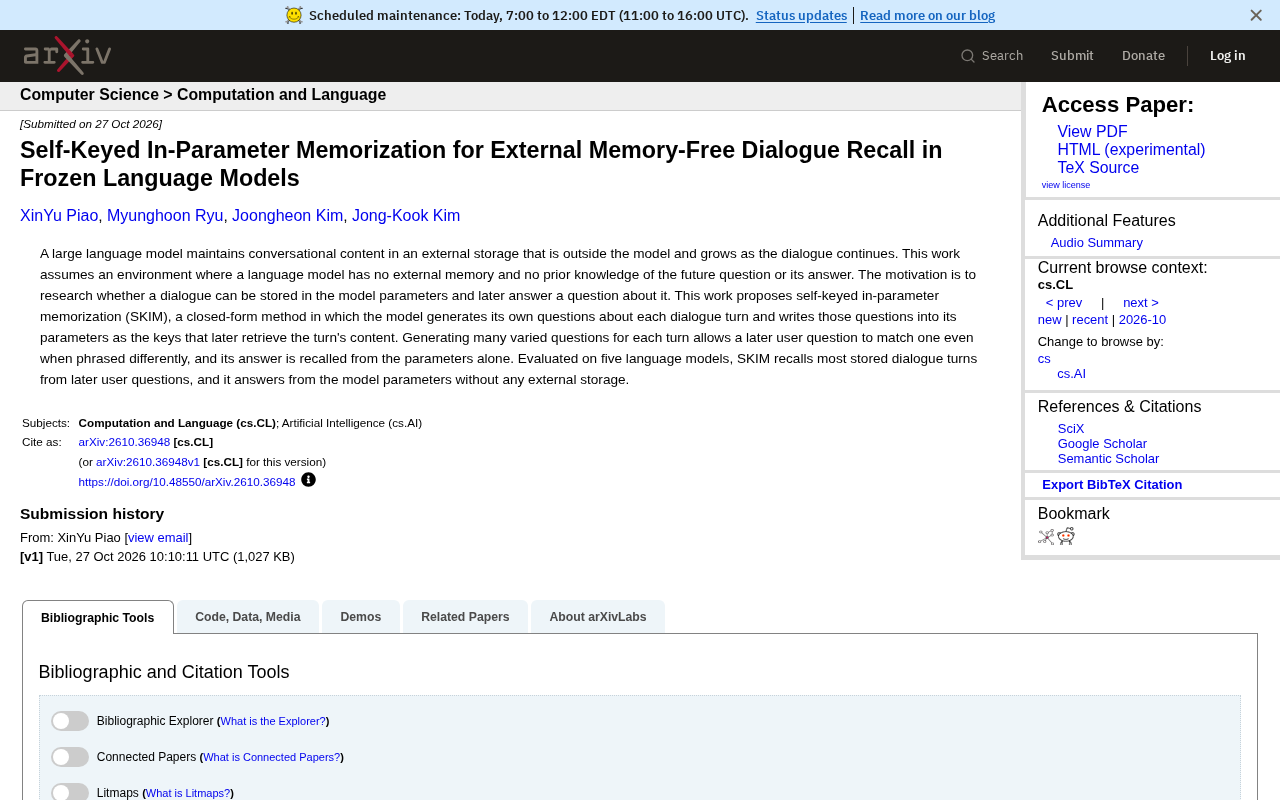
A recent study from arXiv (Self-Keyed In-Parameter Memorization for External Memory-Free Dialogue Recall in Frozen Language Models) proposes a reverse approach: can conversations be written directly into model parameters, allowing a frozen language model to answer questions about past dialogues using only its parameters? The premise of this work is strict—the model has no external memory and does not know the future questions or answers in advance.
SKIM's Core Mechanism: The Model Creates Its Own Questions and Acts as Its Own Key
The proposed method is called Self-Keyed In-Parameter Memorization (SKIM), a closed-form approach. Its key design is "self-keyed": the model automatically generates many diverse questions for each dialogue turn, then writes these questions into the parameters as "keys" for later retrieval of that turn's content.
The ingenuity of this design lies in covering the diversity of user phrasings. The same meaning can be expressed in countless ways; if only a single fixed key were stored, a user's rephrasing could cause a match failure. By generating many variant questions for each dialogue turn, SKIM ensures that even when a later user question is worded differently, it will most likely align with one of the keys, thereby recalling that turn's answer from the parameters alone.
The entire writing process is closed-form, involving no gradient updates or additional training, so the model remains frozen and parameter modifications are computed directly.
Closed-form methods refer to computational approaches with explicit analytical expressions that yield results in a single step without iterative optimization. In machine learning contexts, this typically corresponds to directly solvable formulas such as least squares, kernel regression, and ridge regression, as opposed to iterative training that relies on gradient descent. SKIM's closed-form writing means parameter updates are produced in one shot via matrix operations, requiring neither backpropagation nor saving optimizer states; the trade-off is that writing capacity and precision are limited by the form and numerical stability of the chosen closed-form solution.
Key-value retrieval is a classic abstraction of associative memory: mapping cues (keys) to content (values), and at query time comparing the input against keys and weighting the retrieval of corresponding values. The attention mechanism of modern Transformers is essentially soft key-value retrieval, but the keys and values come from the current context rather than parameters. SKIM moves this structure into parameter space, using self-generated questions as keys and dialogue content as values, enabling a frozen model to complete "recall" without reading context.
Experimental Design and Results
The study evaluated five language models. Results show that SKIM can recall most stored dialogue turns from subsequent user questions, with answers coming entirely from model parameters and independent of any external storage.
This means that after a conversation ends, the model parameters themselves carry the retrievable information of that conversation. For scenarios requiring long-term memory without wanting to maintain an external database, this method offers an entirely new technical path. However, the abstract does not disclose specific model names, dataset details, or precise recall rate figures—these require consulting the full paper.
Significance and Limitations
From a research motivation standpoint, SKIM challenges the default assumption that "external memory is a necessity for dialogue systems," transforming the memory problem into one of parameter editing and key-value retrieval. If the method can maintain effectiveness on larger-scale models and longer conversations, it could influence the architectural design of dialogue systems—shifting from "prompt stacking + vector databases" to "parameters as memory."
But the boundaries of the current stage must also be recognized: the abstract only mentions that "most" turns can be recalled, without characterizing failure cases; how many turns the method remains effective after, whether writing multiple dialogue turns interferes with each other, and how the quality of generated questions affects recall are all questions requiring further verification. The researchers should provide more detailed ablation analyses in the paper.
For researchers and engineers focused on LLM memory mechanisms, parameter editing, and dialogue system architecture, this work is worth tracking. It opens a direction: frozen models need not merely passively accept context—through carefully designed parameter writing, models can "internalize" dialogue history and autonomously recall it when needed.
Parameter editing (model editing) is a class of techniques that directly modify model weights to inject or update knowledge, with representative work including locate-then-edit, rank-one updates, and batch writing methods based on closed-form solutions. Unlike fine-tuning, parameter editing pursues "precise writing with minimal collateral damage," hoping that after modification the model updates on target facts while not significantly damaging other capabilities. SKIM can be seen as an extension of parameter editing to the dialogue memory scenario, where the difficulty lies in that written content accumulates over time and new and old writes may overwrite or interfere with each other—precisely why multi-turn stability requires dedicated evaluation.
Frozen language models refer to models that do not update any weights during inference. Traditionally, frozen means the model can only passively consume information in the prompt; but parameter editing shows that frozen and writable are not contradictory—weights can be modified offline while inference still maintains unchanged forward computation. This distinction is important for deployment: parameter writing can be batched during conversation gaps or off-peak periods, and during online service the model behaves exactly like an ordinary frozen model.
One-line Summary
SKIM uses a closed-form method to write conversations into frozen model parameters, achieving dialogue recall without external storage.
Paragraph Summary
The article introduces an arXiv study, SKIM (Self-Keyed In-Parameter Memorization), which addresses the storage bloat and model "memorylessness" caused by current LLMs relying on external storage such as prompts or vector databases to maintain conversational context, proposing to write conversations directly into the parameters of frozen language models. Its core is the "self-keyed" design: the model automatically generates many diverse questions for each dialogue turn as retrieval keys, then writes them into parameters via a closed-form method without gradient updates, so that even when users phrase questions differently, alignment and recall of the corresponding turn's content can still occur. The study evaluated five language models and showed that most stored turns can be recalled from subsequent questions, with answers coming entirely from the parameters themselves. The article argues that this method challenges the default assumption that external memory is a necessity for dialogue systems, but multi-turn writing interference, long-conversation stability, and failure case characteristics still require verification.
Related articles
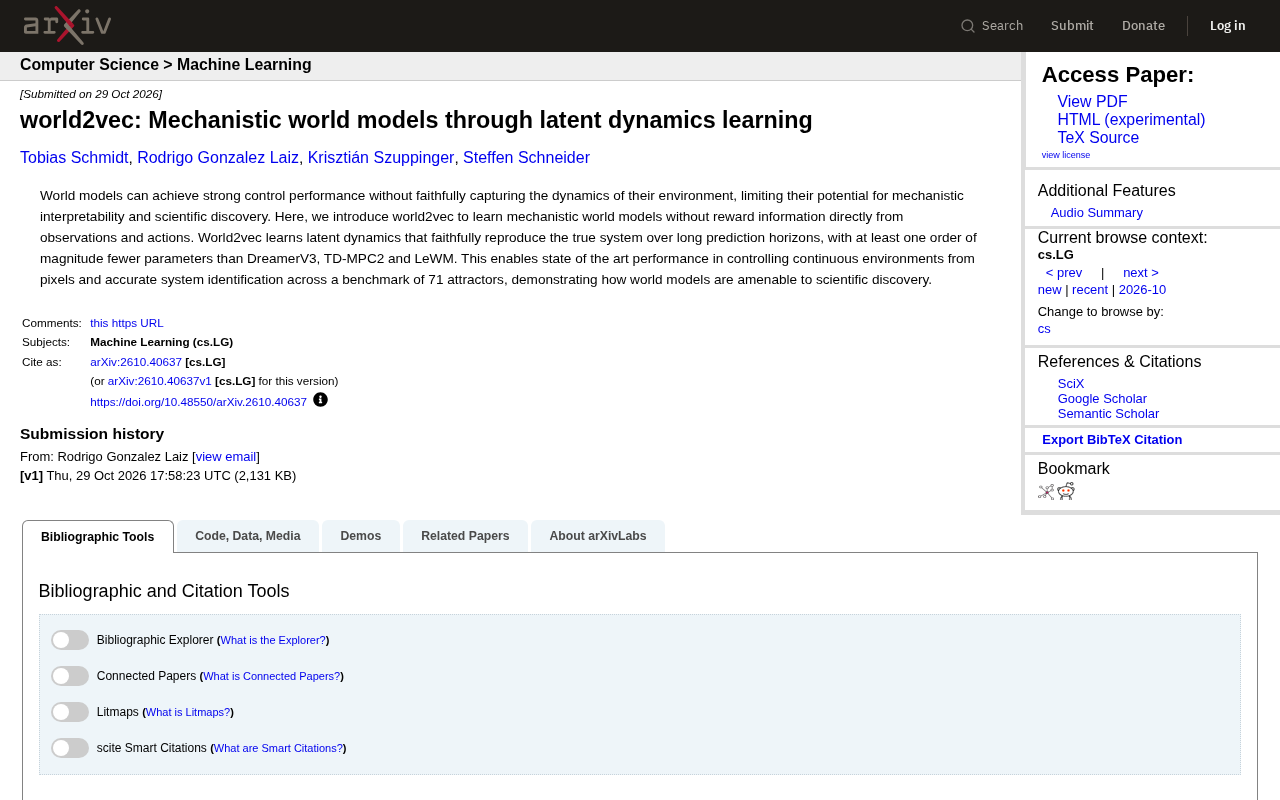
world2vec: Building Mechanistic World Models with Latent Dynamics Learning
world2vec proposes a reward-free method for learning mechanistic world models via latent dynamics, faithfully reproducing systems over long horizons with at least an order of magnitude fewer parameters than DreamerV3, TD-MPC2, and LeWM, and achieving accurate system identification on 71 attractor benchmarks.

A New KL-DRO Paradigm: Adaptive Scenario Generation Around a Learned Density Model
KL-DRO research proposes centering the KL ball on a learned density model instead of the empirical distribution, with adaptive scenario generation guiding sampling toward the worst case. Experiments show lower cost under distribution shift when records are scarce and the model can extrapolate, with comparable in-distribution cost.

ODE Samplers for Discrete Diffusion Models: Exponential Residual Flows Accelerate Generation
Discrete diffusion models lack deterministic ODE sampling? This article introduces Exponential Residual Flows (ERFs), which introduce continuous residual variables per token to construct piecewise ODEs for deterministic sampling and support consistency distillation acceleration. Superior to prior methods on code and text generation tasks.