SLP-Bench: A New Benchmark for Evaluating Clinical Speech Acoustic Assertions in Reasoning Audio Models

SLP-Bench is the first to fine-grainedly evaluate acoustic assertions in reasoning audio models' chain of thought, revealing near-random zero-shot performance and a stability-factuality disconnect.
The study proposes SLP-Bench, which grades each acoustic assertion in reasoning audio language models' chain of thought against clinician perceptual ratings, covering 5 clinical datasets and 25 dimensions across factuality, resampling stability, and cross-paraphrase consistency. Zero-shot balanced accuracy of ten open ALMs is only 0.52-0.58, close to random, and assertions are sensitive to perturbations and phrasing; the most consistent model is not the most factual. GRPO fine-tuning with clinical ratings as reward raises a 7B model's balanced accuracy from 0.54 to 0.60 and average kappa from 0.39 to 0.61, with answer accuracy stable.
Why Clinical Speech Evaluation Needs a New Benchmark
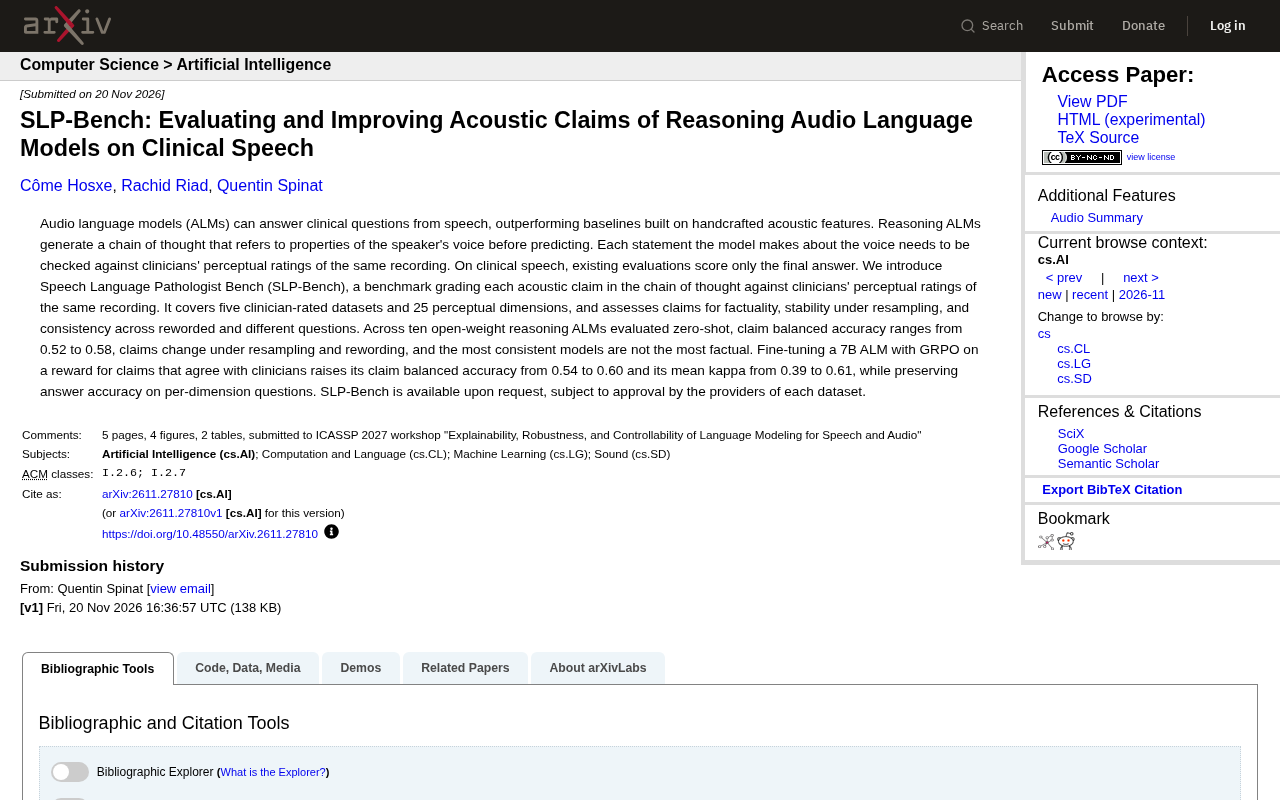
Audio language models (ALMs) can already answer clinical questions directly from speech, outperforming baseline systems based on handcrafted acoustic features. Reasoning ALMs generate a chain of thought before giving an answer, which includes descriptions of the speaker's vocal attributes—such as voice quality, pitch, and resonance. Whether these acoustic assertions are accurate directly affects the credibility of the model's reasoning. However, existing evaluations focus only on the correctness of the final answer, ignoring whether each statement about voice in the chain of thought aligns with clinicians' perception.
Clinical speech scenarios place extremely high demands on the accuracy of acoustic assertions. Speech-language pathologists (SLPs) rely on multidimensional perceptual judgments of voice during assessment. If model-generated assertions deviate from expert ratings, even a coincidentally correct final answer may mask systematic biases in the reasoning process. This is precisely the gap the new benchmark aims to fill.
Audio language models (ALMs) are a class of multimodal models that accept both audio and text inputs and generate natural language outputs. Unlike traditional speech recognition systems, ALMs typically encode audio into discrete or continuous representations, which are then fed together with text tokens into a large language model decoder to directly perform tasks such as description, question answering, and reasoning. In clinical speech scenarios, ALMs can be asked questions like "Is this speaker's voice quality hoarse?" or "Is the resonance abnormal?" and provide natural language answers. Chain-of-Thought (CoT) refers to a series of intermediate reasoning steps a model generates before outputting the final answer. For reasoning ALMs, the chain of thought often contains explicit descriptions of audio attributes, which form the basis for the answer, so their accuracy directly affects the credibility of the reasoning.
Core Design of SLP-Bench
The research team proposed the Speech Language Pathologist Bench (SLP-Bench), which grades each acoustic assertion in the chain of thought against clinicians' perceptual ratings of the same recording. The benchmark covers five clinician-rated datasets and 25 perceptual dimensions, evaluating assertion quality from three perspectives: factuality, resampling stability, and consistency across paraphrases and different questions.
This multidimensional evaluation framework goes beyond simple answer matching. Factuality measures whether assertions align with clinician ratings; stability tests whether the model still gives the same assertions after audio resampling; consistency examines whether assertions remain coherent after question paraphrasing or switching questions. Together, these three reveal the robustness of model reasoning.
Balanced accuracy is a metric for evaluating classification performance, computed as the macro-average of per-class recall. In clinical perceptual ratings, positive and negative samples across acoustic dimensions are often imbalanced (e.g., most recordings do not exhibit a certain abnormality), so ordinary accuracy is dominated by the majority class, whereas balanced accuracy more fairly reflects the model's ability to identify the minority class. Cohen's kappa measures the agreement between model assertions and clinician ratings, correcting for the probability of chance agreement. Kappa values typically range from 0 to 1, where 0 indicates agreement no better than random guessing and 1 indicates perfect agreement; in clinical assessment, values above 0.6 are generally regarded as moderate-to-substantial agreement. Together, these two metrics characterize whether model assertions are "accurate" and "how well they align with expert judgment."
Problems Revealed by Zero-Shot Evaluation
In zero-shot evaluation of ten open-weight reasoning ALMs, assertion balanced accuracy ranged only from 0.52 to 0.58, indicating that the models' acoustic assertions on clinical speech are close to random level. More notably, assertions changed after resampling and question paraphrasing, showing that the models are sensitive to audio perturbations and question phrasing.
A counterintuitive finding is that the model with the highest consistency is not the one with the highest factuality. This means a model may stably output incorrect assertions, revealing a disconnect between stability and accuracy. This result suggests that pursuing coherence in the reasoning chain alone cannot guarantee clinical reliability; evaluation must also account for factuality.
Improvements from Fine-Tuning
The study fine-tuned a 7B ALM using GRPO, with the reward signal based on the agreement between assertions and clinician ratings. After fine-tuning, assertion balanced accuracy increased from 0.54 to 0.60, and the average kappa coefficient increased from 0.39 to 0.61, while answer accuracy on dimension-specific questions remained stable.
This result demonstrates that targeted reward design can significantly improve the alignment between model acoustic assertions and clinical perception without sacrificing final answer performance. The substantial increase in the kappa coefficient is particularly critical, as it measures the degree of agreement with clinician ratings, not merely accuracy.
GRPO (Group Relative Policy Optimization) is a policy-gradient-based reinforcement learning method originally used to improve the reasoning capabilities of large language models. Unlike PPO, which requires a separate value network, GRPO samples a group of outputs for the same input and constructs advantage estimates based on the relative rewards within the group, thereby eliminating the value model and reducing training costs. In this study, the reward signal is defined as the agreement between the model's acoustic assertions and clinicians' perceptual ratings, and the model learns through within-group comparisons which assertions are closer to expert judgment. This design applies the reward directly to the acoustic descriptions in the reasoning chain rather than only to the final answer, thus improving assertion factuality while maintaining answer accuracy.
Implications for Clinical Speech AI
The value of SLP-Bench lies in lowering the granularity of evaluation from the answer level to the reasoning assertion level. For clinical speech applications, models need not only to reach correct conclusions but also to describe voice characteristics in ways that clinicians endorse. The accuracy shortcomings and the stability-factuality disconnect exposed by zero-shot evaluation point the way for future model improvements.
The fine-tuning experiment demonstrates that using clinical perceptual ratings as a reward signal is a viable optimization path. In the future, similar benchmarks are expected to drive audio language models in clinical scenarios from "correct answers" toward "trustworthy reasoning." SLP-Bench is available only upon approval by each dataset provider, a restriction that also reflects the sensitivity of clinical data sharing.
One-line Summary
SLP-Bench is the first to fine-grainedly evaluate acoustic assertions in the chain of thought of reasoning audio models, revealing near-random zero-shot performance and a disconnect between stability and factuality.
Paragraph Summary
The study proposes the SLP-Bench benchmark, which grades each acoustic assertion in the chain of thought of reasoning audio language models against clinicians' perceptual ratings of the same recording, covering 5 clinical datasets and 25 perceptual dimensions and evaluating from three perspectives: factuality, resampling stability, and cross-paraphrase consistency. The zero-shot assertion balanced accuracy of ten open-source reasoning ALMs is only 0.52-0.58, close to random level, and assertions are sensitive to audio perturbations and question phrasing; the model with the highest consistency is not the most factual, indicating the risk of stably outputting incorrect assertions. After fine-tuning a 7B model with GRPO using clinical rating agreement as the reward, assertion balanced accuracy rose from 0.54 to 0.60 and average kappa from 0.39 to 0.61, while answer accuracy remained stable.
Related articles

Jensen Huang Returns to Nvidia: The Power Game Behind an "Aggro Reset"
Nvidia's board reappointed Jensen Huang as CEO less than two weeks after his scandal-driven resignation. This analysis explores the board's decision-making, Trump's political intervention, media power failure, and market reaction behind the dramatic return.

Why Voice AI Can't Understand Kenyans' Everyday Conversations
Swahili speech recognition hits 3.24% error on read text, but everyday Kenyan speech mixes English, Sheng slang, and accents—leaving mainstream voice AI struggling.

Data Centers Build Their Own Natural Gas Plants: AI Compute's Breakout Around a Decade-Long Grid Wait
Grid interconnection approvals can take a decade, so xAI and others are building off-grid natural gas plants to power AI clusters. This article analyzes the drivers, costs, and impact of behind-the-meter generation on AI infrastructure.