SO(3)-Equivariant CNN: Spherical Physics Symmetry Without Relearning Convolutional Networks

SO(3)-equivariant CNN on HEALPix sphere avoids learning symmetry and greatly reduces simulation needs.
The article presents a gauge-equivariant SO(3)-equivariant CNN on HEALPix grids built from steerable filters, parallel transport, and spin-weighted features, giving provably exact equivariance with hyperparameter-controlled error. It achieves top accuracy in dense gradient regression, matches state-of-the-art in CMB foreground removal and denoising, and yields the tightest posteriors in cosmological lensing SBI at equal simulation counts.
Title
SO(3)-Equivariant CNN: Spherical Physics Symmetry Without Relearning Convolutional Networks
Meta Description
Researchers propose an SO(3)-equivariant convolutional network for HEALPix spherical grids, achieving exact equivariance through steerable filters, parallel transport, and spin-weighted features—no need to learn symmetry from data. It achieves state-of-the-art results in gradient regression and cosmological SBI, significantly improving simulation efficiency.
Article Content
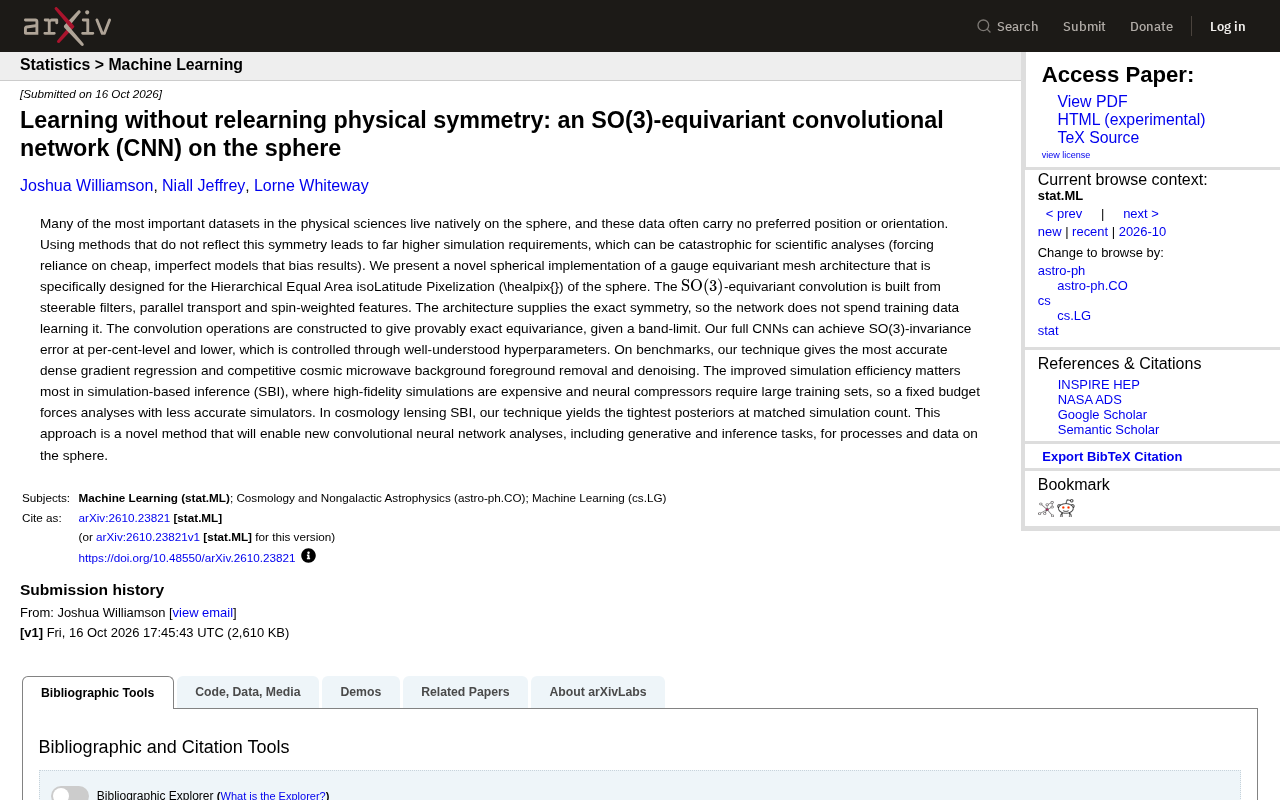
Many key datasets in the physical sciences are naturally defined on the sphere and often have no preferred position or orientation. Conventional methods that fail to incorporate this symmetry dramatically increase simulation requirements and may even force researchers to use cheap but imperfect models, thereby introducing bias. A recent study proposes a gauge-equivariant grid architecture for HEALPix spherical grids, building SO(3)-equivariant convolutions through steerable filters, parallel transport, and spin-weighted features, so that the network need not relearn symmetries from data.
Why Spherical Symmetry Matters So Much
The statistical properties of spherical data (such as the cosmic microwave background radiation or Earth science observations) do not depend on rotation. If a neural network cannot build in this symmetry, it must use large numbers of training samples to "learn" rotational invariance—which directly drives up simulation costs. In simulation-based inference (SBI), high-fidelity simulations are extremely expensive, and under a fixed budget, using imprecise simulators leads to biased posterior distributions. This study injects SO(3) equivariance directly through architectural design, eliminating this burden at its root.
Simulation-Based Inference (SBI) is a class of statistical inference methods that do not require an explicit likelihood function: researchers sample parameter-data pairs from a simulator and train neural networks to approximate the posterior distribution or likelihood ratio. Its core bottleneck lies in the fidelity and quantity of simulators—high-fidelity simulations (such as N-body simulations in cosmology) may cost thousands of CPU hours per run, and under a fixed budget, using approximate simulators causes the learned posterior to systematically deviate from the true posterior. The value of equivariant architectures is that they transform known physical symmetries from "a burden requiring data to learn" into "structure built into the architecture," thereby concentrating limited simulation samples on constraining asymmetric degrees of freedom. This is precisely the methodological foundation of the study's emphasis on "no need to relearn physical symmetries."
Technical Core: Provably Exact Equivariant Convolutions
The authors implement a gauge-equivariant grid architecture on the HEALPix pixelization scheme. Specifically, the convolution operation consists of three components:
- Steerable filters: Filters are defined in the frequency domain, and equivariant responses are achieved by rotating harmonic coefficients;
- Parallel transport: Handles vector comparisons between different tangent spaces on the sphere;
- Spin-weighted features: Naturally represent directional information on the sphere.
Given a band limit, these convolution operations have provably exact equivariance rather than approximate equivariance. The SO(3) invariance error of the full CNN can be controlled at the percentage level or even lower, and this error is explicitly controlled by hyperparameters such as the band limit and network depth—meaning practitioners can trade off accuracy and computation as needed.
HEALPix (Hierarchical Equal Area isoLatitude Pixelization) is a spherical pixelization scheme widely used in astrophysics. Its characteristics are that all pixels have equal area and pixels are regularly distributed along latitude rings, facilitating harmonic analysis (spherical harmonic transforms) of spherical signals. Unlike cubed-sphere or latitude-longitude grids, HEALPix's equal-area property avoids excessive pixel density in polar regions, and its hierarchical structure naturally supports multi-resolution analysis. This is precisely the standard storage format for cosmic microwave background radiation observation data (such as from the Planck satellite). The architecture in this study is built directly on HEALPix's pixel adjacency relationships and spherical harmonic transforms, so it can seamlessly interface with existing astronomical data pipelines—an important source of its engineering practicality.
Vector fields on the sphere (such as polarization, wind fields, or gradient directions) cannot be directly compared or convolved like planar vectors: tangent planes at different points have different orientations, so vectors must first be moved along geodesics to the same tangent space via parallel transport before inner products can be computed. Spin-weighted spherical harmonics provide a natural basis for describing such directional fields—spin 0 corresponds to scalar fields (such as temperature), and spin ±2 corresponds to polarization fields (such as the Q/U components of the CMB). Steerable filters couple with these spin-weighted harmonics in the frequency domain, so that the rotational response of the filter can be analytically given by phase rotations of harmonic coefficients, thereby achieving exact equivariance under the continuous rotation group SO(3) on discrete pixel grids, rather than approximating only at a few discrete angles.
Benchmark Performance: Gradient Regression and CMB Foreground Removal
On dense gradient regression tasks, the method achieves the most accurate performance; on cosmic microwave background (CMB) foreground removal and denoising tasks, it performs comparably to existing state-of-the-art methods. More critically, simulation efficiency is improved: in the cosmological lensing SBI task, with the same number of simulations, this technique yields the tightest posterior distributions. This means that under limited computational resources, researchers can obtain higher statistical confidence.
Implications for Spherical Neural Network Analysis
This architecture is not only suitable for classification or regression but also opens new paths for generative modeling and inference tasks on the sphere. Because equivariance is guaranteed by the architecture rather than learned, the entire network capacity can be devoted to fitting asymmetric patterns in the data rather than being wasted on rediscovering known physical laws. For fields such as astrophysics, Earth science, and molecular simulation, this represents a more data-efficient and more physically consistent deep learning paradigm.
Paper title: Learning without relearning physical symmetry: an SO(3)-equivariant convolutional network (CNN) on the sphere
One-line Summary
Proposes an SO(3)-equivariant CNN on the HEALPix sphere that avoids learning symmetry and greatly reduces simulation needs.
Paragraph Summary
The article introduces a new study for spherical data: a gauge-equivariant SO(3)-equivariant convolutional network built on the HEALPix pixelization scheme. The statistical properties of spherical data (such as the cosmic microwave background radiation and Earth science observations) do not depend on rotation, and conventional networks must relearn this symmetry from data, causing simulation costs to skyrocket; in simulation-based inference, under limited budgets, using imprecise simulators also biases the posterior. This study constructs convolutions through steerable filters, parallel transport, and spin-weighted features, with provably exact equivariance under a given band limit, and the invariance error can be explicitly controlled by hyperparameters such as band limit and network depth. Experimentally, the method achieves the most accurate performance in dense gradient regression, performs comparably to existing state-of-the-art methods in CMB foreground removal and denoising, and yields the tightest posterior in the cosmological lensing SBI task with the same number of simulations.
Related articles

Why Does the Tesla Roadster Need to Fly? A Deep Dive into Musk's Wild Demo
Tesla's Roadster launch showed wall-climbing, upside-down driving, and flying stunts—but The Vergecast notes the demo car may lack a battery, the Rocket version is invite-only and not street-legal, and the website terms don't guarantee delivery. After nine years of delays, why does this car still need to exist?

AI Is Not a Replacement: Human-AI Collaboration Through the Lens of Factory Root Cause Analysis
Starting from factory root cause analysis, this article explains how AI accelerates evidence chain construction rather than replacing human experts, exploring the pragmatic implementation logic and business value of 'AI supporting people rather than replacing them.'

AI Agent Decision Auditing: Building an Evidence Chain in Regulated Workflows
Starting from a Reddit discussion, this article analyzes three core issues in AI agent decision auditing within regulated workflows: what fields audit records should contain, how to handle feedback latency for erroneous decisions, and how to continuously calibrate LLM judge consistency with human judgment.