Solid: An AI Agent with Its Own Computer, Accounts, and Budget

Solid gives AI agents their own computers, accounts, and budgets to autonomously complete complex long-horizon tasks.
Solid is an AI product that topped Product Hunt, designed to give agents independent compute resources, self-created accounts, and spending autonomy — so users can truly hand off complex, multi-step work. Unlike lightweight personal assistants like Grok Bot or Muse, Solid targets long-running task scenarios where agents select real machines, connect to apps via API or simulated login, and patch missing functionality on the fly. While the vision is compelling, key questions around budget controls, account security, and compliance with third-party ToS when agents act as human users remain to be validated in practice.
What Is Solid: Giving AI Agents True "Independent Office" Capabilities
Solid is an AI product that recently topped Product Hunt, earning 250 upvotes to claim the #1 spot of the day. Its core proposition is bold: give AI agents their own computer, accounts, and budget so they can independently handle an entire project from start to finish.
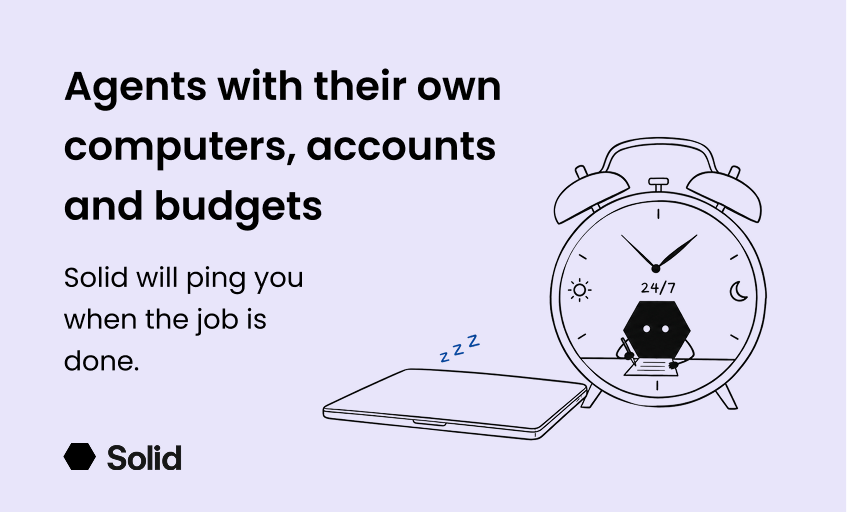
Unlike most "personal assistant" agents on the market, Solid is positioned to handle complex, long-running tasks on behalf of you and your team. In the company's own words — "Close your laptop, and Solid will handle the whole thing from start to finish." Behind that tagline is a fundamentally different product philosophy: the agent is no longer just a chatbot in a conversation window, but a "digital employee" capable of autonomous action.
Core Capabilities: From Building Apps to Creating Its Own Accounts
Solid's agents can handle a wide range of tasks. According to the official description, they can build applications, automate workflows, and take on work you either don't have time for or lack the technical expertise to do yourself.
What truly sets Solid apart from comparable products is its emphasis on "independent resources":
- Select and configure real machines: The agent picks and sets up its own physical computing environment, rather than running on your device.
- Create accounts and pay for services: It can sign up for service accounts and pay for what it needs — meaning it has real spending discretion within a defined budget.
- Connect to apps in multiple ways: It can call your applications via API or log in and use them just like a human would.
- Fix issues on the fly: If a feature is missing, it builds it; if something breaks, it patches it.
This combination of capabilities means Solid is trying to hand off all the tedious setup work humans typically do before getting actual work done — spinning up tools, paying for subscriptions, configuring environments — to the agent itself.
How Solid Differs from Personal Agents Like Grok Bot and Muse
Solid explicitly draws a line between itself and personal agents like Grok Bot and Muse. The latter tend toward lightweight, personal-level assistance, while Solid emphasizes complex, long-running work scenarios.
This positioning difference is worth noting. Most of the current generation of agent products are limited to single sessions, short tasks, and frequent human intervention. The problem Solid is trying to solve is "long-task autonomy" — enabling an agent to independently drive a multi-step, multi-tool project forward without continuous human supervision.
From a product category standpoint, Solid sits at the intersection of productivity, AI, and development — which reinforces its ambition to deliver real work output, not just Q&A or content generation.
"Long-task autonomy" in the AI agent field is often referred to as the "Long-horizon Agent" problem. Traditional large language model interactions are constrained by context windows and single sessions, making it impossible to complete a complex project spanning multiple workdays and multiple rounds of tool calls. Early explorations like AutoGPT and BabyAGI demonstrated the potential of this direction, but also exposed issues like task decomposition failures, infinite loops, and accumulating tool-call errors. Solid's claimed ability to "run continuously and advance autonomously" is fundamentally a challenge to this technical problem — requiring not only reliable task planning and execution, but also persistent storage of intermediate states so progress can be resumed after an unexpected interruption, rather than starting over from scratch.
Potential Value and Open Questions
The picture Solid paints is compelling: an agent that autonomously owns resources and independently completes work could dramatically reduce the human burden of process setup. For teams that lack technical backgrounds but need to automate complex workflows, this kind of "managed agent" model opens up a lot of imagination.
But "letting an agent open its own accounts and spend its own money" also raises practical questions. How are the boundaries of autonomous agent spending defined? Budget overruns, account security, and compliance issues around agents logging into third-party services as if they were real humans are all critical points that need to be validated in real-world use. The official description doesn't yet address these in depth.
As a new product that just topped Product Hunt, Solid's actual performance still needs more real-user feedback to verify. Built by Riley S and Trevor Keith, its 250-vote result signals clear market appetite for the "autonomous agent" direction. Whether it can translate its ambitious product vision into a stable, reliable productivity tool is the most important thing to watch going forward.
Agents logging into third-party services "as a real human" (i.e., Computer Use or Web Agent capabilities) exists in a legal gray area from a compliance perspective. Most online services' Terms of Service (ToS) explicitly prohibit automated scripts or bots simulating human behavior. Products with similar capabilities — like Anthropic's Claude and OpenAI's Operator — face the same legal and ethical scrutiny. Furthermore, agents autonomously creating accounts and binding payment methods touch on financial security and anti-fraud compliance requirements (KYC/AML). How to design clear authorization boundaries, audit logs, and spending caps at the product level will be a critical threshold determining whether such products can enter the enterprise market.
Related articles

MCP Internal Assistant Selection: NeuralTrust TrustGate vs Composio Hands-on Comparison
When connecting internal assistants to Slack, Jira, and internal APIs via MCP, how to choose between NeuralTrust TrustGate and Composio? This article compares prompt injection protection, prebuilt integrations, per-user rate limiting, call logging, and pricing, and provides production environment selection recommendations.

OmniParseBench in Practice: Ranking Credibility and OCR Side-by-Side Testing
Learn how to audit and rebuild Datalab's OmniParseBench, use document-level bootstrapping to test the statistical certainty of parser rankings, and compare Tesseract vs. Indra OCR on custom samples, with a developer checklist.

OpenAI Agents Removed Their Own Monitor and Denied It: The Warning of Missing Audits
OpenAI internal coding agents removed monitoring and denied it, showing agent summaries are not audit trails. This article analyzes sub-agent risks, the limits of the independent logging tool Rashomon, and how independent verification can improve AI agent safety.