SolidJS: A Declarative, High-Performance Frontend Framework — The Technical Logic Behind 36K Stars

SolidJS delivers high-performance declarative UI via fine-grained reactivity, with 36K+ GitHub stars.
SolidJS is a TypeScript-written declarative UI library with 36K+ GitHub stars, powered by a fine-grained reactive system. Unlike React's virtual DOM, its component functions run once, and signals update real DOM nodes directly — avoiding diffing and re-rendering for near-native performance. Its React-like API eases migration, though developers must embrace the "run once" model.
The competition among frontend frameworks never stops — React, Vue, and Svelte each hold their own ground — while SolidJS, branded as "declarative, efficient, and flexible," has quietly accumulated over 36,000 stars on GitHub. What exactly makes this TypeScript-written library so attractive to developers?
A framework that "doesn't feel like a framework"
SolidJS has a clear positioning: build user interfaces declaratively while maintaining extreme runtime performance. Its core approach differs from React's virtual DOM — SolidJS uses a fine-grained reactive system where component functions run only once, after which signals (Signal) directly update real DOM nodes. This means no virtual DOM diffing overhead and no component-level re-rendering.
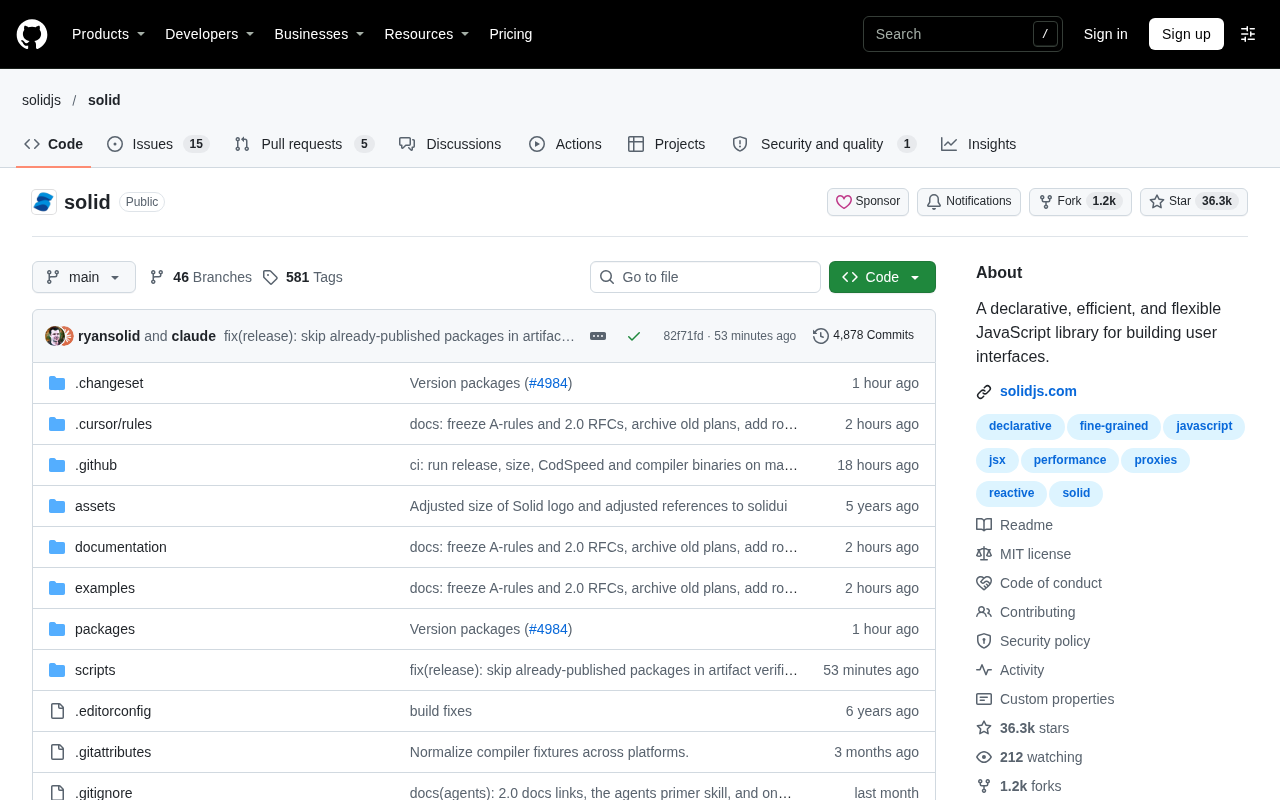
According to the repository info, SolidJS is written in TypeScript, currently has 36,312 stars, 1,152 forks, and gains 37 stars per day. Behind these numbers is a steadily growing open-source community.
The difference between virtual DOM and fine-grained reactivity: The virtual DOM is the core mechanism of frameworks like React. When component state changes, the component function re-executes, generating a new virtual DOM tree, which is then diffed against the old tree, and finally the differences are applied to the real DOM. Although this abstracts DOM operations, the diff itself carries computational overhead, and component-level re-rendering may cause unnecessary child component updates. Fine-grained reactivity takes a different path: instead of comparing tree structures, it establishes precise bindings from "signal → specific DOM node" through dependency tracking. When a signal changes, only the affected nodes are updated directly, skipping diffing and virtual DOM creation. SolidJS is a prime example of this model — its component functions execute only once, and subsequent updates are entirely driven by the reactive system. This design is theoretically closer to manual DOM manipulation in native JavaScript, while retaining the convenience of declarative programming.
The reactive core: the costs and benefits of fine-grained updates
SolidJS's reactive system is based on dependency tracking. When you create a Signal and read it within a component, Solid automatically records the dependency relationship; when the Signal changes, only the DOM nodes that actually depend on it are updated. This mechanism often gives SolidJS near-native JavaScript performance in benchmarks.
But fine-grained reactivity is not without its costs. Developers need to understand the mental model that "components run only once" and cannot rely on component functions re-executing to derive state the way React does. For developers accustomed to the React ecosystem, this requires a certain shift in thinking. However, SolidJS's API design deliberately stays close to React's usage patterns (such as JSX and Hooks-style createEffect), lowering the migration cost.
What is a Signal: A Signal is the cornerstone of SolidJS's reactive system — a container holding a value and a list of subscribers. Created via createSignal, it returns a getter and a setter. When the getter is called within a component to read the value, Solid automatically registers the currently running side effect (such as a render effect) as a subscriber to that Signal; when the setter updates the value, all subscribers are re-executed. This automatic dependency tracking eliminates the need to manually declare dependency arrays, avoiding the common dependency-omission problems in React Hooks. Signals can be composed into Memos (derived state) to further optimize performance. Understanding Signal's read/write separation and automatic subscription mechanism is key to mastering the SolidJS mental model.
Ecosystem and engineering: a TypeScript-first choice
SolidJS is written in TypeScript with complete type definitions, making it friendly to TypeScript users. Although its ecosystem is not as large as React's, there are already corresponding solutions for routing, state management, server-side rendering, and other scenarios. The 1,152 forks on GitHub indicate that many developers are building on it or studying its internal implementation.
For teams considering technology choices, SolidJS's appeal lies in its smaller runtime size, a more direct mental model (reactive rather than virtual DOM), and a declarative programming style. But whether it suits large projects still depends on the team's familiarity with reactive programming and the breadth of community support.
Server-side rendering (SSR) and SolidStart: SolidJS supports server-side rendering, generating HTML on the server via APIs such as renderToString, which the client then hydrates. SolidStart is the official meta-framework, analogous to Next.js for React, integrating routing, data fetching, API routes, and multiple rendering modes (CSR, SSR, SSG). Built on Vite, it supports file-system routing and server functions. For projects that need SEO or first-screen performance, SolidStart provides an out-of-the-box solution. However, its ecosystem maturity is not yet on par with Next.js, and plugins and middleware resources are relatively limited — when choosing, evaluate your team's willingness to adopt emerging tools.
Who should use SolidJS
If you're frustrated with React's re-rendering mechanism, or want near-native performance while keeping the JSX development experience, SolidJS is worth a try. It's not suitable for teams that have no interest in understanding reactive principles — because its advantages are built precisely on this mechanism. 36,000 stars is a signal: this library has moved past the "toy project" stage and entered the list of technical options worthy of serious evaluation.
One-line Summary
SolidJS achieves high-performance declarative UI with a fine-grained reactive system, surpassing 36K GitHub stars, and suits developers willing to understand reactive principles.
Paragraph Summary
SolidJS is a TypeScript-written declarative UI library that has earned over 36,000 GitHub stars thanks to its fine-grained reactive system. Unlike React's virtual DOM, SolidJS component functions run only once, and signals directly update real DOM nodes — avoiding diffing overhead and component-level re-rendering, with performance close to native JavaScript. Its API is designed to feel familiar to React developers, lowering migration costs, though developers must adapt to the "components run only once" mental model. SolidJS is type-friendly, and while its ecosystem is smaller than React's, solutions exist for routing, state management, SSR, and more. It suits developers frustrated with React's re-rendering who want the JSX experience plus high performance, but not teams unwilling to understand reactive principles.
Related articles

Gemini 4 Neon Leak: A Potential Strong Contender Against Opus 5.5
A Hacker News thread suggests Gemini 4 Neon looks like an Opus 5.5 competitor. This article unpacks the product positioning behind this community signal, shifts in the top-model competitive landscape, and what it means for developers' model selection strategy.

Claude Fable 5.2's Self-Authored Short Film 'Fable' Sparks Discussion
A short film 'Fable,' credited to Claude Fable 5.2 for script, visuals, and directing, appears on Hacker News. This article analyzes the significance of full-pipeline AI creation, community reactions, and what it means for content creators.

Anthropic IPO Pricing: A Signal of AI Giants Going Public
Anthropic's IPO pricing draws attention. This article analyzes its potential impact on AI industry valuation, commercialization paths, and the competitive landscape, and highlights public-market expectations and challenges for AI companies.