Solo Developer Building a WoW-Style RPG with AI + Unity: Skills, Pets & Commerce Systems in Action

Solo developer builds a WoW-style RPG using Doubao AI + Unity with multiple core systems implemented.
A solo developer is building a World of Warcraft-style RPG using Doubao AI for coding assistance, combined with Unity and Playmaker visual scripting. Core systems already implemented include skills (AoE, DOT damage), pets (following and cooperative combat), and commerce (item trading and economic circulation). Next steps include quest systems, equipment systems, and dungeon gameplay, with plans to launch on Steam as a single-player version first.
Project Overview: One Person Building a WoW-Style RPG with AI
A solo developer is building a World of Warcraft-style RPG game using Doubao AI for programming assistance, combined with the Unity engine and Playmaker visual scripting tool. This video update showcases several core systems already implemented, including skill systems, pet systems, and commerce systems—overall progress is "hitting its stride."
The significance of this project goes beyond the game itself. It validates an important idea: With AI tools maturing rapidly, solo developers now have the ability to tackle complex game projects that once required large teams.
Detailed Breakdown of Implemented Core Systems
Skill System: AoE and DOT Damage
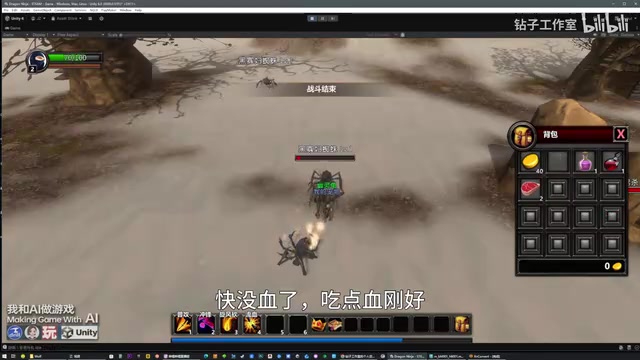
The game has implemented a foundational skill framework covering both basic attacks and special abilities. The video demonstrates "Whirlwind Slash," an AoE skill—after casting, the character deals area damage to surrounding enemies. More notably, the game also features "Bleed" as a DOT (Damage Over Time) effect, where enemies continuously lose health after being afflicted. This is a quintessential combat mechanic in RPG games.
DOT (Damage Over Time) is a classic mechanism in RPG combat design, traceable back to poison and burning effects in the tabletop game Dungeons & Dragons. On the technical implementation level, DOTs are typically attached to targets through a "Buff/Debuff system," triggering damage calculations at fixed time intervals (Ticks). Implementing DOT in Unity requires handling Coroutine or timer logic, while also considering rules for multiple DOT stacking, refreshing, and overwriting—these details directly impact combat depth and numerical balance.
The skill bar UI is already built, and the spellbook panel is in place. While some features are still being refined, the overall framework has good extensibility, making it much easier to add new skills down the road.
Pet System: Following and Cooperative Combat
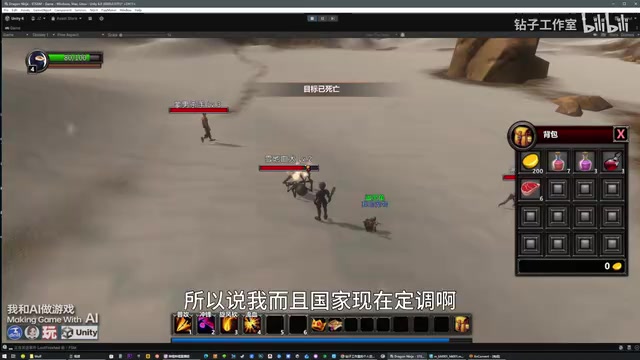
The pet system is fully functional. The video shows pets like "Ghost Witch" following the player and participating in combat. Monsters drop items upon being killed, all configured by the developer, demonstrating the system's customizability.
For a WoW-style RPG, the pet system is a crucial component for enriching gameplay, with significant room for future expansion—such as pet leveling, skill learning, and more.
Commerce System: Item Trading and Economic Circulation
The commerce system is one of the highlights of this update. Players can sell items from their inventory to merchants for gold coins, and purchase health potions, equipment, and other items from merchants. The system already implements differentiated buy and sell prices—purchase price differs from selling price—which is the foundational setup for building an in-game economy.
The buy-sell spread is a fundamental tool in game economy design for controlling inflation. It's essentially a "currency sink" mechanism—players lose a portion of value with every transaction, continuously draining the total currency in circulation. MMOs like World of Warcraft also introduce auction house taxes, repair costs, and other currency recovery mechanisms to collectively maintain long-term economic stability.
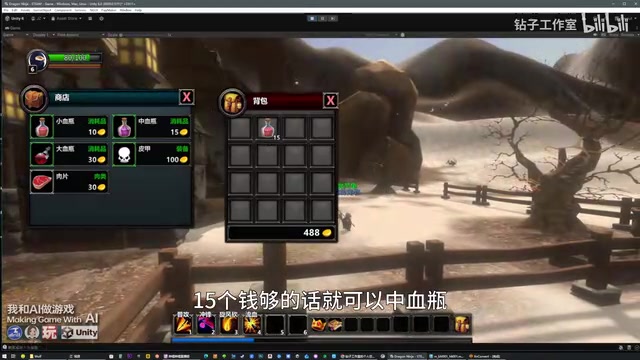
The video demonstrates selling meat for 330 gold coins, purchasing health potions and leather armor—the entire transaction flow works end to end. However, the developer acknowledges that there are still some design decisions to finalize regarding the gold system. For example, should gold exist as an item in the inventory, or should it be an independent currency system? This choice affects the entire economic architecture going forward. "Itemized currency" is easy to implement for trading and drops but can cause inventory management issues; "account currency" is more modern and better prevents duplication exploits but requires independent currency database design. Both approaches have their trade-offs.
Tech Stack: Doubao AI + Playmaker + Unity + C#
This technology combination offers valuable reference for indie game developers:
- Doubao AI: Assists with code generation and logic design, significantly lowering the development barrier
- Unity Engine: Mainstream game engine providing rendering, physics, and cross-platform publishing capabilities
- Playmaker: A visual state machine plugin for Unity that builds game logic through drag-and-drop, reducing hand-written code
- C# Scripts: Unity's primary programming language, handling complex logic that Playmaker can't cover
Playmaker is built on Finite State Machine (FSM) theory, breaking down game logic into node graphs of "States" and "Transitions." This concept originates from automata theory and is widely used in game AI, animation control, and interaction logic. For non-professional programmers, Playmaker's value lies in converting abstract code logic into visual flowcharts, dramatically lowering the cognitive barrier. However, its limitations are also clear: node graphs become difficult to maintain under complex logic, and performance overhead is higher than pure code implementations. Therefore, it's typically used in combination with C# scripts.
Programming assistance tools like Doubao AI are built on Large Language Model (LLM) technology, gaining the ability to understand and generate code through pre-training on massive code corpora. The core value of these tools lies in "code completion" and "logic translation"—developers describe requirements in natural language, and the AI generates corresponding code frameworks. However, AI-generated code has clear limitations: limited understanding of project context, often requiring manual debugging and adaptation, with higher error rates in complex system coupling scenarios. Therefore, AI works better as an "accelerator" rather than a "replacement," especially suitable for handling highly repetitive, logically independent modules.
This combination of "AI assistance + visual tools + traditional programming" enables solo developers without large team resources to gradually build complex RPG game systems.
Future Development Plans and Monetization Strategy
Development Roadmap
The developer has outlined clear priorities for what comes next:
- Quest System: The core driver of player experience—without a quest system, the game lacks a sense of purpose
- Character Equipment System: Completing the character panel and equipment wearing for better progression feedback
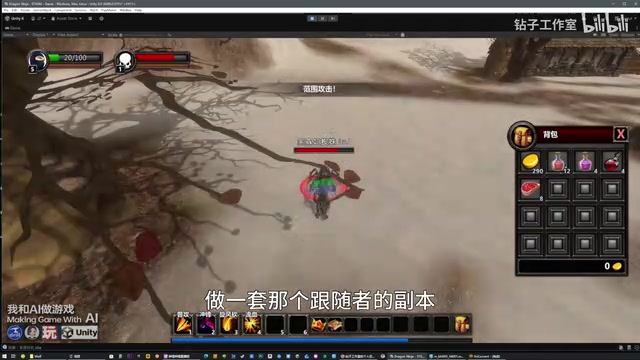
- Dungeon Gameplay: Planning a "follower dungeon" mode to add PVE depth
- Multiple Classes and Races: Enriching character choices to increase replayability
The developer believes that with quest system + commerce system + equipment system in place, the game will have a basic gameplay loop and can begin testing and collecting feedback.
Monetization Strategy
Due to China's domestic game license (版号) approval restrictions, the developer's current strategy is to launch on Steam as a single-player version first, focusing on "dungeons" and "follower dungeons."
Related articles
 Tutorials
ChatGPT Plus Subscription Guide: Are GPT-5.5, image-2, and Codex Worth the Upgrade?
A detailed look at ChatGPT Plus features — GPT-5.5, image-2, and Codex — with a Plus vs Pro comparison and a complete step-by-step subscription guide for users outside the US.
 Tutorials
Harness AI Engineering in Practice: Using Claude Code to Master Enterprise-Level E-Commerce Development
Deep dive into Harness AI Engineering: master enterprise e-commerce development with Claude Code using the Rules, Skills, Wiki, and Changes framework.
 Tutorials
Cursor + Codex Dual-IDE Collaboration: A Practical Methodology for Open-Source Project Customization
A complete methodology for open-source project customization based on real-world experience, detailing the Cursor+Codex dual-IDE workflow, seven-stage process, MVP validation, and AI source code reading techniques.