Sonnet 5.5 vs Opus 5.5: Hands-On Testing Tells You Which to Use

Seven rounds of testing show Sonnet 5.5 narrowly beating Opus 5.5 at 4:3—the key isn't which is stronger but when to use which.
A YouTube creator compared Claude's Sonnet 5.5 and Opus 5.5 across seven real workflows. Opus costs roughly double Sonnet ($4 vs $2 input, $20 vs $10 output per million tokens), yet the score came out Sonnet 4:3. The article distills a practical rule: use Sonnet first when a task has clear completion criteria, and reach for Opus when you need creativity, taste, or a "thinking partner" to help define the goal. Opus excels at motion showreels, vague-instruction planning, and sound design; Sonnet wins on landing pages, spreadsheets, dashboards, and resource guides with its high cost-effectiveness. Across all seven sessions, Opus spent about $16 more and ran about 46 minutes longer, while producing fewer output tokens.
Sonnet 5.5 vs Opus 5.5: Hands-On Testing Tells You Which to Use
When you put the two Claude family models side by side, many people's first instinct is "the expensive one must be better." But a YouTube creator ran Sonnet 5.5 and Opus 5.5 through seven real workflows, and the result wasn't simply double the price, double the quality. The final score of this hands-on test was 4:3—Sonnet actually came out slightly ahead—though the conclusion is far more nuanced than the numbers suggest.
Price Is Double, But Capability Isn't Linear
Let's start with the hardest facts. Sonnet 5.5 is priced at $2 per million input tokens and $10 per million output tokens; Opus 5.5 is $4 input and $20 output. In other words, Opus costs roughly twice as much as Sonnet.
Anthropic itself provides usage guidance: for everyday coding, bug fixing, high-throughput routine development, and polishing documents/slides/spreadsheets, Sonnet is recommended; only when a task requires complex judgment, long-chain agentic coding, knowledge work, or your toughest problems should you bring in Opus.
The creator translated this official advice into a more practical rule of thumb: If a task has a clear definition of done, try Sonnet first; if what you need is creativity, a thinking partner to help you define what "done" even means, then use Opus. This principle was validated over and over across the seven tests that followed.
A note on tokens and pricing: LLM billing is based on tokens, the smallest chunks of text a model processes. As a rough estimate, 1 token ≈ 0.75 English words, while in Chinese roughly 1 character corresponds to about 60 tokens. The reason billing distinguishes "input" from "output" is that output tokens require the model to generate them word by word, which is computationally far more expensive than processing input tokens in parallel—hence output pricing is typically 3-5x input pricing. In this article, Sonnet's $2 input/$10 output and Opus's $4 input/$20 output refer to the price per million tokens processed. It's worth noting that agentic tasks (where the model autonomously calls tools and iterates multiple rounds) repeatedly feed context back into the model, causing input token consumption to balloon—this is exactly why Opus consumed about 38 million more input tokens later on, and it's the key reason why estimating total cost based on "double the unit price" alone can be misleading.
Test One: Landing Page Design, Sonnet Wins the Hero Section
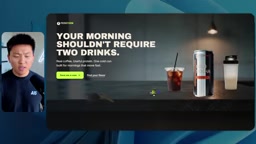
The first task was creating an immersive, high-conversion landing page for a beverage product. Both models ran at high effort level with an identical prompt.
Sonnet's version had immediate impact: smooth text animations, a can that follows mouse interaction, drag-to-scroll background, visually more "explosive." The problem was that its hero can was a 3D render, not a real product image.
Opus's hero section was relatively flat, with less layering, but it used real generated images that conformed to brand guidelines, and the subsequent scroll narrative, animation details, and overall storyline were clearly more complete.
An interesting divergence emerged here. The creator's own preference was: Sonnet's hero section looked better, but Opus's remaining sections were better. Ultimately he awarded this round to Sonnet—reasoning that if Sonnet swapped the fake can for real assets, it might only cost a little more to match Opus's effect. And Opus ran for 28 minutes this round (actually Sonnet 28 minutes, Opus 52 minutes), costing almost double. In his words: "Is Opus's output twice as good as Sonnet's? I don't think so."
High effort level and Cloud artifacts: Anthropic's models support controlling reasoning depth through "thinking budget" or effort parameters. High effort means the model performs a longer internal reasoning chain before responding, typically yielding better performance on complex tasks but also driving up latency and token consumption—this explains why the same task took Opus 52 minutes versus Sonnet's 28. The Cloud artifact mentioned in the article refers to cloud-based interactive pages/documents generated by Claude's Artifacts feature, which users can preview and share directly in the browser, as opposed to the local HTML file Sonnet generated this round (which requires downloading to open). The difference in delivery format directly affects user experience and is an important criterion for the creator's judgment of "readability" and "direct usability."
Test Two: Motion Showreel, Opus's Taste Is Unmistakable
The second task had both models create a brand motion showreel, researching on their own and ensuring brand consistency themselves. "You're a motion designer, come impress me."
Sonnet's performance exceeded expectations: it showed the product in actual use, generated decent voiceover, and had a clever idea of pixels converging into a logo then transforming into AI-generated video.
Opus's version was on another level. Background, animation, and copy were all more "on point." It even proactively scraped a quote from the creator himself off his website and included it. The sound design was specifically called out—this is a part many human designers struggle with, yet Opus handled it consistently.
Cost-wise, Opus was actually faster and produced fewer output tokens, but was more expensive ($20.55 vs $14.37). This round went to Opus. The creator's judgment: even if Sonnet iterated to the same cost, Opus's taste and sound design would still be better.
Test Three: Under Vague Instructions, Opus Wins as a "Thinking Partner"
The third test deliberately gave an extremely vague prompt: "Make me a research-backed action plan to get my channel to 1,000 subscribers in 90 days."
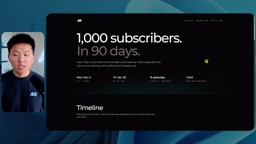
Both models initially only gave Markdown. The creator added the same second instruction: convert to a more readable document. Sonnet generated a local HTML file; Opus gave a Cloud artifact.
Sonnet's version set the timeline outside Q4, with high information density but somewhat cluttered; Opus aligned it into a Q4 90-day sprint, with a clearer view and a clickable complete plan with specific executable tasks that could be dropped directly into a task system.
Opus won this round. The reason: this is a classic scenario requiring a "thinking partner," where the model needs to catch an ambitious goal itself and unfold it. The creator also admitted that if both were given sufficiently specific instructions, Sonnet would likely produce similar results, and cheaper. But under vague instructions, Opus's advantage couldn't be ignored.
Test Four: Document & Spreadsheet Generation, Opus Faster and Cheaper
The fourth task gave both models the same simulated company data, requiring an Excel spreadsheet and an investor pitch deck.
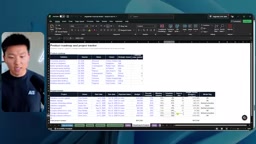
The two decks were highly similar in look and design, hard to separate. But the Excel part created a gap: almost every cell in Opus's spreadsheet had formulas, meaning the whole table would update automatically when data changed—rather than being a static table full of hardcoded values that can't be maintained.
The key reversal came in cost—this round Opus was both faster and cheaper. Since output quality was close, the cheaper and faster one naturally won. This was the only time in the whole session that Opus beat Sonnet on cost-effectiveness.
Tests Five and Six: When Goals Are Clear, Sonnet Catches Up
The fifth task used an HTML interpreter skill, with the topic "which local models can my computer run." Sonnet's version was more visual, but its explanation depth was inferior to Opus; Opus's explanations were clearer and even taught practical judgment methods like the "32GB rule." The creator still awarded this round to Sonnet, reasoning that with one round of feedback-driven iteration, Sonnet would likely surpass Opus at half the cost.
The sixth task required scraping the day's AI news from X and building an interactive information dashboard.
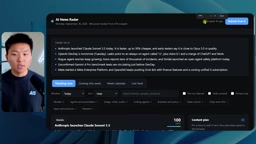
Sonnet delivered a complete, usable local dashboard: scraping stats, heat scores, content plan, calendar view all included. Opus's version was visually more refined, with scraping progress bars, hourly post counts, rising/cooling trends, and automatic tagging by rumor, published, and discussion. Looking at just one round of output, Opus was better; but the creator again did the math—Sonnet was fully capable of building these features, just needing a few more iterations. By his rule, Sonnet is cheaper, so it won.
Test Seven: With Skill Fallback, Instruction Following Is What Matters
The final task gave both models a link to one of the creator's YouTube videos, asking them to generate a resource guide. Because a mature skill was invoked, the standard for "good" was defined in advance.
The two versions were extremely similar in length, structure, and content, with differences too small to judge superiority. So the only criterion fell back to cost and speed: Sonnet was twice as fast and $0.40 cheaper. This round went to Sonnet.
This also confirmed a pattern: When a task has a clear specification and verifiable results, a weaker model just needs to follow instructions to deliver results close to the top-tier model.
Skill and agentic coding: Here, "skill" refers to the "skills" mechanism in the Claude ecosystem—a preset encapsulation of prompts, tool sets, and processes, essentially handing the model a standard operating procedure (SOP) in advance. When a skill has already defined output format, steps, and quality standards, "good" becomes a mechanically verifiable metric, and the gap between models is compressed to mainly who's faster, cheaper, and more obedient. By contrast, agentic coding means the model isn't just completing code but can autonomously plan, read/write files, run commands, and debug iteratively in multi-step tasks—these tasks demand extremely high long-chain judgment and error recovery, which is exactly where Anthropic officially recommends Opus. Understanding the difference between these two also unlocks the article's core logic: the more a task resembles "executing an SOP," the more cost-effective Sonnet is; the more a task requires the model to define the SOP itself, the more Opus's value stands out.
The Final Tally After Seven Tests
Aggregating data from the seven sessions: Opus ran about 46 minutes longer in total, consumed about 38 million more input tokens, and actually produced fewer output tokens. Total cost was about $16 more than Sonnet—considering Opus's unit price is double Sonnet's, the cost gap in this experiment was actually less than double.
The score was Sonnet 4 : Opus 3. But the creator repeatedly emphasized that this isn't a showdown of who's stronger, but a decision manual for "when to use which model." Across the seven rounds, Sonnet won mostly tasks that were "clearly goal-oriented, well-specified, verifiable"; Opus won tasks that were "open-ended, requiring creativity and taste."
The practical advice for users is straightforward: run each model on your real skills, prompts, and workflows, record which model is stronger on which type of task, and select by that record next time. Rather than agonizing over which model is smarter, figure out which category your task belongs to.
Related articles

Gemini 4 Argon Hands-On: AI Builds Board Games, Constructs Temples, and Trains Robots Autonomously
Gemini 4 Argon hands-on roundup: AI autonomously builds a desk racetrack and temple in Blender, writes a ray tracing engine, trains a humanoid robot to sink 7 shots, plus API pricing and developer access.

The Magic Octagonal Coin: Why Only 9% of People Can Predict Its Flip?
Only 9% of people can correctly predict the Magic Octagon coin flip. This article explains its spatial rotation mechanism, common cognitive pitfalls, and a new hypothesis based on Relevance Theory, exploring the limits of human spatial reasoning.

Sam Altman: AI Is Entering the Era of Scientific Discovery — Math Breakthroughs Will Replicate in Biology and Energy
Sam Altman says AI is entering the era of scientific discovery — math breakthroughs will replicate in biology, materials science, and energy to help develop new drugs and energy sources.