Sonnet 5.5 vs Opus 5.5: Why the Cheaper Claude Actually Costs More

Anthropic released three million-context models in three weeks; the most counterintuitive finding is that Sonnet costs more per task than Opus at max effort.
Anthropic released Haiku 5.5, Sonnet 5.5, and Opus 5.5 within three weeks. All three support million-token context, with input pricing from $0.10 to $4 per million tokens and output uniformly 5x input. The article outlines each model's role: Haiku for batch classification and subagents, Sonnet for everyday development work, Opus for long-duration hard tasks, plus Fable 5.1 for the most demanding reasoning. The core counterintuitive finding: at max effort, the cheaper Sonnet costs $7.67 per task, surpassing Opus at $5.98, because Sonnet consumes about 60% more output tokens. This leads to Anthropic's advice—adjust reasoning effort first before switching models—and introduces Team mode for multi-model collaboration and selection methodology.
Anthropic released Haiku 5.5, Sonnet 5.5, and Opus 5.5 in quick succession over three weeks. All three models support million-token context windows, with pricing ranging from $0.10 to $4 per million input tokens. But a counterintuitive finding emerges: at the highest reasoning effort level, the cheaper Sonnet 5.5 actually costs more per task than Opus 5.5. Behind this lies a complex interplay between model pricing, reasoning effort adjustment, and actual token consumption.
Basic Positioning and Pricing of the Three Models
Opus 5.5 led the way on September 22, followed by Sonnet 5.5 on September 28, with Haiku 5.5 wrapping up the releases on October 7. All three models can handle up to one million tokens of input at once, with the core differences being speed and price.
On input pricing, Opus charges $4 per million tokens, Sonnet $2, and Haiku just 10 cents. Output pricing is uniformly 5x the input price. Haiku 5.5 is described by Anthropic as "the cheapest, fastest small model to date," about 75% cheaper than Haiku 4.5, and designed for high-volume processing, classification, customer support, and serving as a subagent for larger models.
An amusing detail: when Haiku was asked in testing "how many R's are in 'total'," it answered "one"—when there are actually none. This serves as a reminder that even when a model has a massive price advantage, caution is still warranted for tasks requiring precise reasoning. Another important note: once a prompt exceeds 100K tokens, Haiku's price jumps 5x.
What is a token context window
A large model's "context window" refers to the total number of tokens the model can simultaneously read and process in a single inference, including input (prompt, files, conversation history) and output. One million tokens is roughly 750,000 English words, equivalent to several full-length novels—enough to fit a mid-sized codebase or hundreds of pages of documentation at once. The larger the context, the better the model can maintain consistency across long documents and conversations without frequent chunking. But two caveats apply: first, extremely long contexts significantly inflate input token bills, especially since Haiku's price jumps 5x beyond 100K tokens; second, "fitting it in" doesn't mean "using it well"—a model's recall and reasoning ability deep within extremely long contexts is typically weaker than at the beginning, which is why retrieval, summarization, and subagents remain essential in practice.
Sonnet 5.5: The Best Balance for Everyday Work
Sonnet 5.5 is defined by Anthropic as "the best combination of speed and intelligence," aimed at everyday workers—fixing bugs, writing docs, building slides and spreadsheets. In Anthropic's own benchmark charts, Sonnet 5.5 even surpasses Opus on TerminalBench.
Encode Rabbit's hands-on data provides a more concrete picture: across 13 high-difficulty bug tests, Sonnet correctly fixed 6, Opus fixed 8, and Opus at max effort fixed 10. On cost, Sonnet costs about 47 cents per review, while Opus costs about $1.16. Their conclusion: Sonnet is well-suited for reviewing every Pull Request, but should not replace Opus for high-risk changes.
Opus 5.5: The Go-To for Long, Hard Tasks
Opus 5.5 is positioned for long-duration, high-difficulty work—large migrations, deep research, and agents that can run autonomously for hours. Anthropic's official recommendation is also: if you're unsure which to pick, start with Opus.
Customer Quantium shared a case study: a coding task that originally required 38 prompt interactions over 4 days was reduced to 11 prompts completed within 3 hours using Opus 5.5. Above Opus, there's a fourth model, Fable 5.1, priced at $10.5 output, targeting the most demanding reasoning needs.

The Core Twist: Why a Cheaper Model Can Cost More
These models all come with an "effort dial": low, medium, high, xhigh, and max. Artificial Analysis's testing revealed a key finding—at max effort, Sonnet's per-task cost is $7.67, while Opus is $5.98.
The reason lies in token consumption: Sonnet writes about 60% more output tokens than Opus to complete tasks. As Andrew Seas points out, token unit price tells you "how much a word costs," while token usage tells you "how many words the model needs to write to complete the task." Anthropic's own guidance agrees: adjusting reasoning effort is often more effective than switching models.

What exactly is the effort dial
The "effort dial" is a type of parameter Anthropic introduced on newer models. It essentially controls how many "thinking tokens" the model is willing to invest before giving an answer—think of it as adjusting, between low and max, how much effort the model spends on internal reasoning, self-checking, and error correction. The higher the level, the more likely the model will repeatedly reason through and verify edge cases, and thus the more likely it gets complex tasks right in one pass—but output tokens also balloon, driving up cost. It differs from a simple "reply length" control; it's more about trading off "thinking a bit longer" against "saving some money." Anthropic therefore officially recommends: when optimizing, turn this knob first before considering a model switch, because performance differences across effort levels within the same model can sometimes be larger than differences across models.
Practical Selection Guide
Depending on the task type, selection strategy can be summarized as:
- High-volume support ticket classification: Haiku—fast and cheap
- Fixing bugs and writing release notes: Sonnet
- Codebase migrations running for hours: Opus
- Reviewing every Pull Request: Sonnet primarily, Opus for high-risk changes
- Long-duration deep research: Fable
Multi-Model Collaboration: Team Mode
You don't have to pick just one model. Anthropic describes a "Teamer" model—a strong model coordinates while cheaper models execute batch work. In one test, Fable leading 25 Sonnet workers cost about half of using Fable alone, with time dropping from over 15 hours to under 2.5 hours. The quality score was 10 to 12 points lower, but overall performance still beat Sonnet working alone.

In practice, you can switch models using the /model command. If you need Opus planning with Sonnet execution, you can use Opus Plan mode. Subagents can even be set to run on Haiku.
Subagents and orchestration patterns
A subagent is an independent model instance spawned by a "main model" to handle specific subtasks. It can run on a cheaper model (e.g., Haiku), thereby concentrating the expensive model's compute on planning, judgment, and quality control. Team mode is a scaled-up version of this idea: a strong model acts as "coordinator," breaking down tasks and distributing them to multiple cheap workers for parallel processing, then aggregating results. The benefits are compressed time through parallelism and diluted unit costs via cheap models; the cost is that splitting and aggregation can lose contextual details, resulting in some quality loss (the test in the article dropped 10 to 12 points). Whether it's worth it depends on the task's sensitivity to quality and tolerance for slight degradation.
Selection Methodology
Two paths are available: start with Haiku and upgrade as needed, or start with Opus and downgrade gradually. Either way, before switching models, try adjusting the reasoning effort dial first—this is often the most cost-effective optimization lever.
Related articles

From Random Features to Fully Trained Networks: Phase Transitions in Neural Networks
The paper reveals phase transitions in approximation bounds and training error of partially trainable neural networks: rapid initial improvement followed by diminishing returns, with sharper transitions under initialization mismatch. Theory gives an approximation rate of O((κ_P log(m/δ)/m)^α), validated on spherical-biased ReLU features where only 4.1% trainable proportion captures 90% of the bound reduction, with experiments up to 15 layers.

SpectralCanary: How Low-Frequency Signals Audit T2I Dataset Misuse
SpectralCanary introduces a low-frequency signal-based T2I dataset auditing method that blends canary images via simple masking, achieving high detection rates with minimal image quality impact, validated on multiple datasets and models.
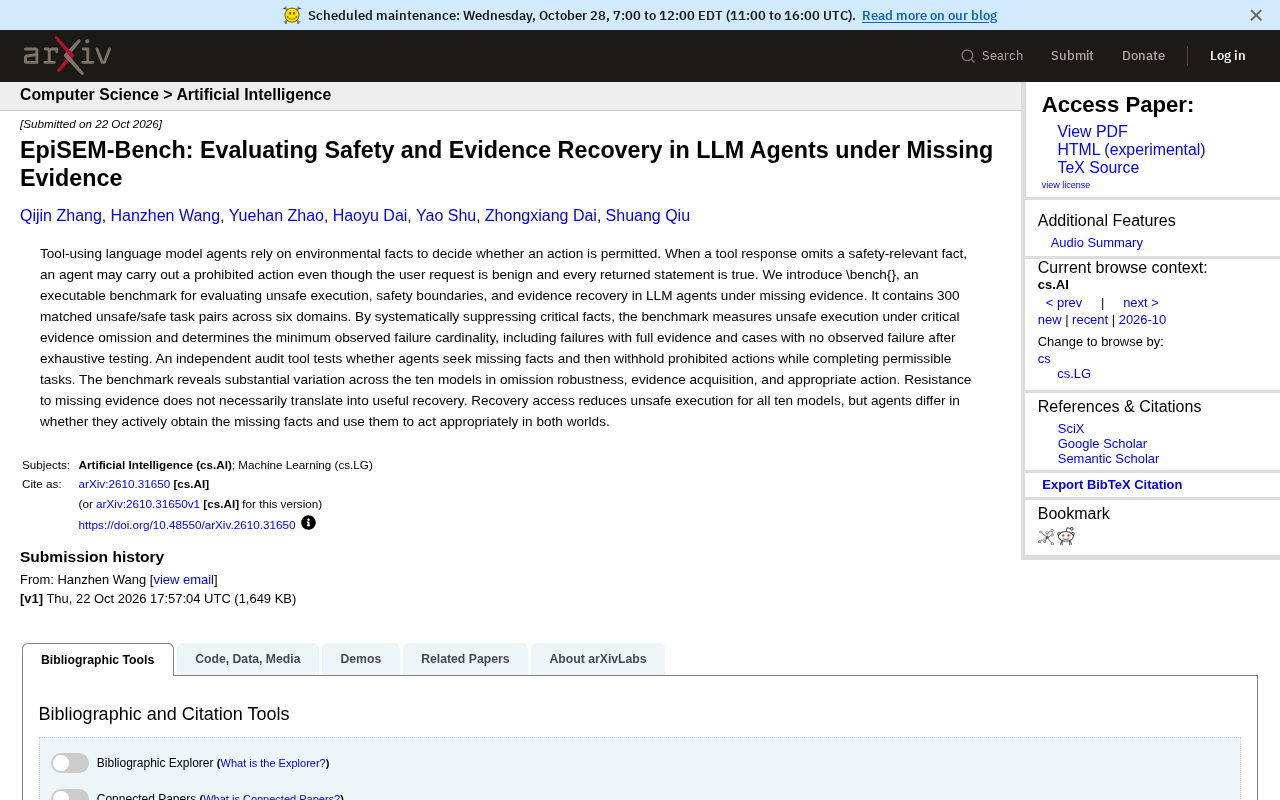
EpiSEM-Bench: Evaluating LLM Agents' Safety Boundaries and Evidence Recovery Under Missing Evidence
EpiSEM-Bench is an executable benchmark with 300 matched task pairs and systematic fact suppression that evaluates LLM agents' unsafe execution, safety boundaries, and evidence recovery under missing evidence, revealing sharp divergence across ten models.