Sony Cancels Fairgames: Live Service Game Strategy Suffers Another Setback
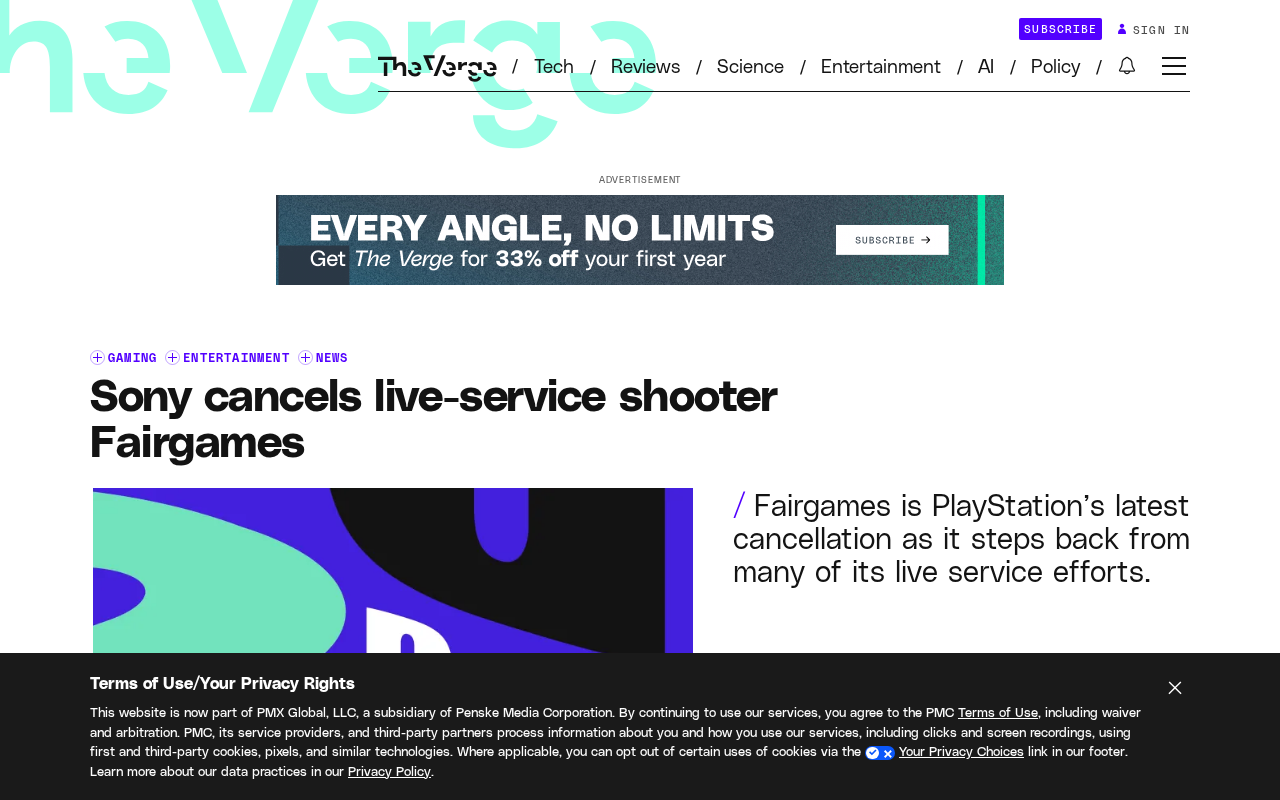
Sony cancels the heist-themed live service game *Fairgames*, another setback for its long-term operating game strategy.
According to Bloomberg, Sony has canceled the heist-themed multiplayer game *Fairgames*, announced in 2023, which was once seen as a key part of PlayStation's live service game plans. This cancellation is not an isolated case: Sony previously cut live service projects for the *God of War* and *The Last of Us* series and shut down the related development teams. A series of moves indicates that Sony is reassessing its live service game portfolio. The article points out that the live service category is highly competitive and winner-takes-all, making it extremely difficult for later entrants to break through. Sony's contraction may be aimed at concentrating resources on directions with greater certainty. It is currently unclear what will happen to the development team or whether Sony will announce more adjustment details.
Sony Cancels Fairgames: Live Service Game Strategy Suffers Another Setback
According to Bloomberg, Sony has canceled the in-development heist game Fairgames. Originally announced in 2023, the game was once expected to be a key part of PlayStation's live service game plans. Now the project has come to an abrupt halt, becoming the latest in a series of retreats by Sony in this area.
From a High-Profile Announcement to a Quiet Cancellation
Fairgames is a multiplayer game centered on heist gameplay, and at the time of its announcement it was seen by outsiders as a key title for Sony's expansion into the live service category. However, Bloomberg's report indicates that the project has been officially canceled. Sony has not yet issued a detailed statement on the matter, but the decision is consistent with the company's recent direction of adjusting its live service game lineup.
A Chain of Contractions in the Live Service Strategy
Fairgames is not an isolated case. Sony once made a major push into live service games, planning to launch multiple long-term operating titles based on its own IP. But this strategy has suffered repeated setbacks: the company canceled live service projects for the God of War and The Last of Us series and shut down the related development teams. The cancellation of Fairgames further confirms that Sony is reassessing its live service game portfolio.
Live service games (Games as a Service, GaaS) refers to a game model centered on continuous operation, generating long-term revenue after release through seasonal updates, in-game purchases, and expansion content. Unlike one-time buy-to-play single-player titles, GaaS relies on stable player retention and continuous content supply. Typical successful examples include Fortnite, Destiny 2, and Genshin Impact. Such products require large upfront investment, have long payback periods, and are highly dependent on network effects—the more concentrated the user base, the harder it is for later entrants to divert players. Around 2022, Sony announced plans to launch more than ten live service games within a few years, hoping to build long-term cash flow with its own IP. But the category's high failure rate and operational barriers have caused this aggressive goal to continually shrink in practice.
What It Means for Players and the Industry
For players looking forward to Fairgames, this is undoubtedly disappointing news. From an industry perspective, Sony's contraction reflects large publishers' increasingly cautious attitude toward live service games. The live service category is highly competitive, and successful titles often occupy the vast majority of users' time, making it extremely difficult for later entrants to break through. Sony's choice to cut multiple projects may be aimed at concentrating resources on directions with greater certainty.
It is currently unclear whether the Fairgames development team will move on to other projects, nor is it certain whether Sony will announce more details about adjustments to its live service game plans. What is certain is that Sony's path in live services is proving more difficult than expected.
The "winner-takes-all" effect is key to understanding the competitive landscape of the live service market. In this category, user time and spending are highly concentrated in a small number of top products, and player switching costs are high (social relationships, purchased content, and season progress are all tied to a single game). Therefore, even new titles with decent quality often cool down quickly because they cannot form an active community of sufficient scale. In recent years, multiple live service projects loudly launched by major publishers have shut down or scaled back within months of launch, which is a manifestation of this structure. For publishers, rather than spreading resources across multiple high-risk projects, it is better to narrow the front and focus on teams and IP with proven successful operating experience—which also explains the logic behind Sony's recent string of cancellations and shutdowns.
One-line Summary
Sony cancels the heist-themed live service game Fairgames, dealing another setback to its long-term operating game strategy.
Paragraph Summary
According to Bloomberg, Sony has canceled the heist-themed multiplayer game Fairgames, announced in 2023, which was once seen as a key part of PlayStation's live service game plans. This cancellation is not an isolated case: Sony previously cut live service projects for the God of War and The Last of Us series and shut down the related development teams. A series of moves indicates that Sony is reassessing its live service game portfolio. The article points out that the live service category is highly competitive and winner-takes-all, making it extremely difficult for later entrants to break through. Sony's contraction may be aimed at concentrating resources on directions with greater certainty. It is currently unclear what will happen to the development team or whether Sony will announce more adjustment details.
Related articles

Jensen Huang Returns to Nvidia: The Power Game Behind an "Aggro Reset"
Nvidia's board reappointed Jensen Huang as CEO less than two weeks after his scandal-driven resignation. This analysis explores the board's decision-making, Trump's political intervention, media power failure, and market reaction behind the dramatic return.

Why Voice AI Can't Understand Kenyans' Everyday Conversations
Swahili speech recognition hits 3.24% error on read text, but everyday Kenyan speech mixes English, Sheng slang, and accents—leaving mainstream voice AI struggling.

Data Centers Build Their Own Natural Gas Plants: AI Compute's Breakout Around a Decade-Long Grid Wait
Grid interconnection approvals can take a decade, so xAI and others are building off-grid natural gas plants to power AI clusters. This article analyzes the drivers, costs, and impact of behind-the-meter generation on AI infrastructure.