Sony Pulse Wireless Headset Review: Planar Magnetic Drivers at $99.99
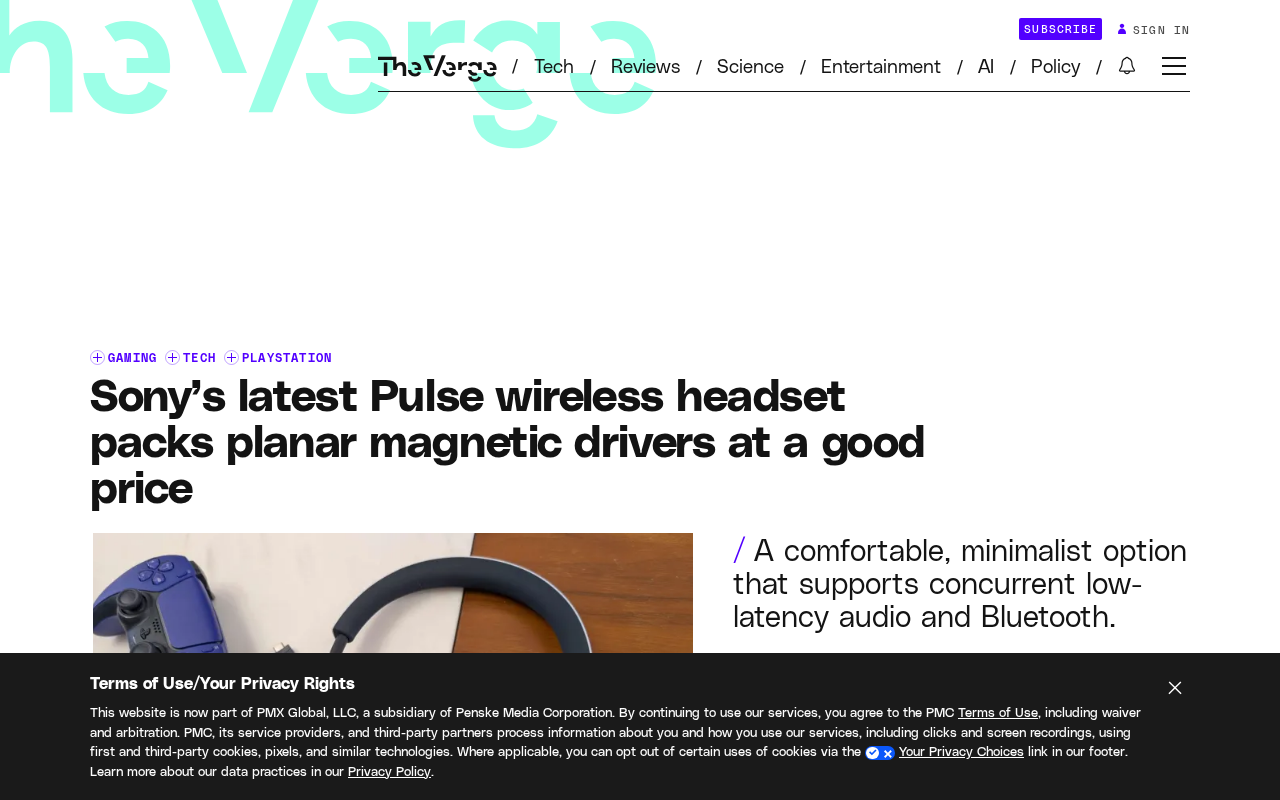
Sony Pulse wireless headset brings planar magnetic drivers to the mainstream $99.99 price point, with standout sound quality and pragmatic features.
Sony launches the PlayStation Pulse wireless headset at $99.99, featuring planar magnetic drivers—rarely seen in wireless gaming headsets—for very good sound quality. It skips active noise cancellation, swappable batteries, and multi-platform connectivity, focusing on wireless connectivity, microphone, and PlayStation ecosystem integration with a "good enough" cost-control approach. At the budget price, planar magnetic technology provides differentiated competitiveness, ideal for value-conscious PlayStation gamers.
Sony Pulse Wireless Headset: Planar Magnetic Drivers Go Mainstream at a Budget Price
The gaming headset market is never short on "all-rounders"—active noise cancellation, multi-platform compatibility, swappable batteries, top-tier sound quality, everything. But if you just want a product that nails the basics, Sony's new PlayStation Pulse wireless headset might be worth a look. Priced at $99.99, it delivers very good sound quality and just the right amount of extra features.
Planar Magnetic Drivers: From High-End to Mainstream
The most eye-catching feature of this headset is its use of planar magnetic drivers. Previously, this technology was mostly found in high-end audiophile headphones, with prices that often put them out of reach. The advantages of planar magnetic drivers lie in more even force distribution across the diaphragm, faster transient response, lower distortion, and the ability to present richer detail and a more precise soundstage. Sony bringing this technology down to the $99.99 price point is quite rare among wireless gaming headsets.
In terms of actual listening experience, the Pulse's sound performance is "very good," more than enough to meet the needs of most gaming and entertainment. For players who care about sound quality but have a limited budget, this is undoubtedly an attractive selling point.
Planar magnetic drivers differ significantly in structure from traditional dynamic drivers. Dynamic drivers use a voice coil to move a cone-shaped diaphragm back and forth, while planar magnetic drivers place a flat diaphragm between two magnetic arrays, with the voice coil distributed evenly across the entire diaphragm as a printed circuit. This design allows the driving force to cover the diaphragm surface uniformly, avoiding the split vibration issues common in dynamic drivers, thereby reducing distortion and improving transient response. However, planar magnetic drivers typically require stronger magnets, making headphones heavier and more expensive, and placing higher demands on amplifier design for wireless headsets. Sony's integration of this technology into a wireless gaming headset is a meaningful engineering attempt.
Feature Trade-offs: Good Enough Is Enough
The Sony Pulse doesn't try to be a headset that "does everything." It has no active noise cancellation, no swappable battery, and no exaggerated multi-platform connectivity. But it retains the most core features of a gaming headset: wireless connectivity, a clear microphone (presumed), comfortable fit (presumed), and deep integration with the PlayStation ecosystem.
This "just right" product philosophy actually makes it more competitive at the budget price point. After all, not everyone is willing to pay for features they won't use.
Active noise cancellation (ANC) uses microphones on the headset to capture ambient noise and generate anti-phase sound waves to cancel it out, with noticeable effects on continuous low-frequency noise. But in gaming headsets, ANC increases cost, power consumption, and weight, and may affect the clarity of voice microphone pickup. The Sony Pulse chooses not to include ANC, instead concentrating costs on planar magnetic drivers and PlayStation ecosystem integration, which fits its "good enough" product logic. For players who mainly use it indoors, passive isolation already meets most scenarios, and skipping ANC helps control price and extend battery life.
Price and Competition: The $99.99 Positioning
The $99.99 price point puts the Pulse directly into the red ocean of mainstream gaming headsets. At this price, players can buy wireless headsets from many third-party brands, but products with planar magnetic drivers are extremely rare. Sony's brand appeal combined with differentiated technology gives the Pulse the potential to become a hit.
Of course, whether it's worth buying also depends on your actual needs for noise cancellation, multi-platform switching, and other features. If you mainly game on PlayStation and value sound quality, the Pulse is a pragmatic choice.
At the $99.99 price point, mainstream wireless gaming headsets mostly use 40mm dynamic drivers, support 2.4GHz wireless connectivity, and some offer Bluetooth dual-mode. Planar magnetic drivers, due to their magnet structure and complex manufacturing process, have previously mostly appeared in audiophile headphones priced above $300, such as Audeze's LCD series. Sony's Pulse offering planar magnetic drivers at a budget price creates technological differentiation in the wireless gaming headset market, but consumers should also note: planar magnetic drivers place higher demands on wireless audio codecs and built-in amplifiers, and actual sound quality also depends on overall acoustic tuning.
Conclusion: A Victory for Pragmatism
The Sony Pulse wireless headset doesn't pile on features; instead, it spends costs where they matter most—planar magnetic drivers bring sound quality potential rarely seen at this price point, while the恰到好处的 feature set keeps the price in check. For value-conscious players, this product deserves a spot on the consideration list.
(Note: The original article does not provide details on battery life, weight, or specific microphone parameters; actual experience may vary by usage scenario.)
One-line Summary
Sony's Pulse wireless headset brings planar magnetic drivers to a mainstream $99.99 price point, with standout sound quality and pragmatic features.
Paragraph Summary
Sony has launched the PlayStation Pulse wireless headset at $99.99, with its biggest highlight being planar magnetic drivers previously found mostly in high-end audiophile headphones—rare among wireless gaming headsets—delivering very good actual listening experience. The product lacks high-end features like active noise cancellation, swappable batteries, and multi-platform connectivity, instead focusing on wireless connectivity, microphone, and PlayStation ecosystem integration, controlling costs with a "good enough" approach. At the budget price point, planar magnetic technology creates differentiated competitiveness, suitable for PlayStation players who value sound quality and have a limited budget.
Related articles

Jensen Huang Returns to Nvidia: The Power Game Behind an "Aggro Reset"
Nvidia's board reappointed Jensen Huang as CEO less than two weeks after his scandal-driven resignation. This analysis explores the board's decision-making, Trump's political intervention, media power failure, and market reaction behind the dramatic return.

Why Voice AI Can't Understand Kenyans' Everyday Conversations
Swahili speech recognition hits 3.24% error on read text, but everyday Kenyan speech mixes English, Sheng slang, and accents—leaving mainstream voice AI struggling.

Data Centers Build Their Own Natural Gas Plants: AI Compute's Breakout Around a Decade-Long Grid Wait
Grid interconnection approvals can take a decade, so xAI and others are building off-grid natural gas plants to power AI clusters. This article analyzes the drivers, costs, and impact of behind-the-meter generation on AI infrastructure.