Sony Revisits the WH-1000XM4 After Six Years: Why This Legendary Noise-Cancelling Headphone Endures
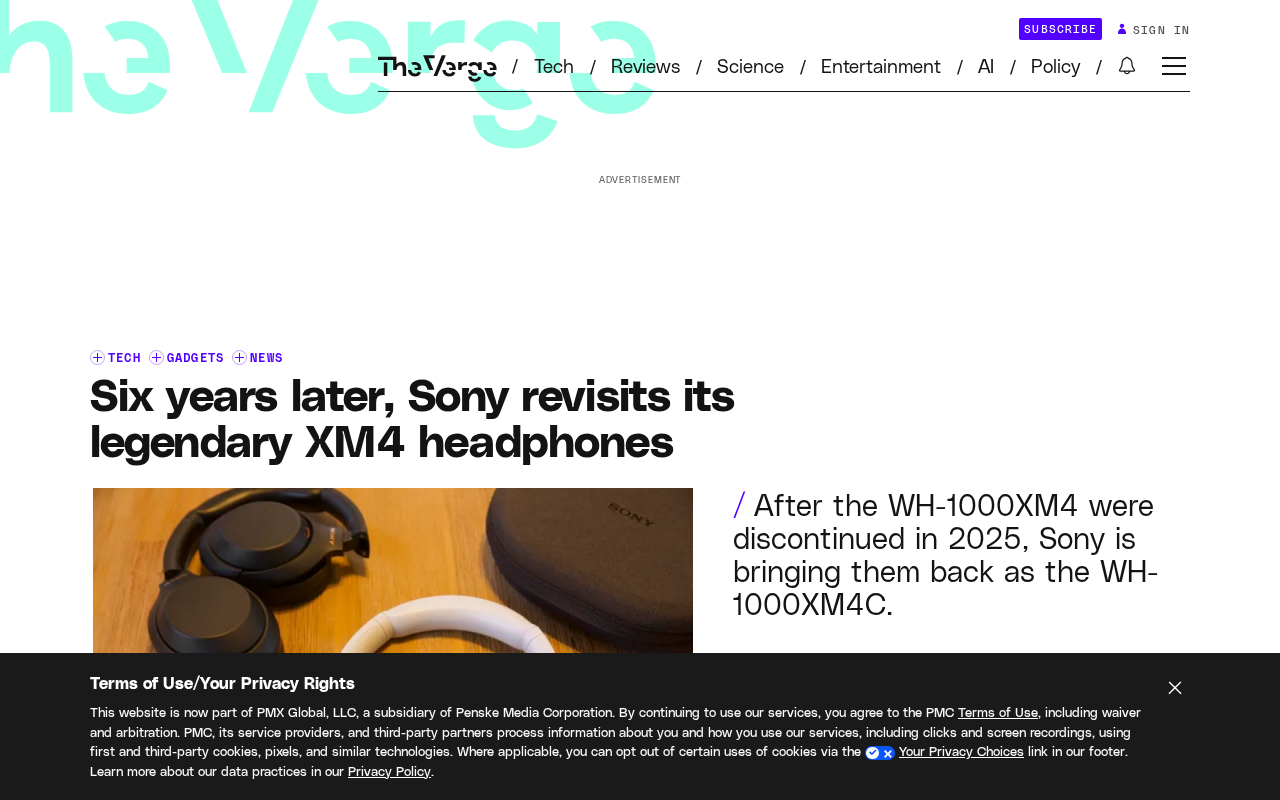
Sony revisits the WH-1000XM4 after six years, exploring why this legendary noise-cancelling headphone endures.
Six years after launch, Sony revisits the WH-1000XM4, a wireless noise-cancelling headphone that became an industry benchmark. Through its balanced excellence in sound quality (LDAC codec), ANC performance (dual-feedback microphone system), and ergonomic design, the XM4 transcended typical product cycles. This article examines what made it a classic, how the headphone industry has evolved since, and the lasting lesson it offers: true innovation means perfecting the core experience, not chasing specs.
A Milestone in the Noise-Cancelling Headphone Market: Sony WH-1000XM4
In the fall of 2020, Sony released the WH-1000XM4 wireless noise-cancelling headphones, a product that quickly became the industry benchmark. In the ongoing noise-cancellation arms race between Sony and Bose, the XM4 claimed the top spot on every major headphone recommendation list — and stayed there for years — thanks to its outstanding sound quality, exceptional Active Noise Cancellation (ANC) performance, and compact industrial design.
Active Noise Cancellation (ANC) is a technology that generates inverse sound waves to counteract ambient noise. Its working principle is based on wave interference: microphones built into the headphones capture external noise in real time, a processor rapidly analyzes the frequency and amplitude of the noise, then generates sound waves with the opposite phase. When the two waves combine, they cancel each other out, achieving noise reduction. This technology was originally developed for aviation to reduce pilot noise fatigue. Consumer-grade ANC matured after 2000, with Bose's QuietComfort series pioneering its commercialization. ANC is highly effective against mid-to-low frequency noise (such as engine rumble) but has limited ability to handle high-frequency transient sounds (like speech), which is why premium noise-cancelling headphones typically combine passive isolation with active noise cancellation.
Six years later, Sony chose to revisit this legendary product — a move that's telling in itself. In an era of breakneck consumer electronics refresh cycles, the fact that a headphone from years ago still warrants repeated discussion speaks volumes about the foresight of its design philosophy and technical execution.
What Makes the Sony XM4 a Classic?
The WH-1000XM4 earned its legendary status through a precise balance of three core strengths:
Sound Quality — Sony's proprietary LDAC codec paired with the DSEE Extreme audio upscaling engine allows Bluetooth wireless transmission to approach wired headphone-level fidelity, delivering excellent high-frequency detail and low-end extension.
LDAC is a high-resolution audio codec developed by Sony, introduced in 2015 and open-sourced as part of the Android standard in 2019. Traditional Bluetooth audio codecs like SBC max out at roughly 328kbps, while LDAC can reach 990kbps — three times higher — enabling transmission of 24bit/96kHz Hi-Res audio. LDAC uses a hybrid encoding approach that adaptively adjusts bitrate across three tiers (330/660/990kbps) based on wireless conditions, preserving as much audio detail as possible while maintaining connection stability. Compared to Apple's AAC (256kbps) and Qualcomm's aptX HD (576kbps), LDAC holds a clear advantage in technical specifications. That said, actual listening experience is also influenced by source quality, driver unit performance, and other factors — a higher bitrate doesn't automatically guarantee superior sound.
Noise Cancellation — A dual-feedback microphone system captures and cancels ambient noise in real time, achieving what was then the industry's best silence. Its noise-cancelling performance in noisy environments like subways and airplanes remains competitive to this day.
The dual-feedback microphone system is a core configuration in premium ANC headphones. The system places one microphone inside and one outside each ear cup: the feedforward microphone sits on the exterior to capture external noise, while the feedback microphone is positioned inside the cup near the ear canal to monitor residual noise. The processor combines signals from both microphones to generate more precise inverse sound waves. This dual-verification mechanism can handle a wider frequency range, achieving noise reduction depths of 30–40dB. A feedforward-only system responds quickly but is susceptible to wind noise; a feedback-only system offers better stability but covers a narrower frequency range. Sony's XM4 uses the HD Noise Cancelling Processor QN1, which performs over 700 calculations per second to ensure real-time feedback loop responsiveness — the technical foundation behind its superior noise cancellation compared to competitors.
Ergonomic Design — Compared to its predecessor, the XM3, the XM4 made notable improvements in weight management and headband pressure distribution, significantly reducing fatigue during extended listening sessions.
Even more noteworthy are the smart features the XM4 introduced: Speak-to-Chat automatically pauses music when you start talking, eliminating the need to remove your headphones; multipoint Bluetooth connectivity enables seamless switching between your phone and computer.
Multipoint Bluetooth allows headphones to maintain simultaneous connections with two or more devices for seamless switching. Traditional Bluetooth pairing is a one-to-one model — switching devices requires disconnecting and reconnecting, creating a fragmented experience. Multipoint connectivity uses time-division multiplexing in the Bluetooth protocol stack to rapidly switch data streams between devices, making the experience feel nearly simultaneous to users. Early implementations suffered from audio latency and connection instability. The feature matured significantly after Bluetooth 5.0, and the Sony XM4 was among the first products to deploy it at scale. In 2020, the Bluetooth SIG released the LE Audio standard, introducing Multi-Stream functionality that theoretically supports unlimited device connections while significantly reducing power consumption and latency. As remote work has become the norm and users need to frequently switch between phones, computers, and tablets, multipoint connectivity has evolved from a premium feature to an essential one.
These features were groundbreaking experience designs at the time and have since become standard on premium noise-cancelling headphones.
What Has Changed in the Headphone Industry Over Six Years?
Since the XM4's launch, the wireless headphone market has undergone a profound shakeup. New features such as spatial audio, personalized hearing EQ adjustments, and ear canal health monitoring have emerged in rapid succession, and brands have continuously ramped up investment in noise-cancellation algorithms.
Spatial Audio has been one of the most important innovations in the audio industry in recent years, aiming to simulate realistic spatial sound positioning through algorithms. The technology incorporates head-tracking sensors so that when users turn their heads, the sound direction remains fixed, creating a cinema-like immersive experience. Apple introduced Spatial Audio in the AirPods Pro in 2020 with deep Apple Music integration, driving widespread adoption of the technology. Sony, Bose, and other manufacturers followed with their own 360 Reality Audio solutions. Spatial Audio implementation relies on HRTF (Head-Related Transfer Function) modeling, which requires collecting extensive ear data to train algorithms. Some premium products even support personalized HRTF calibration by photographing the user's ears to create a custom sound profile. This technology demands a robust content ecosystem and is currently used primarily in streaming and gaming scenarios, making it a new battleground for differentiation among premium headphones.
Sony itself released the successor WH-1000XM5, featuring an entirely new design language and a more advanced V1 noise-cancelling chip.
Yet the XM4 hasn't left the stage. Many users still prefer its foldable hinge design (which the XM5 dropped), and combined with the mature and stable Sony Headphones Connect software ecosystem, the XM4 has maintained strong resale value on the secondhand market. Sony's decision to "revisit" this product now may hint at a special edition release, or it could be a tribute to and reinterpretation of a classic design philosophy.
What Lessons Has the XM4 Left for the Audio Industry?
A truly excellent consumer electronics product was never just a numbers game on a spec sheet — it's about finding that delicate balance between technical prowess, user experience, and industrial design.
The enduring vitality of the WH-1000XM4 proves one thing: when a product truly addresses users' core pain points — quiet during the commute, comfort during extended wear, convenience when switching between devices — it can transcend the limitations of a typical product cycle.
For the audio industry as a whole, the XM4 set a benchmark worth studying again and again: true innovation isn't about piling on new features and specs every year, but about polishing the core experience to perfection. This is perhaps the deeper reason Sony looked back at this product after six years — a reminder to itself, and to the entire industry, of what constitutes a product philosophy that stands the test of time.
Related articles

AI Large Model Interview Trends: 625 Real Post-Interview Reviews Reveal Core Focus Areas
Based on real data from 1,700+ students and 625 interview reviews, discover what AI large model interviewers focus on: multi-Agent architecture, deep fundamentals, and enterprise project experience.

HouseSpaceAI: Upload 2D Floor Plans, AI Automatically Generates Interior Design Schemes
HouseSpaceAI is an AI interior design tool where users upload 2D floor plans or sketches and AI Agents generate multiple design schemes in minutes. Deep dive into its features, use cases, and real-world limitations.

Nathan Fielder Documentary Focuses on Elizabeth Holmes and the Theranos Scandal
Comedy director Nathan Fielder premieres documentary You Can See Everything at Telluride, offering a unique perspective on Elizabeth Holmes and the Theranos fraud scandal, exploring Silicon Valley's startup mythology and the boundaries of deception.