Sopro V2 Turbo Goes Open Source: Voice Cloning at 5x Real-Time on CPU with Just 120M Parameters

Open-source 120M-param TTS model clones voices at 5x real-time speed on CPU with 300ms latency.
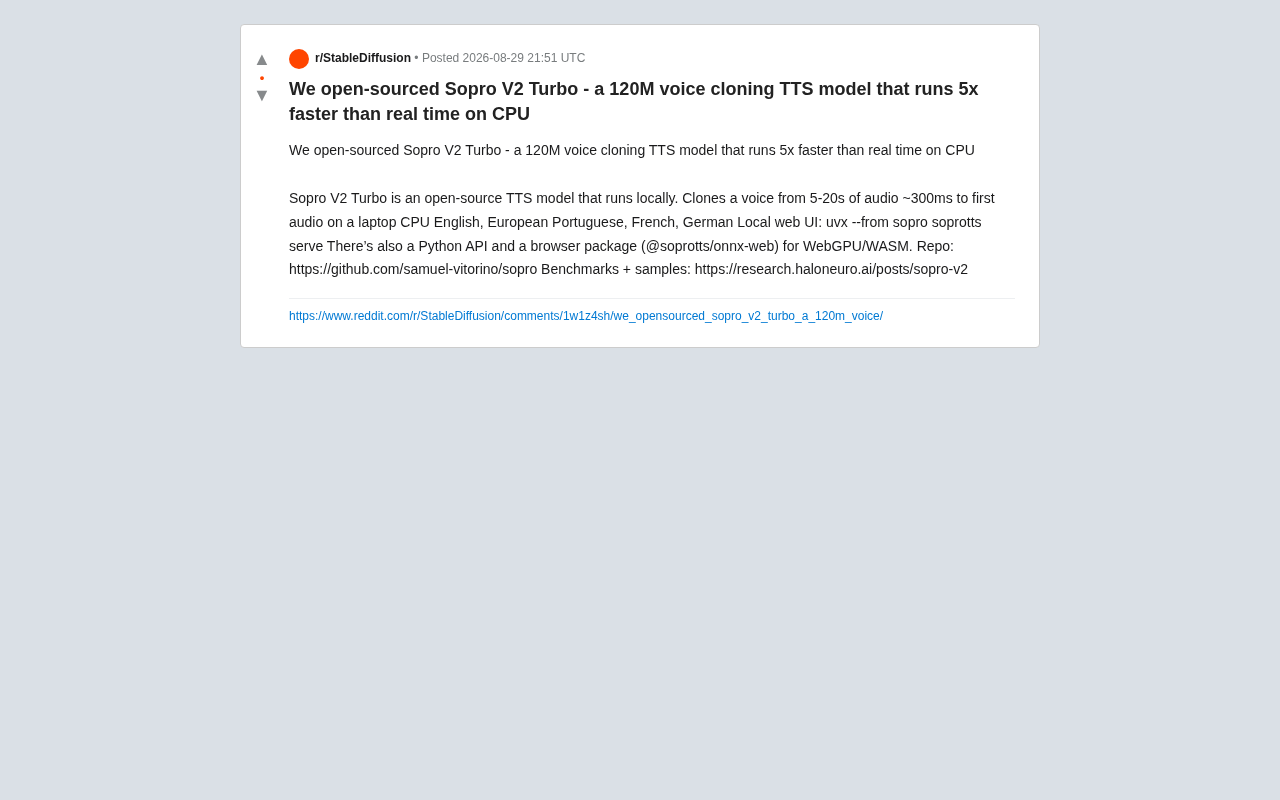
Sopro V2 Turbo is a newly open-sourced TTS voice cloning model with just 120M parameters that achieves 5x real-time generation speed on ordinary CPUs. It clones voices from 5–20 seconds of reference audio with only 300ms first-audio latency. Supporting English, European Portuguese, French, and German, it offers a local Web UI, Python API, and browser-based deployment via ONNX with WebGPU/WASM — all fully offline for maximum privacy.
A TTS Model Built for Local Deployment
In the text-to-speech (TTS) space, large parameter models typically mean steep compute costs and heavy GPU dependency. But Sopro V2 Turbo, recently open-sourced on Reddit, takes a radically different approach — achieving 5x real-time speech generation on an ordinary CPU with a lightweight architecture of just 120 million (120M) parameters.
The release quickly caught the open-source community's attention. For developers, a voice cloning model that runs entirely locally, requires no expensive graphics card, and delivers ultra-low latency is exactly the tool needed for offline applications, privacy-sensitive scenarios, and edge device deployments.
Core Capability: Low-Latency Voice Cloning
300ms Time-to-First-Audio, Clone a Voice with Just 5–20 Seconds of Audio
The most striking feature of Sopro V2 Turbo is its response speed and low cloning threshold. According to the official description, the model needs only 5 to 20 seconds of reference audio to clone a target voice — no lengthy recordings or complex fine-tuning required.
On the latency front, the model delivers its first audio output in approximately 300 milliseconds on a laptop CPU. For interactive applications like voice assistants and real-time conversation systems, this latency is already close to the natural rhythm of human dialogue. And "5x real-time speed" means generating 1 second of audio takes only about 0.2 seconds of compute time, providing ample performance headroom for batch voice generation and long-text narration scenarios.
Multi-Language Support
Sopro V2 Turbo currently supports four languages:
- English
- European Portuguese
- French
- German
One interesting detail: the specific inclusion of "European Portuguese" is quite uncommon among TTS models that are predominantly English-focused and occasionally cover Brazilian Portuguese. This signals a targeted effort to address European market voice requirements.
Flexible Deployment Options
Out-of-the-Box Local Web UI
For users who want to get started quickly, Sopro provides a one-click local web interface. Simply run:
uvx --from sopro soprotts serve
This uvx-based approach eliminates tedious environment setup and spins up a visual speech synthesis service locally, significantly lowering the barrier to entry for non-technical users.
Multi-Platform Integration for Developers
Beyond the Web UI, the project offers multiple integration paths for developers across different tech stacks:
- Python API: Ideal for backend services, automation scripts, and data processing pipelines;
- Browser package (@soprotts/onnx-web): Built on the ONNX runtime, supporting WebGPU and WASM, allowing the model to run directly in the browser without uploading user audio to any server.
The browser-side capability is particularly critical. With WebGPU and WASM, developers can build web applications that perform speech synthesis entirely on the client side. This not only reduces server costs but fundamentally protects user voice data privacy — all computation happens on the local device.
Why Small Models Are Undervalued
Parameter Count Isn't the Only Metric
In the current wave of multi-billion-parameter large models, a 120M model is easily overlooked. But Sopro V2 Turbo serves as a reminder: for specific tasks, well-designed small models often deliver a far superior deployment experience.
For voice cloning tasks, a model doesn't need general intelligence — it just needs to excel at timbre transfer and speech naturalness. Keeping parameters within a reasonable range yields a host of engineering advantages: CPU compatibility, low latency, and low memory footprint. For embedded devices, offline scenarios, and cost-sensitive small-to-medium teams, the practical value far outweighs chasing the highest possible audio quality scores.
The Privacy-First and Offline-First Trend
As data privacy regulations tighten and users grow increasingly concerned about the privacy implications of cloud-based voice services, local and offline TTS solutions are becoming a clear technological trend. Sopro V2 Turbo's fully local operation aligns perfectly with this need — voice data never leaves the device, eliminating data leakage risks at the source.
Recommendations and Outlook
For developers looking to try it out, here are a few starting points:
- Quick trial: Run the local Web UI and test cloning with a few seconds of recorded audio;
- Product integration: The Python API suits backend voice generation, while the browser package is ideal for building privacy-first web applications;
- Performance evaluation: The team provides benchmarks and samples — we recommend testing audio quality and latency against your specific use case.
To set realistic expectations: as a lightweight model with only 120M parameters, Sopro V2 Turbo may not match the peak audio quality of large-parameter commercial models. Its multilingual coverage is also currently limited to major European languages, with no support yet for Chinese or other Asian languages. However, when it comes to the combination of "local execution + low latency + low-barrier cloning," it undeniably offers an extremely compelling open-source option.
Project repository: https://github.com/samuel-vitorino/sopro
As more developers contribute to the project, there's every reason to expect further progress in language coverage, audio quality optimization, and cross-platform support.
Related articles

AgentCore in Practice: Connecting Custom Tools and MCP Servers to Agents
DebuggerCafe tutorial shows how to connect custom tools and MCP servers to Amazon Bedrock AgentCore agents, covering tool contract design, MCP reuse, and production concerns.

816B Parameters Scores Only 39? The Real Cost-Effectiveness of the Open-Source LLM Parameter Race
Meta's 816B Muse Spark Open scores just 39 on Artificial Analysis, while 180B Qwen3.8-Flash-Next scores 40. This article analyzes 11 open-weight models' parameters vs. scores, exploring the real impact of activated parameters, quantized size, and deployment cost.

Aerial Manipulators: The Next Step for Drones from 'Seeing' to 'Changing'
Starting from a Reddit discussion, this article analyzes the technical challenges, potential applications, and deployment bottlenecks of aerial manipulators, exploring the key challenges for drones moving from environmental perception to physical manipulation.