Soul Glo's Diaspora Problems: An Inimitable Hardcore Manifesto

Soul Glo's Diaspora Problems uses hardcore as a vessel to collage noise rock and experimental passages, re-mapping genre boundaries.
The article reviews Soul Glo's album Diaspora Problems, noting it's not another standard hardcore record but treats hardcore as a vessel for complex narratives of race, identity, and class. The album switches between high-speed assaults and abrupt ruptures, incorporating noise rock, experimental passages, and rap-like delivery; song structures frequently shift, and frontman Pierce Jordan moves between screams and whispers, forcing listeners to constantly adjust their listening habits. The article also mentions the new album NA I'M GON GRAB ALLAT has released two singles, continuing the unpredictable path, and suggests revisiting Songs to Yeet at the Sun to understand the band's evolution.
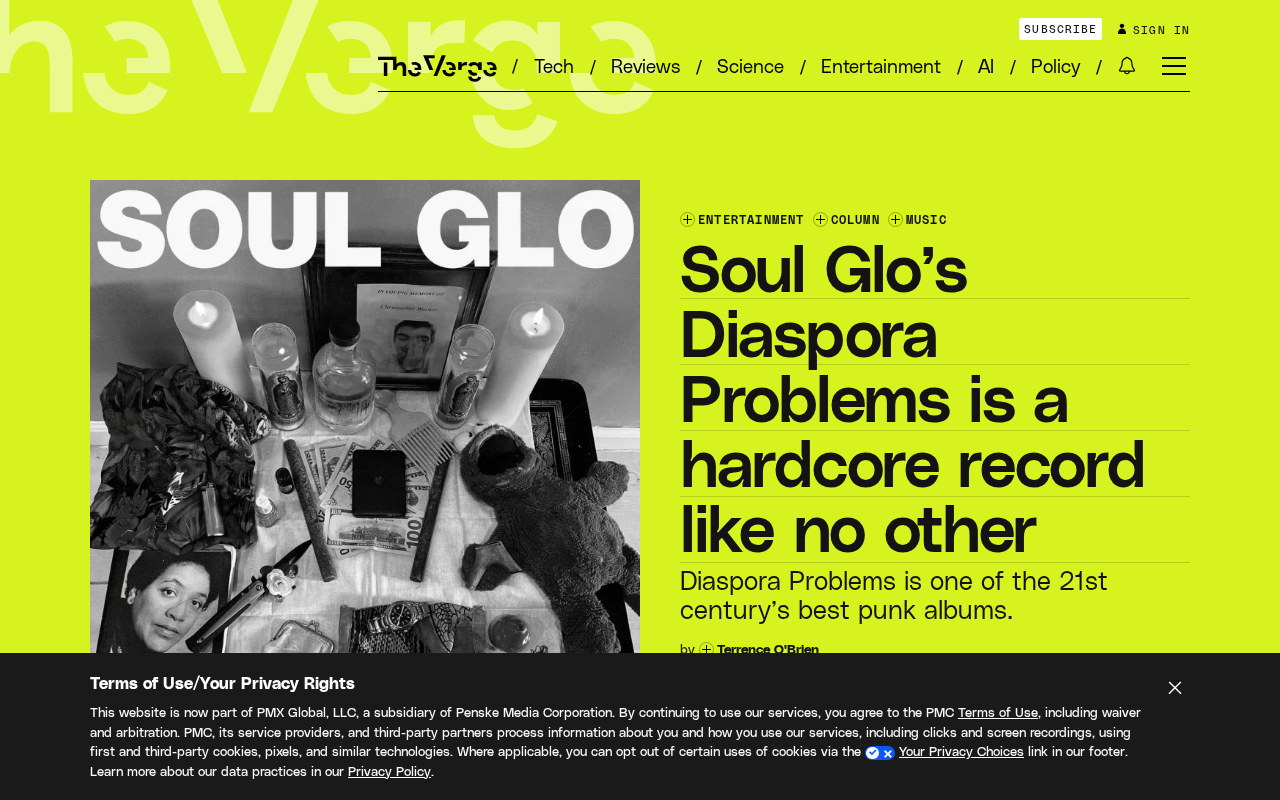
Hardcore punk is often labeled as "angry" and "direct," but few bands can transform these traits into lasting artistic tension. Soul Glo's Diaspora Problems is one of those records—it's not just another hardcore album, but a re-mapping of genre boundaries.
A Hardcore Record That Refuses Categorization
After its release, Diaspora Problems quickly became a year-end favorite for many critics and fans. What makes it unique is that Soul Glo doesn't treat hardcore as a closed grammar, but as a vessel capable of carrying complex narratives. From start to finish, the album switches between high-speed assaults and abrupt rhythmic ruptures, with the hardcore skeleton filled with noise rock, experimental passages, and even vocal delivery closer to rapping.
This collage isn't showmanship; it's a necessity of expression. When lyrics deal with race, identity, class, and existential anxiety, a single musical language feels insufficient. Soul Glo uses stylistic friction to create a sense of oppression, making it impossible for listeners to comfortably "consume" a hardcore album.
Hardcore Punk is an extreme offshoot of punk rock that emerged in the early 1980s, characterized by faster tempos, heavier tones, shorter song structures, and more violent live performances. Bands like Black Flag, Minor Threat, and Bad Brains established the basic grammar of the genre: terse, direct, high-energy, and often closely tied to independent labels and underground touring networks. Hardcore is not just a musical style but also a subcultural ethic emphasizing DIY, anti-commercialism, and community identity. Soul Glo grew up in this tradition, but they treat hardcore as an extensible creative method rather than a stylistic template to be strictly followed, which distinguishes them from many of their peers.
Why It Sounds "Unlike Other Hardcore"
Structural Restlessness
Most hardcore songs rely on short, explosive structures, but many tracks on Diaspora Problems undergo multiple shifts within a minute or two: a blast beat suddenly collapses into a half-speed muddy passage, or a scream is followed by almost clean-spoken words. These transitions lack缓冲, forcing listeners to constantly reorient.
Blast beat is an extreme drumming technique originally widely used in grindcore, death metal, and some hardcore scenes. It features rapid alternating kick drum hits with both feet while hands alternate at极快的速度 between snare and cymbals, creating a dense, nearly continuous wall of sound. In hardcore, blast beats are often used to create short bursts and a sense of loss of control. Soul Glo frequently uses blast beats on Diaspora Problems, but often dismantles them into half-speed passages or noisy pauses within seconds. This "quote—destroy" approach makes extreme technique no longer an end in itself but a lever for emotional shifts.
Text and Sound Counterpoint
Soul Glo frontman Pierce Jordan's voice moves between screams, whispers, and rapid-fire delivery, often more like "speaking" than "singing." This treatment amplifies the sharpness of the lyrics—when the text discusses systemic pressure and identity dilemmas, the sense of loss of control in the voice itself becomes part of the content.
Noise Rock emerged in the mid-to-late 1980s, represented by Sonic Youth, Big Black, Swans, and others. It retains rock band instrumentation but dissolves traditional rock listenability through dissonant chords, feedback noise, unconventional timbres, and structural repetition and erosion. Noise rock shares the underground spirit and confrontational stance of hardcore but emphasizes timbral experimentation and atmospheric oppression. Soul Glo introduces noise rock guitar treatment into the hardcore framework, giving Diaspora Problems a textural roughness beyond speed—one of the key reasons it sounds "unlike other hardcore."
Continuation and Expectations for the New Album
Soul Glo's upcoming record NA I'M GON GRAB ALLAT has released two singles. From the released material, the band hasn't retreated to a safer hardcore template but continues along the path opened by Diaspora Problems. Two singles aren't enough to fully reveal the new album, but they suffice to show that the band still treats "unpredictability" as a core creative principle.
While waiting for the new work, it's worth revisiting Diaspora Problems and the earlier Songs to Yeet at the Sun. The former showcases Soul Glo's ability to organize chaos into structure in the studio, while the latter retains more raw, gritty live energy. Together, the two records make it clearer how the band gradually turned hardcore from a style into a method.
Staying Sharp in an Era of Genre Fatigue
The hardcore scene never lacks new bands; what it lacks is creators willing to treat genre as a question rather than an answer. What makes Soul Glo special is that they respect hardcore's history—its speed and confrontational nature—while refusing to be limited by it. Diaspora Problems is repeatedly mentioned not because it's "heavier" or "faster," but because it makes hardcore unpredictable again.
When an album requires listeners to actively adjust their listening habits to enter, it often has a better chance of still being discussed years later. Soul Glo has achieved this, and that's the fundamental reason it's "unlike other hardcore records."
One-line Summary
Soul Glo's Diaspora Problems uses hardcore as a vessel to collage noise rock and experimental passages, re-mapping genre boundaries.
Paragraph Summary
The article reviews Soul Glo's album Diaspora Problems, noting it's not another standard hardcore record but treats hardcore as a vessel for complex narratives of race, identity, and class. The album switches between high-speed assaults and abrupt ruptures, incorporating noise rock, experimental passages, and rap-like delivery; song structures frequently shift, and frontman Pierce Jordan moves between screams and whispers, forcing listeners to constantly adjust their listening habits. The article also mentions the new album NA I'M GON GRAB ALLAT has released two singles, continuing the unpredictable path, and suggests revisiting Songs to Yeet at the Sun to understand the band's evolution.
Related articles

Training a PPO Agent for the Hidden-Information Card Game Cabo on a MacBook
A developer trained a self-play PPO agent for the hidden-information card game Cabo on a MacBook. The article covers training configuration, slot symmetry handling, emergent strategies, and plateau challenges.

Training PPO on a MacBook: A Browser-Based Cabo Card Game with Hidden Information
A Reddit developer trained a self-play PPO AI for the hidden-information card game Cabo on a MacBook and made it playable in the browser, offering insights for AI app development.

Jensen Huang's Internal Letter on Rumors: An Unpublicized PR Crisis?
A Hacker News post claims Nvidia CEO Jensen Huang sent staff a letter about an affair, but lacks the original text or official confirmation. This article examines the background, community discussion, and potential impact on investors and employees, urging caution with unverified information.