SpaceX and Tesla Boards Form Special Committees to Evaluate Potential Merger

SpaceX and Tesla boards form independent special committees to evaluate a potential merger; Musk backs it but recuses himself.
The boards of SpaceX and Tesla have each established special committees of independent directors to evaluate a potential merger. Musk is not on either committee but supports the idea. The arrangement aims to isolate conflicts of interest, as Musk is CEO of both companies and a merger would be a related-party transaction. The committees' formation signals a formal board-level review but not a guaranteed deal. Disclosed details remain limited, with terms, timeline, valuation, and regulatory path still unknown.
According to an RSS source report, the boards of directors of SpaceX and Tesla have each established special committees to evaluate a potential merger between the two companies. Elon Musk himself has expressed support for the idea but emphasized that he is not on either committee — both committees are composed of independent directors.
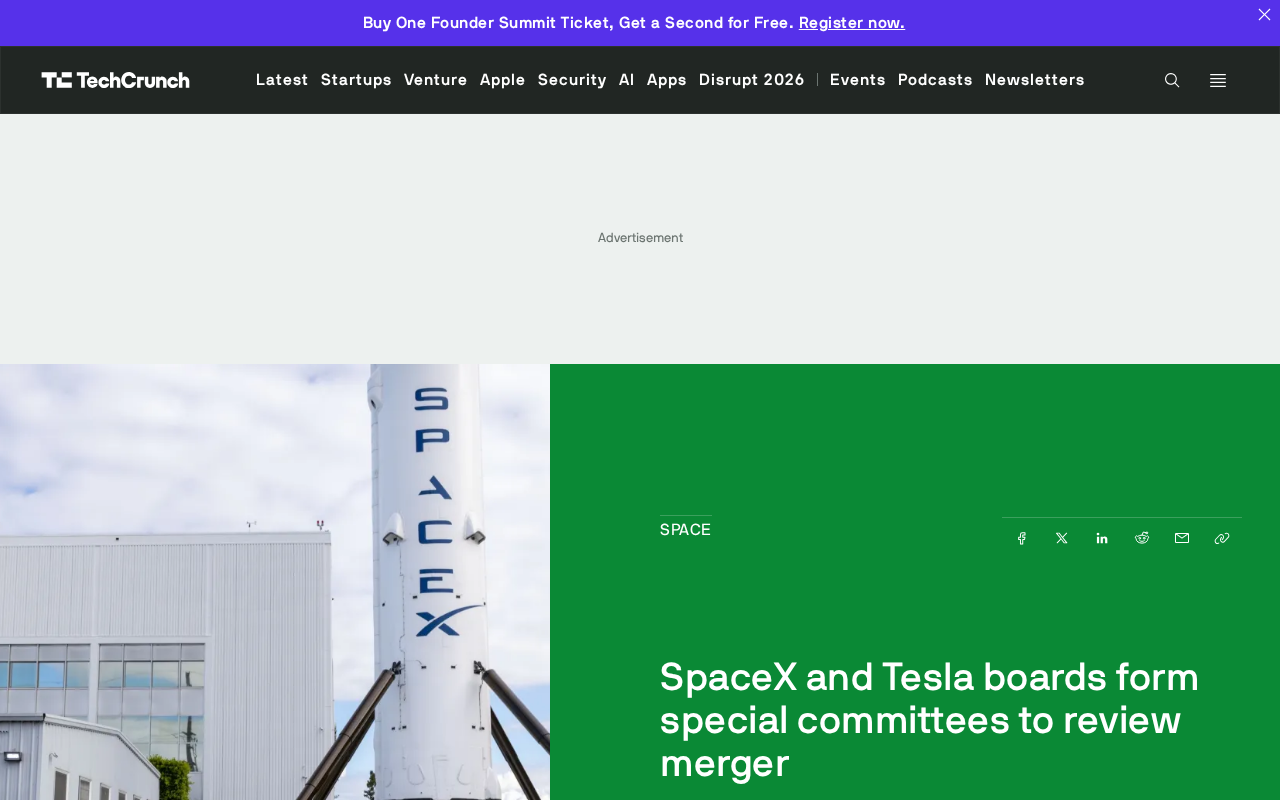
Governance Arrangements for the Merger Evaluation
Independent Directors Take the Lead, Musk Recuses Himself
The key detail in this arrangement lies in the governance structure: both special committees are composed of independent directors, and Musk has explicitly stated he is not among them. This design is no accident. When a transaction involves a controlling shareholder or a related party, having a special committee of disinterested independent directors conduct the review is a common practice in corporate governance, aimed at insulating related-party transaction decisions from interested parties.
Musk is simultaneously CEO of Tesla and CEO of SpaceX, so if the two companies were to pursue a merger, he would clearly be an interested party. Assigning the evaluation to independent directors provides procedural legitimacy for the decision and, to some extent, addresses external concerns about the fairness of related-party transactions.
Special Committee (Special Committee) is an independent decision-making body temporarily established by a board of directors to handle specific significant matters, commonly seen in scenarios such as mergers and acquisitions, related-party transactions, and take-private deals. Its members are typically disinterested independent directors and it has the authority to engage independent financial advisors and legal counsel. The core function of a special committee is to isolate conflicts of interest: when a counterparty or key decision-maker has a related-party relationship with the company, a committee led by independent directors can evaluate transaction terms from a more objective standpoint, reducing the risk that a controlling shareholder or management uses related-party relationships to harm the company and minority shareholders. In judicial practice, whether a special committee is established and operates independently and prudently often becomes an important basis for courts reviewing the fairness of related-party transactions.
Musk's Stance: Endorsing the Direction, Avoiding the Process
Public information shows that Musk holds a positive attitude toward the merger idea, but in his statements he deliberately distanced himself from the committees. This "support but no participation" position is noteworthy: on one hand, as the central figure at both companies, his endorsement carries practical significance for advancing the transaction; on the other hand, recusing himself from the specific review process helps maintain the committees' image of independent judgment.
Why the Merger Topic Deserves Attention
Tesla and SpaceX have overlapping business interests. Musk has long advocated some form of integration of resources across his companies, and interaction between the two firms at the talent, technology, and capital levels has always existed. If a merger materialized, it would involve a restructuring between two enormous entities — one private and one public — with complex equity structures, and its valuation, exchange ratio, and regulatory approvals would all be extremely complex undertakings.
The information disclosed so far is quite limited. The report only confirms the establishment of the special committees and Musk's recusal statement, without addressing specific merger terms, timelines, or valuation methods. The establishment of the special committees itself does not mean the transaction will necessarily proceed — it indicates more that a formal evaluation process has been initiated at the board level.
Related-Party Transaction (Related-Party Transaction) refers to a transaction between a company and its directors, executives, controlling shareholders, or their related parties. Because the parties have a controlling or significant influence relationship, related-party transactions inherently carry risks of unfair pricing and tunneling of benefits. In public company governance, related-party transactions typically require prior approval by independent directors, review by the board or shareholders' meeting, and fulfillment of disclosure obligations. As a public company, if Tesla were to merge with SpaceX — where Musk also serves as CEO — it would constitute a typical related-party transaction and would need to meet stricter procedural requirements. The evaluation by an independent special committee is precisely a key link in this governance chain, and its conclusions will directly affect whether the transaction can gain board and shareholder approval.
Exchange Ratio (Exchange Ratio) is the core term in a merger transaction used to determine the shareholding proportions of both parties' shareholders in the new entity, usually based on the relative valuations of the two companies. For companies like Tesla and SpaceX — enormous in scale and complex in equity structure — valuation itself is highly difficult: SpaceX is a private company lacking a public market price, and its valuation depends on private financing rounds, secondary market transactions, or independent valuation reports; Tesla, though publicly listed, has high stock price volatility, and Musk's shareholding and pledge arrangements would affect control arrangements. The exchange ratio not only determines the economic interest allocation between the two sides' shareholders but also involves tax treatment, accounting methods (such as the purchase method), and regulatory approvals, making it one of the most contentious elements in such transactions.
Information Boundaries and Key Points to Watch
The existing source provides only a brief report, lacking key details such as merger motivations, transaction structure, and regulatory pathways. Directions worth watching going forward include: whether the special committees engage independent financial and legal advisors, whether the two companies disclose evaluation progress, and regulators' attitudes toward such related-party transactions. Until then, any specific judgment on the merger's prospects lacks sufficient basis.
One-line Summary
SpaceX and Tesla boards each form independent special committees to evaluate a potential merger; Musk supports but recuses himself.
Paragraph Summary
The report says the boards of SpaceX and Tesla have each established special committees to evaluate a potential merger between the two companies. Both committees are composed of independent directors, and Musk himself is not among them, though he supports the merger idea. This governance arrangement aims to isolate conflicts of interest, since Musk serves as CEO of both companies and a merger would constitute a related-party transaction. The establishment of the special committees indicates that a formal evaluation process has begun at the board level, but does not mean the transaction will necessarily proceed. Currently disclosed information is limited, lacking key details such as merger terms, timelines, valuation methods, and regulatory pathways; future attention should focus on whether the committees engage independent advisors and on regulators' stance.
Related articles

JobRunner MCP Server: AI Agents Can Now Fix Failed Java Jobs
JobRunner launches an open-source MCP server enabling AI agents to view cluster status, diagnose failures, and recover Java jobs—incident response from any cloud coding environment or existing agent.

MLAI Digital Launches 9 Security Agents: MCP Server Safeguards the Full Lifecycle of Agentic AI
MLAI Digital launches Security MCP Server with nine built-in specialized security agents covering vulnerability discovery, attack simulation, prompt injection detection, API and infrastructure assessment, and accelerated remediation—embedding security validation across the full Agentic AI lifecycle from development to production.

Running Isaac Lab on H100 GPUs: Exploring Better Approaches
Exploring optimization methods for running Isaac Lab on NVIDIA H100 GPUs, including MIG configuration, mixed precision, TensorRT acceleration, and community experience to improve robotics simulation and reinforcement learning efficiency.