SpaceX Deploys Next-Gen Starlink V3 Satellites as Amazon's Rival Project Stalls

SpaceX launches Starlink V3 on Starship, widening its lead over Amazon's stalled Project Kuiper.
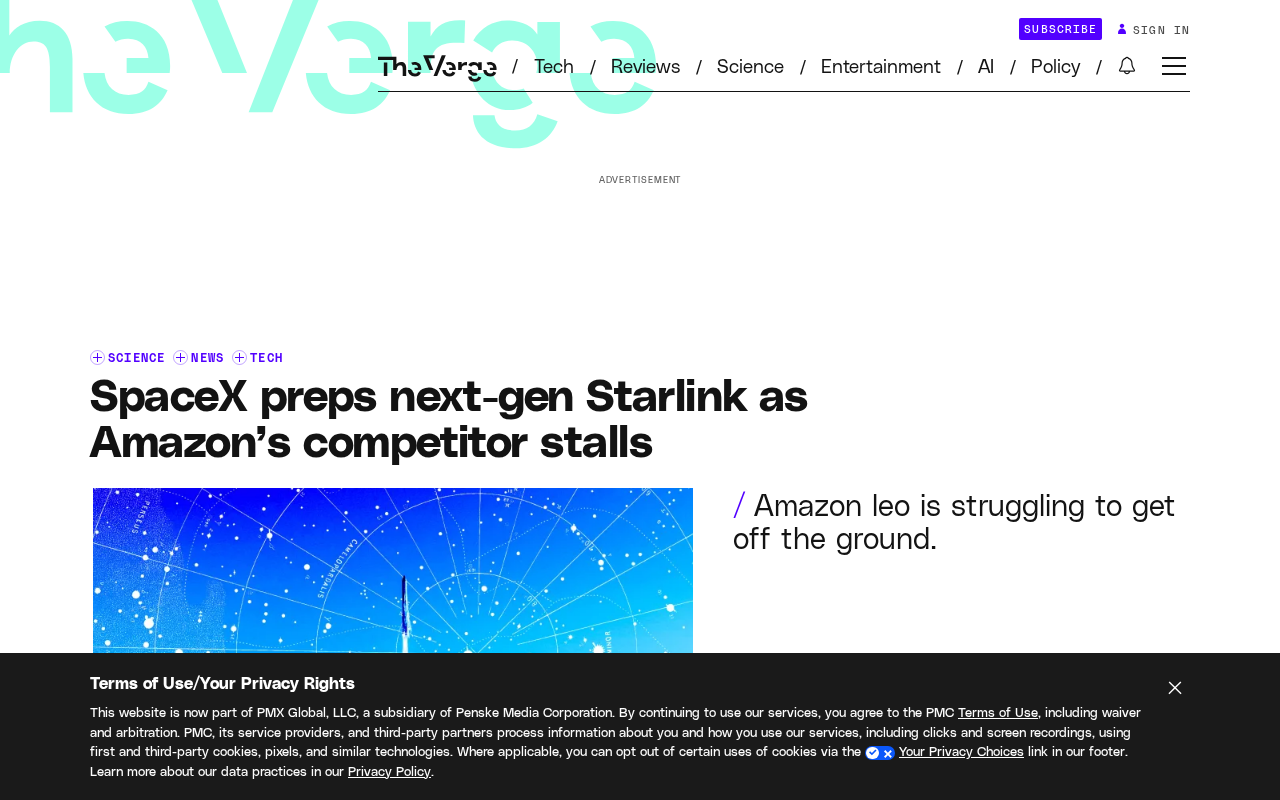
SpaceX is preparing to launch 26 next-generation Starlink V3 satellites aboard Starship, simultaneously validating the vehicle's orbital capability. V3 satellites offer significantly higher capacity and throughput than current models, and Starship's massive payload capacity will drive down per-satellite costs while accelerating constellation upgrades. Meanwhile, Amazon's Project Kuiper remains severely behind schedule due to launch resource constraints, unable to mount a near-term challenge to Starlink. If successful, this mission marks the LEO broadband race entering a new phase where launch vehicle capability and satellite generations are the defining competitive dimensions.
SpaceX Races Ahead with Next-Generation Starlink Deployment
SpaceX is preparing to execute a highly anticipated mission that its biggest competitor, Amazon, will likely be watching very closely. If successful, SpaceX will deploy its Starlink V3 satellites for the first time — a batch that promises significant capability upgrades for the ever-expanding Starlink constellation.
According to disclosed details, 26 satellites will ride aboard Starship, with SpaceX simultaneously attempting to place the vehicle itself into Earth orbit. This makes the mission a high-stakes, high-reward technical validation that combines two major strategic goals: deploying the next-generation satellites and demonstrating Starship's orbital capability.
What Starlink V3 Actually Means
Starlink V3 is positioned as a major leap forward from the existing constellation. Compared to earlier batches, V3 satellites are expected to deliver significantly higher per-satellite capacity, communication throughput, and overall network performance. For users relying on low-Earth orbit (LEO) broadband, greater capacity translates to faster connection speeds and a more robust network — especially in remote areas and high-demand scenarios.
Binding the V3 launch to Starship adds another dimension to this mission. Starship's payload capacity far exceeds that of Falcon 9, allowing more and larger satellites to be placed into orbit in a single launch. Once this combination matures, it will substantially reduce per-satellite deployment costs and accelerate the constellation's generational refresh cycle, further cementing SpaceX's lead in the LEO internet market.
The Starlink constellation has evolved through multiple technical generations. The initial V0.9 was a test batch; V1.0 marked the start of large-scale commercial deployment; V1.5 introduced laser inter-satellite links (ISL), enabling direct satellite-to-satellite communication without ground station relays — dramatically reducing latency and extending coverage to polar regions. V2.0 Mini is the current workhorse launched on Falcon 9, offering substantially higher throughput than V1.5. V3 is an entirely new platform designed specifically for Starship's payload envelope — because Starship's fairing diameter and mass capacity far exceed Falcon 9's, V3 satellites can be physically larger, carry more powerful phased-array antennas, and support more frequency bands, potentially delivering several times the capacity of a single V2.0 Mini satellite. This logic — where rocket capability defines the ceiling for satellite capability — is one of the core reasons SpaceX treats Starship commercialization as a top strategic priority.
Amazon's Competitive Predicament
In stark contrast to SpaceX's accelerating pace, Amazon's competing satellite internet project is in a state of clear stagnation. Amazon's deployment cadence lags significantly behind SpaceX's constantly expanding Starlink constellation, making it difficult to pose an immediate threat.
The LEO broadband industry is one where scale and first-mover advantage are decisive. SpaceX, leveraging the low-cost launch economics of reusable rockets, has already placed a massive number of satellites in orbit, building a coverage advantage that rivals cannot close in the short term. While competitors are still working through deployment bottlenecks, SpaceX is already transitioning to the next generation of technology — and that kind of generational gap is the hardest thing to overcome in any competitive market.
Amazon's LEO satellite internet initiative is called Project Kuiper, and it aims to deploy over 3,200 satellites in low Earth orbit at roughly 630 kilometers altitude. The project received FCC approval in 2019, but without its own launch vehicle, Amazon has been forced to rely on multiple third-party providers — United Launch Alliance's Vulcan rocket, Ariane 6, and even SpaceX's Falcon 9 — resulting in fragmented launch schedules and higher costs. As of now, prototype satellite validation has been completed, but large-scale commercial deployment has yet to begin, putting it far behind Starlink's existing fleet of thousands of operational satellites. The FCC requires Amazon to deploy half of its planned constellation (approximately 1,618 satellites) by July 2026 or face license review risk, creating intense pressure on its launch cadence.
The Next Phase of the Satellite Internet Race
If successful, this launch will be more than just a satellite deployment — it will be a critical milestone in validating SpaceX's strategic combination of Starship and next-generation satellites. It signals that the satellite internet race is entering a new phase defined by launch vehicle capability and constellation generations.
For the industry as a whole, SpaceX's sustained lead will continue to raise the barrier to entry for latecomers. When economies of scale, cost advantages, and the speed of technology iteration are all compounding simultaneously, the satellite internet market may remain dominated by a handful of players for a considerable time to come. For Amazon to close the gap, it will need a fundamental breakthrough in launch capability and deployment efficiency.
(Note: This article is based on limited original reporting. Specific technical specifications for Starlink V3 and the final mission outcome are still pending official confirmation.)
The commercial logic of LEO broadband is highly dependent on two compounding assets: on-orbit scale and spectrum resources. The more satellites in orbit, the higher the frequency reuse efficiency per unit of coverage area, which improves user experience, attracts more paying subscribers, and creates a revenue flywheel that funds further launches. Meanwhile, the ITU's (International Telecommunication Union) frequency and orbital slot registration operates on a "first-come, first-served" basis, granting priority protection to spectrum and orbital positions that have been registered and actively used. By deploying rapidly and at high density, SpaceX has not only built a user-scale moat, but also staked out a substantive position in frequency resources — creating both institutional and commercial barriers that make it extremely difficult for new entrants to compete.
Related articles

Gemini 4 Argon Hands-On: AI Builds Board Games, Constructs Temples, and Trains Robots Autonomously
Gemini 4 Argon hands-on roundup: AI autonomously builds a desk racetrack and temple in Blender, writes a ray tracing engine, trains a humanoid robot to sink 7 shots, plus API pricing and developer access.

The Magic Octagonal Coin: Why Only 9% of People Can Predict Its Flip?
Only 9% of people can correctly predict the Magic Octagon coin flip. This article explains its spatial rotation mechanism, common cognitive pitfalls, and a new hypothesis based on Relevance Theory, exploring the limits of human spatial reasoning.

Sam Altman: AI Is Entering the Era of Scientific Discovery — Math Breakthroughs Will Replicate in Biology and Energy
Sam Altman says AI is entering the era of scientific discovery — math breakthroughs will replicate in biology, materials science, and energy to help develop new drugs and energy sources.