SpaceX Reportedly Eyes Boost Mobile Acquisition as Starlink Aims to Disrupt US Telecom Giants

SpaceX reportedly plans to acquire Boost Mobile to enter the US mobile market with spectrum and channels.
The article examines rumors that SpaceX may acquire Boost Mobile, analyzing strategic motives and potential impact. The acquisition's core value lies in obtaining terrestrial spectrum, prepaid users, and retail channels, enabling Starlink to upgrade from a remote-area supplement to a hybrid "satellite + terrestrial" operator and transform from a T-Mobile partner into a direct competitor. The article notes that satellite-to-phone technology maturation and the massive mobile market form a second growth curve, but the deal faces FCC spectrum transfer review, Big Three opposition, and uncertain EchoStar willingness. If successful, the US mobile market could form a four-player landscape of the Big Three plus Starlink, accelerating the space-terrestrial integrated network race.
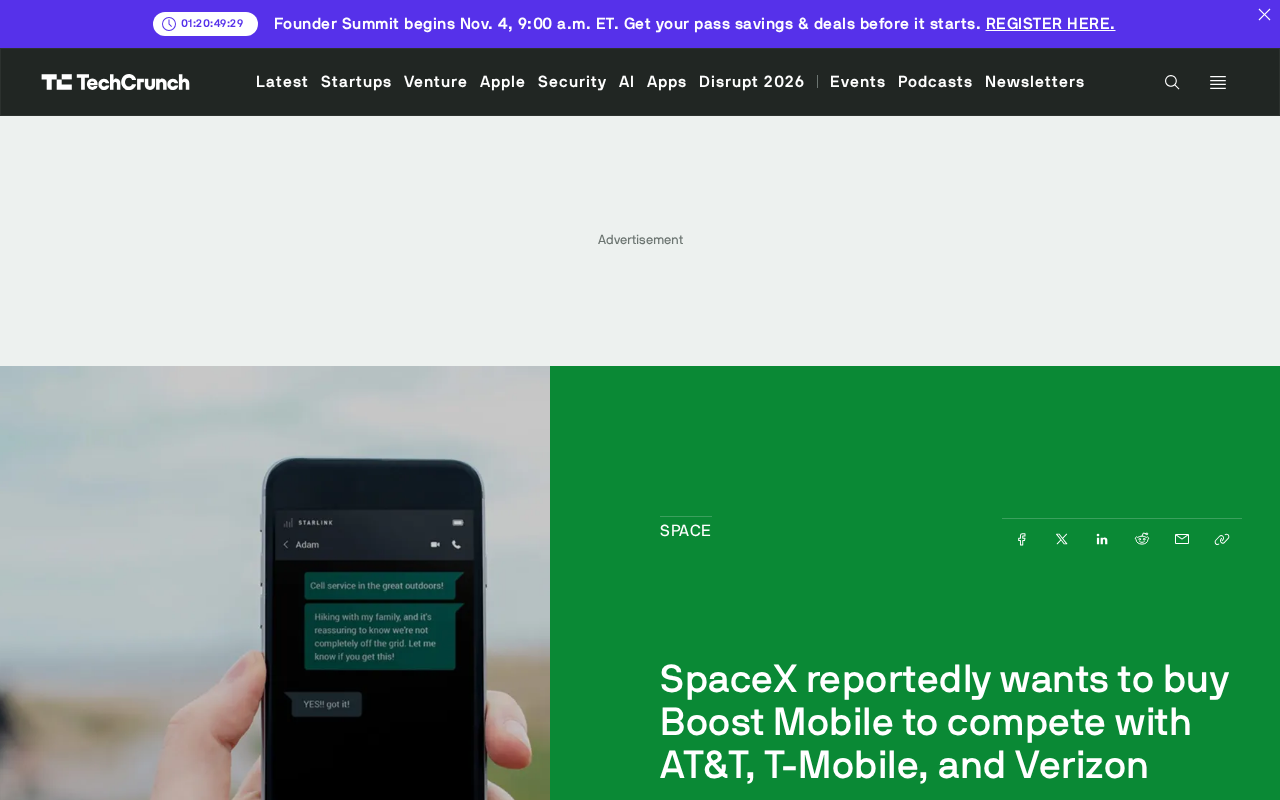
SpaceX is looking for new growth paths for its Starlink satellite network, and the latest rumors point to an unexpected arena: terrestrial mobile communications. According to multiple foreign media reports, SpaceX is interested in acquiring US mobile carrier Boost Mobile to gain the spectrum and terrestrial network resources needed to compete head-on with AT&T, T-Mobile, and Verizon. If the deal materializes, it would mark a critical leap for Starlink from "satellite broadband provider" to "all-scenario telecom operator."
1. Why Boost Mobile?
Boost Mobile currently belongs to EchoStar and is a prepaid-focused mobile virtual network operator (MVNO) with millions of users and certain spectrum resources. For SpaceX, the core value of acquiring Boost Mobile lies in three points:
-
Terrestrial spectrum and network access: Starlink's strength lies in remote areas and scenarios such as maritime and aviation, but in dense urban areas, terrestrial cellular networks still hold advantages in capacity and cost. Acquiring Boost Mobile's spectrum licenses and network resources would allow SpaceX to build a hybrid "satellite + terrestrial" network, addressing Starlink's shortcomings in indoor coverage and urban capacity.
-
User base and distribution channels: Boost Mobile's existing prepaid user base and retail channels can help SpaceX quickly enter the mass consumer market without building an offline sales system from scratch.
-
Complementarity with the T-Mobile partnership: SpaceX previously partnered with T-Mobile to launch the "Direct to Cell" satellite-to-phone service, but that partnership is essentially about providing supplementary coverage for T-Mobile's network. If SpaceX acquires Boost Mobile, it will have its own mobile brand, transforming from "supplier" to "competitor" and greatly enhancing its strategic initiative.
MVNO (Mobile Virtual Network Operator) refers to a telecom enterprise that does not own physical network infrastructure such as wireless spectrum and base stations, but instead leases networks from traditional carriers and provides services to users. Boost Mobile has long operated as an MVNO, and its value lies not in building its own base stations but in its brand, user base, distribution channels, and wholesale network agreements. For SpaceX, acquiring an MVNO would quickly provide ready-made user operations capabilities and retail touchpoints, but if the goal is to truly control spectrum and network, it remains to be seen whether EchoStar will transfer the relevant spectrum licenses as part of the deal—this is the most critical and complex part of the transaction structure.
2. Starlink's Terrestrial Ambitions: From Supplement to Substitute
Starlink currently has a large global satellite broadband user base, but its business model is highly dependent on users purchasing terminals and subscribing to services. As satellite internet competition intensifies (with projects like Amazon Kuiper advancing), Starlink needs to find a second growth curve.
Mobile communications is a market far larger than satellite broadband. The three major US carriers AT&T, T-Mobile, and Verizon generate hundreds of billions of dollars in revenue annually. If SpaceX enters through Boost Mobile, even capturing a small share of the market would be enough to create significant revenue growth.
More critically, Direct to Cell technology is maturing. SpaceX has already demonstrated through its T-Mobile partnership the ability to send text messages via satellite, with future support for voice and data. If SpaceX owns both terrestrial spectrum and satellite networks, it can achieve an "ubiquitous" connectivity experience—using terrestrial networks in cities and automatically switching to satellite in remote areas—exactly the differentiated advantage that traditional carriers find difficult to replicate.
Direct to Cell (satellite-to-phone) refers to technology that allows ordinary smartphones to connect directly to low-Earth-orbit satellites without external antennas. The challenge lies in the fact that satellites are hundreds of kilometers above ground and phone transmit power is extremely low, making the link budget very tight. As a result, early versions can only support text messages and low-rate data, with voice and broadband data requiring subsequent satellite iterations and spectrum coordination. This technology typically requires the terrestrial spectrum held by carriers (such as PCS bands) as the frequency basis for satellite links, which is the fundamental reason SpaceX seeks partnerships with terrestrial carriers or direct spectrum ownership: without spectrum, satellite-to-phone cannot be commercially scaled.
3. Regulatory and Competitive Obstacles Not to Be Underestimated
The obstacles facing this deal are equally obvious. The Federal Communications Commission (FCC) has strict review procedures for spectrum license transfers, especially involving SpaceX's foreign investment background and national security considerations. In addition, AT&T, T-Mobile, and Verizon will inevitably strongly oppose the deal at the regulatory level, citing reasons such as "market concentration" and "unfair competition"—SpaceX owning both satellite and terrestrial networks could create vertical integration advantages.
Whether EchoStar is willing to sell Boost Mobile is also unknown. Boost Mobile is an important asset of EchoStar's mobile business, and selling it would mean giving up direct-to-consumer channels. However, EchoStar itself faces spectrum construction and financial pressures, making it not impossible to monetize some assets.
FCC (Federal Communications Commission) is the independent US regulatory agency responsible for managing spectrum allocation, licensing, and spectrum transfer reviews in telecom mergers and acquisitions. Transactions involving changes in control of spectrum licenses typically require applications to the FCC and are subject to reviews on public interest, competitive impact, and national security. For applicants with foreign ownership, the review also involves inter-agency national security assessment procedures, which can take months or longer. This means the success of such transactions depends not only on the willingness of buyers and sellers but also heavily on regulatory timing and the political environment.
4. Potential Impact on the Industry Landscape
If the acquisition succeeds, the US mobile communications market will evolve from a "Big Three" structure to a "Big Three + Starlink" four-player landscape. For consumers, increased competition could bring more flexible pricing plans, especially for rural and remote area users—where traditional carriers face high coverage costs and poor service quality, and satellite + terrestrial hybrid networks could fill the gap.
For existing carriers, SpaceX's entry will force them to accelerate the deployment of satellite direct-to-cell technology. T-Mobile has already partnered with SpaceX, and AT&T and Verizon are also advancing their own satellite partnership projects. A race for "space-terrestrial integrated" network coverage has already begun.
It should be noted that this news is still at the "rumor" stage, and neither SpaceX nor EchoStar has officially confirmed it. However, given Starlink's continuously expanding business boundaries and Musk's interest in the telecom market, this direction is not surprising. Starlink started with satellite broadband, gradually expanded into maritime, aviation, and military communications, and now mobile communications—its ultimate goal may be to become a global comprehensive network operator.
5. Conclusion
The rumor of SpaceX acquiring Boost Mobile reflects the industry trend of accelerating integration between satellite internet and terrestrial communications. Starlink is no longer satisfied with being a "supplementary network for remote areas" but is attempting to enter the mainstream telecom market directly through capital acquisitions. Regardless of whether the deal ultimately goes through, this development deserves attention from traditional carriers: the competitor from space has already arrived on the ground.
One-line Summary
SpaceX is reportedly planning to acquire Boost Mobile to enter the US mobile communications market with spectrum and channels.
Paragraph Summary
The article centers on rumors that SpaceX may acquire Boost Mobile, analyzing its strategic motivations and potential impact. The core value of the acquisition lies in obtaining terrestrial spectrum, prepaid user base, and retail channels, enabling Starlink to upgrade from a supplementary network in remote areas to a "satellite + terrestrial" hybrid operator, and to transform from a T-Mobile partner into a direct competitor. The article notes that the maturation of satellite-to-phone technology and the massive scale of the mobile communications market constitute a second growth curve, but the deal faces obstacles including FCC spectrum transfer review, opposition from the Big Three carriers, and uncertainty about EchoStar's willingness to sell. If successful, the US mobile market could form a four-player landscape of the Big Three plus Starlink, accelerating the race for space-terrestrial integrated networks.
Related articles

On-Device LLM + ESP32: Build a DIY Calorie Reminder
A Bilibili creator open-sourced a calorie intake reminder: a phone app uses the open-source miniCPM model to locally recognize food photos and estimate calories, while an ESP32 mini screen syncs data and shows intake status with green/yellow/red rings — magnetically attachable to the fridge door for constant reminders.

Running 125B MoE on a 12GB GPU? Inside Strata's Three-Tier Cooperative Engine
Open-source C++ engine Strata runs 125B MoE models locally on 12-16GB consumer GPUs at 40-95 tokens/s. Here's how its VRAM/memory/SSD three-tier pipeline works.

Running Audio and Vision Locally with a 2B Model: LFM3 Hands-On Revealed
A blogger tests Liquid AI's LFM3 Audio 2B and Omni 2B on a MacBook Air: 2B parameters run speech and vision offline, tool calling exceeds expectations, but noise transcription and hallucination issues are evident.