SpaceX Starship V3 First Flight: What the Successful Upgrades but Failed Booster Recovery Mean
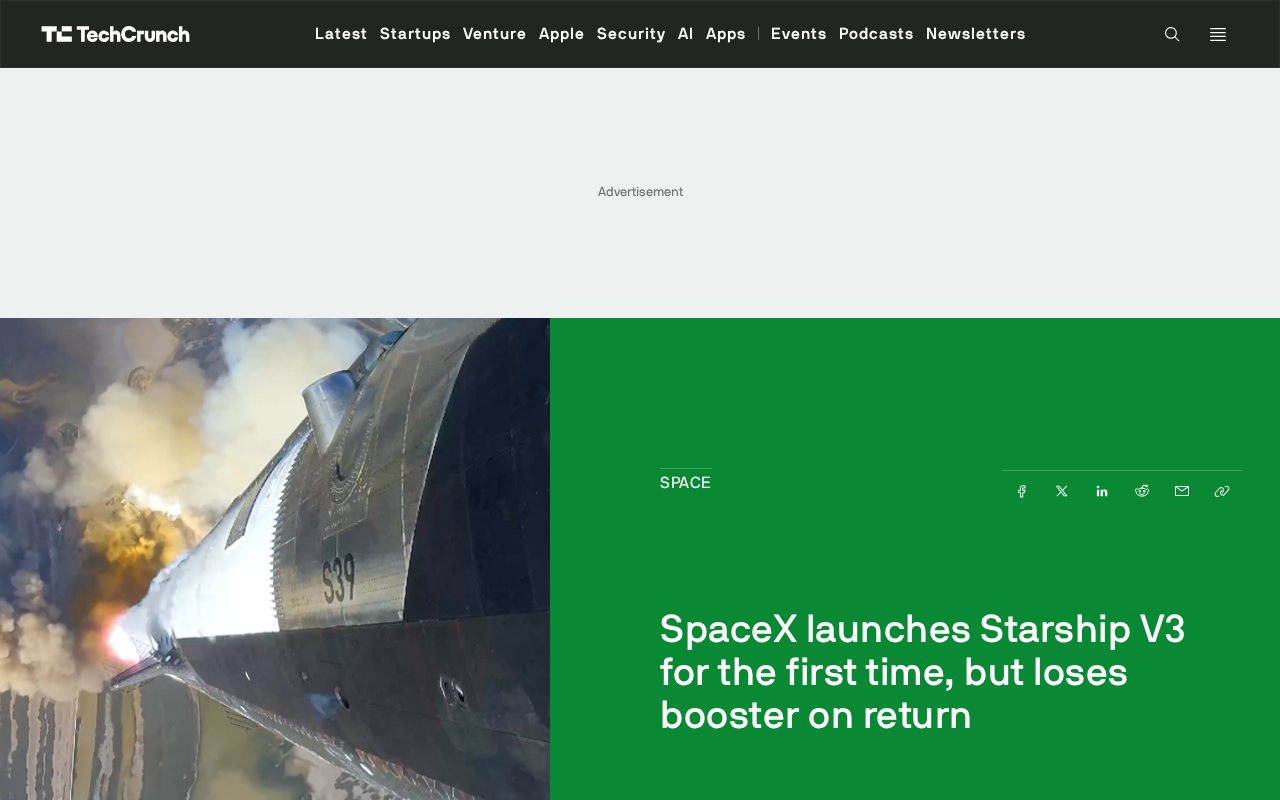
Starship V3 first flight succeeds in core systems but fails booster recovery
SpaceX completed the first Starship V3 launch with engine ignition, stage separation, and orbital flight all achieved as planned, but the Super Heavy booster failed during recovery. The V3 version features upgraded Raptor 3 engines with approximately 25% more thrust and is a critical upgrade supporting NASA's Artemis lunar missions, Mars colonization, and Starlink deployment. SpaceX will address the recovery issue through rapid iteration in subsequent test flights.
Starship V3 First Flight: Core Systems Succeed but Booster Recovery Falls Short
SpaceX recently completed the first launch of its upgraded Starship V3. The launch was generally considered successful—engine ignition, stage separation, orbital flight, and other critical milestones were all achieved as planned. However, the Super Heavy booster failed during the return phase and was not recovered. This outcome both demonstrates SpaceX's rapid progress in rocket technology iteration and exposes the engineering challenges that fully reusable technology still faces.
The Starship System: Technical Foundation of the Largest Rocket in Human History
The Starship system consists of two stages: the Super Heavy Booster at the bottom and the Starship spacecraft on top. The entire system stands approximately 120 meters tall with a fully loaded thrust exceeding 7,500 metric tons—far surpassing the previously most powerful Saturn V rocket (approximately 3,400 metric tons of thrust). The V3 version features the upgraded Raptor 3 engine, with each unit delivering roughly 25% more thrust than its predecessor. The booster is equipped with 33 engines, while the spacecraft carries 6. The entire system uses liquid oxygen and methane (LOX/CH4) propellant—a choice that balances high specific impulse performance with the long-term needs of In-Situ Resource Utilization (ISRU) on Mars. In theory, carbon dioxide and water can be extracted from the Martian atmosphere to synthesize methane, enabling interplanetary round trips.
What's New in Starship V3: Greater Thrust, Larger Payload
Starship V3 represents a major upgrade to SpaceX's super heavy-lift launch vehicle system. As the largest and most powerful rocket in human history, the Starship system is directly tied to several of SpaceX's core missions over the coming years:
- NASA Artemis Lunar Missions: In 2021, NASA awarded SpaceX the Human Landing System (HLS) contract worth approximately $2.9 billion, designating Starship as the sole crewed lunar lander for the Artemis program. The plan requires Starship to complete multiple In-Space Refueling operations in Earth orbit before flying to lunar orbit to dock with the Orion spacecraft and ultimately deliver astronauts to the lunar surface. The V3 version's increased payload capacity directly reduces the number of refueling missions needed per lunar landing, significantly lowering mission complexity.
- Mars Colonization Plan: The primary launch vehicle in Musk's long-term vision for sending humans to Mars—the choice of LOX/methane propellant was made precisely with this goal in mind.
- Next-Generation Starlink Satellite Deployment: A larger fairing and greater payload capacity mean more large satellites can be deployed per launch.
- Commercial Launches and Space Tourism: Opening entirely new commercial markets with ultra-heavy payload capabilities.
The V3 version features significant improvements in thrust, payload capacity, and system design—these upgrades form the technical foundation for turning the above missions from plans into reality.
Why the Booster Recovery Failed: Technical Difficulty and Iterative Logic
Recovery Is Critical to Starship's Economics
The commercial viability of the Starship system depends heavily on achieving full reusability. The Super Heavy Booster is extremely expensive to build, and without recovery after each launch, operating costs cannot be brought down to SpaceX's target levels. SpaceX had previously validated first-stage rocket recovery technology on Falcon 9 and attempted innovative recovery methods such as the "chopstick catch" during earlier Starship test flights.
The Mechazilla Chopstick Catch is a unique recovery method designed by SpaceX for the Super Heavy Booster. Mechanical arms on the launch tower (nicknamed "Mechazilla") catch the booster by its grid fins as it descends vertically, completely eliminating the traditional landing leg deployment step. The core logic behind this design is: removing landing legs saves several metric tons of structural weight while allowing the booster to be rapidly refueled without needing to be moved after landing, theoretically compressing booster turnaround time to just hours. SpaceX successfully demonstrated this technology for the first time during the fifth Integrated Flight Test (IFT-5) in October 2024. However, the introduction of new V3 hardware brought new control and structural variables, creating higher uncertainty for this recovery attempt.
First-Flight Failures of New Hardware Are Not Unexpected
SpaceX follows a Rapid Iterative Development model, a philosophy originating from agile development in the Silicon Valley software industry that Musk has systematically applied to hardware engineering. The core logic is: rather than conducting indefinite ground-based simulation and verification, it's better to rapidly manufacture prototypes at relatively low cost and conduct real flight tests, using real-world data to drive improvements. This approach stands in stark contrast to NASA's traditional "success-oriented" development culture, which tends to pursue near-perfect verification before each flight.
From an engineering perspective, the booster recovery failure on V3's maiden flight is understandable. Each new hardware generation introduces numerous variables that have never been validated in flight. Looking back at Falcon 9's development history, it took approximately 5 years and multiple failures from its first flight in 2010 to its first successful land recovery in 2015. Similarly, Starship progressed from low-altitude hop tests in 2019 to achieving booster capture in 2024, following the same trajectory of accelerated learning through failure.
SpaceX's Next Steps: Data Analysis and Rapid Iteration
SpaceX has characterized this Starship V3 first flight as "mostly successful," indicating that the vehicle's core systems performed as expected. While booster recovery was not achieved, the primary flight mission objectives were completed.
SpaceX's next priorities include:
- Fault Isolation: Deep analysis of telemetry data from the booster's return phase to precisely identify the root cause of the recovery failure.
- Solution Verification: Testing targeted fixes and improvements in subsequent test flights.
- Increasing Flight Rate: Gradually increasing the V3 launch cadence to accumulate flight data and establish a reliability baseline.
Against the backdrop of increasingly intense global space competition, continued iteration of Starship V3 will further widen the technology gap between SpaceX and its competitors.
Conclusion: A Milestone Flight Where Merits Outweigh Flaws
Starship V3's maiden flight marks another critical step for SpaceX toward a fully reusable super heavy-lift rocket. While the booster recovery failure is certainly disappointing, the successful completion of core flight objectives validates the direction of the V3 upgrades. As subsequent test flights proceed rapidly, Starship V3 is poised to become a transformative tool reshaping human space activities within the coming years—from returning to the Moon to venturing toward Mars, this giant rocket carries not just payloads, but the next chapter of humanity's deep space exploration.
Key Takeaways
- SpaceX completed the first Starship V3 launch, with the overall mission rated as mostly successful
- The booster failed during recovery on return, showing reusability technology still faces challenges
- Starship V3 features upgraded Raptor 3 engines with significantly increased thrust and payload capacity
- Starship V3 is a critical upgrade supporting SpaceX's lunar, Mars, and Starlink objectives
- Core systems performed nominally on the maiden flight, validating the V3 upgrade direction
- SpaceX will address the recovery issue through rapid iteration in subsequent test flights
Related articles
 Tech Frontiers
A Rare Quiet Day in AI: Recursive Self-Improvement Stirs Beneath the Surface
A rare quiet day in AI sees multiple sources go silent simultaneously. Behind the calm, Recursive Self-Improvement (RSI) research continues. What this means for the industry.
 Tech Frontiers
Reve 2 vs. Ideogram 4: A Deep Dive into Layout Control in AI Image Generation
A deep comparison of Reve 2 and Ideogram 4's layout control capabilities, covering technical approaches, real-world use cases, and industry trends for designers and creators.
 Tech Frontiers
In the Weights: Check Your Influence Score in the AI World
In the Weights is an AI influence search engine that quantifies your presence in the AI world with a score. Explore how it evaluates practitioners and what it means for digital identity.