SpaceX Successfully Catches Starship Spacecraft with "Chopsticks" for the First Time
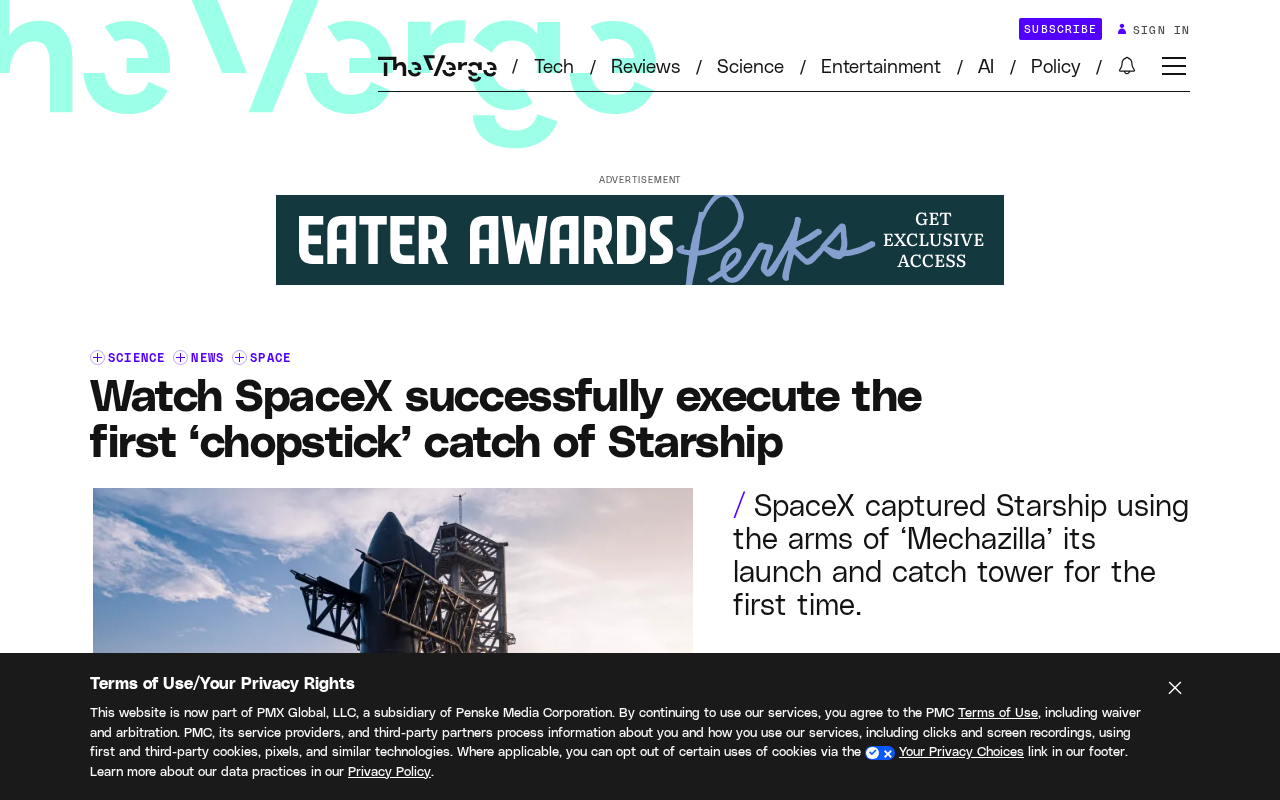
Starship's 15th test flight first caught the Starship spacecraft itself with the launch tower's robotic arms, extending recovery from booster to spacecraft.
On Starship's fifteenth test flight, SpaceX achieved a new breakthrough: the launch tower's robotic arms successfully caught the Starship spacecraft itself for the first time, rather than the Super Heavy booster as before. The originally planned booster capture was aborted during this flight, after which the company instead completed the spacecraft capture, reflecting Starship's test-while-flying iterative model.
SpaceX achieved a new milestone on Starship's fifteenth test flight: for the first time, the launch tower's "Mechazilla" successfully caught the Starship spacecraft itself with its "chopsticks," rather than the booster as in previous attempts. The maneuver was briefly aborted during Flight 15 before being carried out successfully.
From Booster to Spacecraft: An Upgrade in the Capture Target
SpaceX had previously demonstrated multiple times its ability to catch the Super Heavy booster with the launch tower's robotic arms—an operation popularly dubbed "chopsticks catching a rocket." But this time, what was caught was the Starship spacecraft itself.
According to the original report, SpaceX had originally planned to catch the booster during Starship's fifteenth flight, but that plan was aborted, and the company then went on to successfully complete the first "chopsticks" capture of the Starship spacecraft. This means the capture technology's applicable target has expanded from the booster to the spacecraft—a key step in building out the Starship recovery system.
SpaceX CEO Elon Musk has repeatedly emphasized that rapid reusability is the core goal of the Starship program, and launch tower capture is one of the means to achieve it—it allows the returning vehicle to come directly back to the launch tower, eliminating the need for transport and re-rigging.
Division of labor between the Super Heavy booster and the Starship spacecraft: The Starship system consists of two stages—the first stage is the roughly 71-meter-long "Super Heavy" booster, which provides the vast majority of thrust during liftoff; the second stage is the Starship spacecraft itself, the part that ultimately reaches orbit, carries out missions, and returns. After stage separation, the two return separately: the booster typically turns back shortly after separation, with relatively manageable velocity and thermal loads; the spacecraft must complete orbital insertion, atmospheric reentry, and other processes, and faces far harsher velocity and aerodynamic heating conditions on return. For this reason, capturing the spacecraft is significantly more difficult than capturing the booster, placing higher demands on attitude precision, structural load-bearing, and coordination with the launch tower's robotic arms. This is the technical reason why this "expansion from booster to spacecraft" is regarded as a key step.
Why "Chopsticks" Capture Matters
Traditional rocket recovery relies on landing legs and ground landing sites, whereas Starship uses direct capture by the launch tower's robotic arms. This approach places extremely high demands on the vehicle's attitude control, structural strength, and precise coordination with the launch tower.
Extending the capture target from the booster to the spacecraft means both stages of Starship are expected to prove out the "return to the launch tower" path. For a Starship system designed for rapid reusability, this is an important signal that the recovery process is becoming complete.
However, the original report did not disclose the specific technical parameters of this capture, the state of the spacecraft, or subsequent reuse plans; further details await official clarification from SpaceX.
Rapid reuse versus the landing-leg approach: Traditional rocket recovery (such as Falcon 9) relies on landing legs to touch down vertically at a landing site, after which cranes or transport equipment are needed to lay the booster down, haul it back to the hangar, re-inspect it, and stand it upright on the launch pad again—a whole process that takes days to weeks. Starship instead uses the launch tower's robotic arms to directly "catch" the returning vehicle, with the aim of bringing the vehicle back to the launch tower almost in place, skipping extensive transport and rigging and thereby compressing the turnaround time between two flights. Musk has set a goal of shortening the reuse cycle to the order of hours, which would be nearly impossible under the traditional landing-leg approach. The trade-off is that capture imposes extremely stringent fault-tolerance requirements on the vehicle's hover/deceleration precision, structural strength, and the launch tower's control system—any deviation could damage the vehicle or the launch tower.
Test Flight Cadence and Technical Iteration
The Starship program has consistently followed an iterative model of "fly—find problems—improve—fly again." The process in Flight 15, where the capture plan was first aborted and then succeeded, also reflects this approach of testing while flying and adjusting strategy based on actual conditions.
A single successful capture does not mean the recovery process is fully mature, but it is a clear waypoint on Starship's reusability path. Whether subsequent test flights can reliably reproduce this operation will determine whether launch tower capture can move from a "first success" to a routine procedure.
Starship's iterative development philosophy: Unlike the traditional aerospace approach of "thorough ground verification before first flight," SpaceX employs rapid prototype iteration for Starship: each prototype is allowed to expose problems or even fail during flight, using real flight data to drive the next round of design changes. This shortens the cycle from design to flight, but the trade-off is that individual test flight results vary considerably—a given operation may succeed on one flight and need to be aborted on the next. The process described in this article, where "the capture plan was first aborted and then succeeded," exemplifies this kind of flexible adjustment: ground and flight teams decide whether to execute high-risk maneuvers based on real-time conditions. Therefore, when evaluating Starship progress, what usually matters is not a single success or failure but whether the capability envelope continues to advance across multiple flights.
One-line Summary
Starship's fifteenth test flight successfully caught the Starship spacecraft itself with the launch tower's robotic arms for the first time, extending the recovery target from the booster to the spacecraft.
Paragraph Summary
SpaceX achieved a new breakthrough on Starship's fifteenth test flight: the launch tower's robotic arms successfully caught the Starship spacecraft itself for the first time, rather than the Super Heavy booster as before. The originally planned booster capture was aborted during this flight, after which the company instead completed the spacecraft capture, reflecting Starship's test-while-flying iterative model. Extending the capture target from the booster to the spacecraft means both stages of Starship are expected to prove out the "return to the launch tower" path—a key waypoint on the rapid reusability roadmap. However, the report did not disclose the specific technical parameters of this capture, the spacecraft's state, or subsequent reuse plans, and a single success does not mean the recovery process is mature; whether it can be reliably reproduced will determine whether it can become routine.
Related articles

Inside Honey Trap Training: Emotional Dissociation and Anchoring Techniques
How are spies trained for honey trap missions? A trainee reveals emotional dissociation, perfume and keyword anchoring, and target photo binding—psychological techniques that condition reflexes for intelligence work.

Frontier AI Risk Management: Full-Pipeline Practices from Training to Deployment
OpenAI outlines a frontier AI risk management framework: from training-stage model alignment to deployment-stage sandboxing and blocking safeguards, plus post-deployment monitoring—a layered risk control system across the model lifecycle.
DaisyRose-27B: 1,200-Task RL Boosts Qwen3.8 from 5.6% to 12% on Terminal-Bench 4.1
DaisyRose-27B uses RL training on 1,200 tasks to boost Qwen3.8's Terminal-Bench 4.1 score from 5.6% to 12%, showing lightweight RL can more than double terminal task performance.