SparkBots AI: Extract Key Information from Webpages and PDFs in Seconds

SparkBots AI uses trainable specialized bots for sub-second, hallucination-free webpage and PDF extraction.
SparkBots AI is a newly launched Product Hunt document information extraction tool powered by Jev. It trains specialized bots for specific page types instead of re-reasoning with a general LLM each time, achieving sub-second responses on similarly structured webpages or PDFs. Answers come strictly from source text and missing information is left blank, avoiding hallucination—suited to resumes, contracts, listings, and sales leads. It trades generality for speed and determinism versus ChatGPT and Claude. It received 78 votes and ranked 14th on Product Hunt, but pricing, privacy, training workflow, and layout tolerance remain undisclosed, so real-document testing is advised before core integration.
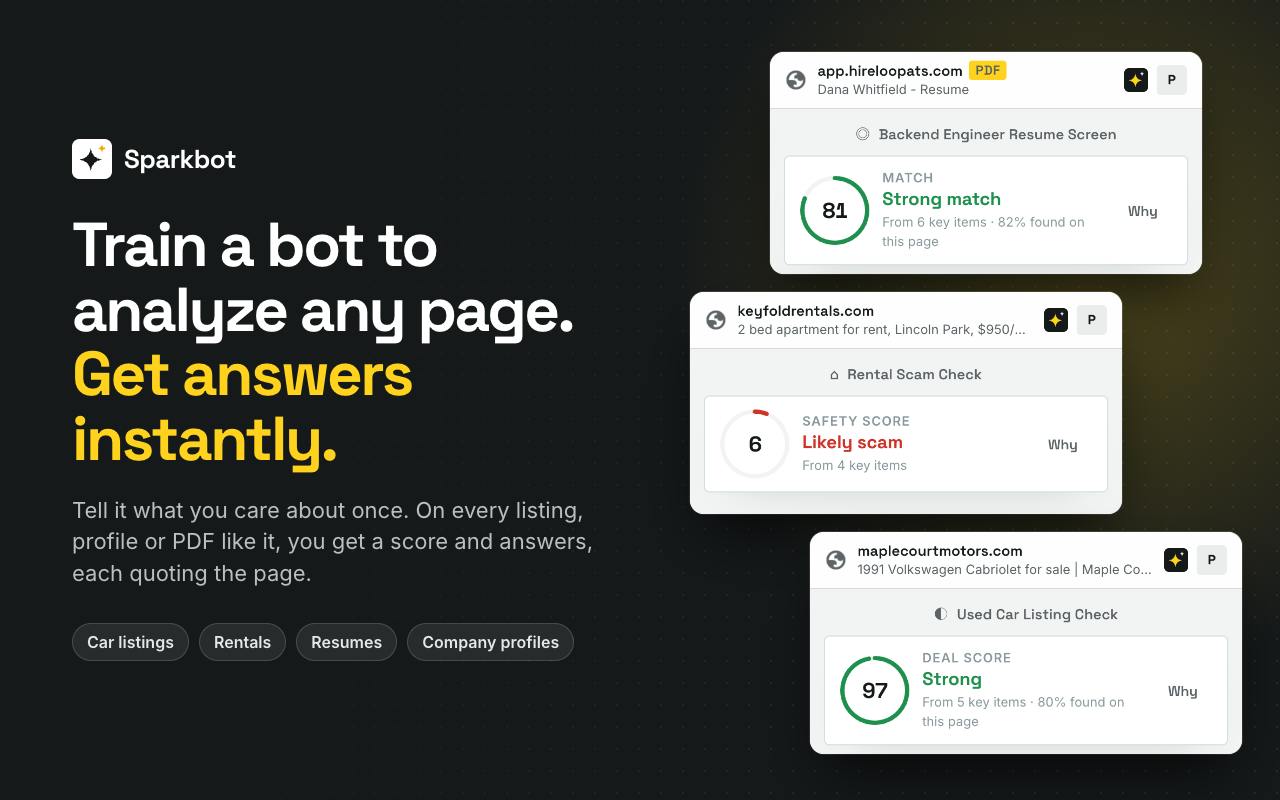
In an age of information overload, quickly extracting key details from webpages or PDFs is a core requirement for many business processes. SparkBots AI (technically powered by Jev), which just debuted on Product Hunt, aims to solve this problem with "trainable small specialized bots," claiming to return answers in under a second and to avoid the hallucinations that plague general-purpose large models.
From General-Purpose LLMs to Specialized Small Models: SparkBots' Positioning
SparkBots' core approach diverges from general-purpose LLMs like Claude and ChatGPT. According to the official description, a SparkBot can be "trained" to deeply analyze any webpage or PDF; once trained, it can deliver answers in under a second when facing similarly structured pages. This speed metric is one of the product's headline selling points. For scenarios requiring batch processing of resumes, contracts, property listings, or sales leads, sub-second responses mean the extraction step can be embedded into real-time workflows rather than queued asynchronously.
The product page also emphasizes one point in particular: although SparkBot uses AI, it is not a "slow LLM." Its answers come directly from page content, and information it cannot find is left blank, so it "will not hallucinate or fabricate details that don't exist." This is effectively a response to enterprise users' most common concern about generative AI—in document processing for contracts, resumes, and similar low-tolerance materials, a fabricated field can be worse than a missing one.
Hallucination is a specialized concept in the generative AI field, referring to a model generating content that appears plausible but does not match the input facts, or is even entirely fictitious. In large language models, hallucination stems from their mechanism of probabilistically predicting the next word: models tend to output fluent, coherent text rather than strictly verifying facts. For structured document processing scenarios such as contracts, resumes, and financial reports, the harm of hallucination is especially pronounced—a fabricated contract amount or candidate's years of work experience can directly lead to flawed business decisions. Common industry mitigation methods include retrieval-augmented generation (RAG), constrained decoding, and answer provenance, but these methods can only reduce the probability and cannot fundamentally eliminate it. SparkBots' claimed "no hallucination" essentially shifts the extraction task from a generative paradigm to a discriminative or retrieval-based paradigm: the answer must have a corresponding passage in the source text, and if none is found, an empty value is returned, thereby structurally avoiding the possibility of fabrication.
The divergence between general-purpose LLMs and specialized small models (Small Language Model / Specialized Model) is a core watershed in current AI application deployment. General-purpose LLMs such as the GPT-4 and Claude series have enormous parameter counts and broad training data coverage, giving them cross-domain reasoning, summarization, and multi-turn dialogue capabilities, but each inference requires feeding the full context into the model, with latency typically in the seconds range or higher, and invocation costs growing linearly with context length. Specialized small models are trained or fine-tuned for a single task or single document type, with small parameter counts and short inference paths, enabling sub-second responses, and their accuracy on narrowly defined tasks often matches that of large models. The trade-off is weak generalization: once page layouts or field definitions change, a specialized model may need retraining. This trade-off between "narrow and fast" and "broad and slow" determines the different roles the two play in business processes—general-purpose LLMs suit exploratory, open-ended tasks, while specialized small models suit high-frequency, templated batch processing.
Trainable, Reusable Extraction Logic
SparkBots does not reason from scratch on every question; instead, it first "trains" a bot for a specific page type and then reuses it on similar pages. This pattern is not unfamiliar in the field of document information extraction, but SparkBots packages it as a product for business users rather than an API that requires coding. The official list of intended use cases includes sales leads, company information, resumes, property listings, and contracts, covering essentially the document types that small and mid-sized teams routinely need to structure.
This "train once, reuse many times" design also brings an implicit cost advantage: compared with calling a large model to re-read an entire document each time, a specialized bot's per-call overhead on repetitive tasks is theoretically lower. However, the product page does not disclose specific pricing, the number of samples required for training, or the range of supported file formats—all of which are unavoidable questions when evaluating its practical usability.
Document information extraction is a mature research direction in natural language processing, aiming to identify and extract predefined fields—such as invoice numbers, contract parties, and work experience in resumes—from semi-structured or unstructured documents. Traditional approaches rely on rule templates or regular expressions, which are costly to maintain and sensitive to layout changes; deep learning methods train sequence labeling or question-answering models on annotated samples and have some layout robustness. In recent years, vision-based document understanding models (such as the LayoutLM series) have further jointly modeled text and layout. The "train once, reuse many times" approach described by SparkBots is, at the product level, close to building a lightweight extractor for a specific page type, and its technical implementation may be based on few-shot learning from a small number of samples or template matching plus semantic validation. Understanding this background helps assess its capability boundaries: it is effective on pages with "similar structure," but for PDFs with drastic layout changes or poor scan quality, effectiveness needs to be verified empirically.
Trade-offs vs. General-Purpose LLMs
Comparing SparkBots with ChatGPT and Claude makes its applicable boundaries clearer. General-purpose LLMs excel at open-domain reasoning, summarization, and dialogue, making them suitable for content without fixed templates; the cost is higher response latency and the risk of hallucination on factual extraction tasks. SparkBots chooses to sacrifice generality for speed and determinism, with answers strictly limited to content already present on the page.
This trade-off means it is better suited to extraction tasks with "clear fields and relatively fixed templates" rather than open-ended analysis. The official positioning calls it a "deep analysis" tool, but based on the description, its capability boundary is closer to high-precision structured information extraction than to interpretive reasoning. For tasks such as assessing contract clause risks or comprehensively evaluating candidates, a specialized bot can provide the raw fields, but the judgment logic still needs to be done by humans.
Market Reception and Open Questions
SparkBots AI received 78 votes on Product Hunt, ranking 14th, with 5 comments. This result shows it addresses a pain point for some users, but it is still far from being a phenomenon-level product, and the sample size is not yet sufficient to judge long-term reputation. The maker is Malcolm (Hello Spark AI), and the official website link points to a Product Hunt redirect page.
Key items missing from currently public information include: the specific workflow for training a bot, the tolerance for supported page structure changes, data privacy and storage policies, and the pricing model. For teams that would hand customer contracts or resumes to a third party for processing, the latter two are especially important. SparkBots' promises of "no hallucination, sub-second" are appealing, but these promises need to be verified on real, messy webpages and PDFs—after all, demo environments on product pages are usually much cleaner than real data.
For teams currently looking for document information extraction solutions, SparkBots is worth adding to a watch list, especially for business lines tired of manually reviewing large-model hallucinations. But before integrating it into core workflows, it is advisable to run a small-scale test with your own real documents, focusing on two things: whether the trained bot remains stable after minor page layout changes, and whether the blank-value strategy behaves as expected when key fields are missing.
One-line Summary
SparkBots AI uses trainable specialized small bots to achieve sub-second, hallucination-free information extraction from webpages and PDFs.
Paragraph Summary
SparkBots AI is a document information extraction tool newly launched on Product Hunt, technically powered by Jev. Its core idea is to train specialized bots for specific page types rather than calling a general-purpose large model to re-reason each time, thereby achieving sub-second response times on similarly structured webpages or PDFs. The product emphasizes that answers come strictly from the original page text and that missing information is left blank, so it does not hallucinate, making it suitable for extraction scenarios with relatively fixed templates such as resumes, contracts, property listings, and sales leads. Compared with ChatGPT and Claude, it trades generality for speed and determinism. The product received 78 votes on Product Hunt and ranked 14th, preliminarily validating market demand, but key information such as pricing, privacy policy, training workflow, and tolerance for layout changes has not yet been disclosed, and small-scale testing with real documents is needed before integrating it into core workflows.
Related articles

A New Paradigm for Text Editing in Compose: TextFieldState Replaces the Old API
Jetpack Compose introduces the TextFieldState API to fix dropped characters and cursor jumps from async input. The old value/onValueChange callbacks will be deprecated in 1.13. This article covers InputTransformation, OutputTransformation, four state hoisting patterns, and new formatted text editing capabilities.

Remote Compose: A New Document-Driven Paradigm for Cross-Platform UI on Android
Remote Compose transmits compact binary documents instead of screen pixels, enabling efficient UI rendering on remote surfaces like Wear OS and widgets. This article covers its document creation API, expression animations, size optimization techniques, and Wear OS progress.

How Crashlytics Eliminates Android Memory and Responsiveness Issues
Through the Chroma Clip case study, this article explains how Firebase Crashlytics uses Application Exit Info, Profiling Manager, GWP ASAN, and ARM MTE to pinpoint ANRs, OOMs, memory limit terminations, and native memory corruption—solving the challenge of stack traces that don't point to the real culprit.