Spec Website: An Open-Source Website Specification Checklist

An open-source checklist for verifying website compliance across structure, accessibility, security, SEO, privacy, and AI readability.
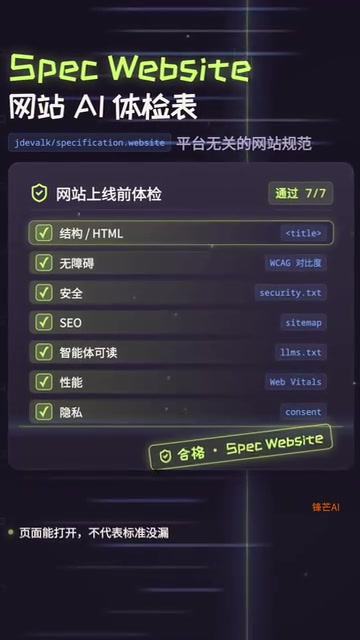
Spec Website is an open-source, platform-agnostic website specification checklist that helps developers systematically verify their sites against standards across six key dimensions: page structure, accessibility, security, SEO, privacy, and AI agent readability. Rather than being a tutorial, it provides actionable check items with authoritative references, making it ideal for pre-launch reviews, team alignment, and periodic audits. Its standout feature is the AI agent readability dimension, preparing websites for an era where AI systems need to understand and interact with web content.
A Page That Loads Doesn't Mean It Meets Standards
Your website is live. The pages load fine, and the features work — but is that really enough?
Are your heading tags properly structured? Have you implemented accessibility? Are all security headers configured? Can search engines crawl your site correctly? Can AI agents understand your website? These questions are scattered across different standards documents, and almost no one can keep the full picture in their head.
Spec Website was created to solve exactly this pain point. It's a platform-agnostic website specification checklist that works like a health checkup form, helping you verify item by item whether your site meets various standards.
What Is Spec Website?
Not a Tutorial — An Actionable Checklist
Spec Website is fundamentally different from typical frontend tutorials. It doesn't teach you how to use a specific framework or walk through code implementations. Instead, it answers three core questions:
- What should the output include: Which specification items your website should satisfy
- Why it matters: The reasoning and references behind each specification
- How to verify: How to check compliance and what common mistakes look like

As the project README puts it directly: website specifications are hard because the sources are too fragmented. Page structure, accessibility, security, search optimization, privacy protection — each has its own standards ecosystem. Spec Website consolidates these scattered specifications into a single checklist, with every item citing authoritative sources for full traceability.
Six Key Dimensions of Inspection
The Spec Website checklist covers the most critical dimensions of website development:
| Dimension | Focus Areas |
|---|---|
| Page Structure | HTML semantics, heading hierarchy, metadata completeness |
| Accessibility | ARIA labels, keyboard navigation, screen reader compatibility |
| Security | HTTPS, security headers, CSP policies |
| Search Optimization | SEO meta tags, structured data, sitemap |
| Privacy | Cookie declarations, data collection compliance |
| Agent Readability | Whether AI agents can understand website content and structure |
Let's dive into the technical background behind each dimension to help you understand why every specification matters.
Page Structure: Semantics Are Not Optional
HTML semantics means using HTML tags with clear meaning (such as <header>, <nav>, <article>, <section>, etc.) to build page structure, rather than overusing <div> and <span>. The core value of semantic HTML is that it enables browsers, search engines, and assistive technologies to accurately understand the hierarchical relationships and functional roles of page content. W3C significantly strengthened the semantic tag system in the HTML5 specification, but in practice, many websites still have issues like heading level jumps (e.g., jumping from h1 directly to h4), missing lang attributes, and empty meta descriptions. These seemingly minor oversights directly impact search engine content comprehension and screen reader navigation experience. Spec Website's page structure checks are designed to target these high-frequency omissions one by one.
Accessibility: From Moral Imperative to Legal Obligation
Web accessibility primarily follows the WCAG (Web Content Accessibility Guidelines) standard published by W3C, with the latest version being WCAG 2.2. The standard is built around four principles: Perceivable, Operable, Understandable, and Robust. ARIA (Accessible Rich Internet Applications) is a set of attribute specifications developed by W3C to enhance the accessibility of dynamic content and complex UI components. For example, a custom dropdown menu without proper role, aria-expanded, and similar attributes will be completely incomprehensible to screen reader users. In Western markets, accessibility compliance is no longer just a moral imperative — it's a legal obligation. The Americans with Disabilities Act (ADA) and the European Accessibility Act (EAA, effective June 2025) both impose mandatory website accessibility requirements, and non-compliant businesses may face lawsuits and fines.
Security: Security Headers and CSP Are the First Line of Defense
HTTP security headers are mechanisms through which servers communicate security policies to browsers via response headers. Common security headers include: Strict-Transport-Security (enforcing HTTPS), X-Content-Type-Options (preventing MIME type sniffing), X-Frame-Options (preventing clickjacking), and Referrer-Policy (controlling referrer information leakage). The most complex and important among these is CSP (Content Security Policy), which uses a whitelist mechanism to restrict the sources from which a page can load resources — it's the core defense against XSS (Cross-Site Scripting) attacks. A well-configured CSP can reduce the success rate of XSS attacks by over 90%, but due to its high configuration complexity, many websites either have no CSP deployed at all or have policies so permissive they're effectively useless. Spec Website's security dimension not only lists the security headers that need to be configured but also explains each header's purpose and common misconfiguration patterns.
Search Optimization: Structured Data Helps Machines "See" Content
Structured data refers to web content annotated in a machine-readable format following a specific vocabulary (most commonly Schema.org). Common implementation methods include JSON-LD, Microdata, and RDFa, with Google officially recommending JSON-LD. The direct value of structured data is reflected in Rich Results in search — such as product rating stars, FAQ accordions, event dates, and more. But its deeper value lies in providing explicit semantic anchors for search engines and AI systems, enabling machines to precisely understand entity relationships like "this is a product," "this is a review," or "this is an organization," rather than relying solely on natural language inference. Spec Website's search optimization dimension covers the complete inspection chain from basic meta tags to advanced structured data.
The Biggest Highlight: AI Agent Readability Checks
Among all inspection dimensions, Agent Readability is the most forward-looking part of Spec Website.

Traditional website specifications primarily target two types of "readers": human users and search engine crawlers. But with the proliferation of large language models and AI agents, websites now need to cater to a third type of reader — AI agents.
What Are AI Agents? Why Do They Need to "Read" Websites?
AI agents are AI systems capable of autonomously perceiving their environment, making plans, and executing tasks. In web scenarios, typical AI agent behaviors include: browsing web pages on behalf of users to gather information, comparing products and services across different websites, and automatically filling out forms to complete transactions. Unlike traditional search engine crawlers, AI agents require a deeper level of semantic understanding — they need to know not just what content is on a page, but also understand the relationships between content, the website's credibility, and the legitimacy of action paths.
Currently, OpenAI's ChatGPT plugin ecosystem, Google's Gemini, and various AutoGPT frameworks are all driving deeper interaction between AI agents and websites. This means websites need to provide machine-readable identity declarations (such as Schema.org markup), clear API endpoint descriptions (such as llms.txt files — an emerging protocol for telling AI systems about a website's core content and available services), and explicit permission boundary declarations.
The core questions Spec Website asks in this dimension include:
- Can machines understand who you are? Is the website's identity information presented in a structured format?
- Can machines understand what you offer? Do services and content have clear semantic descriptions?
- Can machines determine which paths are trustworthy? Are the website's trust signals sufficient?
As various AI agents begin browsing web pages, gathering information, and executing tasks on behalf of users, a website's "readability" for agents will become increasingly important. This isn't just about SEO rankings — it's about whether your website can be correctly understood and recommended within the AI ecosystem. This is arguably one of the most critical specifications for the future.
Project Status and Use Cases

As of now, Spec Website has earned 701 stars and 45 forks on GitHub, with the most recent code push being very recent, indicating the project is still actively maintained. While the growth isn't explosive, for a utility-focused project, this steady pace actually suggests consistent iteration.
Who Should Use Spec Website?
Spec Website is not an auto-fix tool — it won't fix problems for you. It's a standardized checklist. The use cases are very clear:
- Pre-launch self-checks: Before publishing a new website, go through the checklist item by item to avoid missing critical specifications
- Team alignment: Frontend, backend, security, and SEO teams can use the same checklist to communicate, reducing information gaps
- Agent compatibility assessment: Check whether your website is AI-agent-friendly and prepare for the AI era
- Periodic audits: After website iterations, run through the checklist again to ensure new features haven't broken existing compliance
It's worth noting that as a "platform-agnostic" checklist, Spec Website applies equally whether you're using React, Vue, WordPress, or plain static HTML. It focuses on the final output — the HTML the browser receives, HTTP headers, the Accessibility Tree, etc. — not the tech stack you used to build it.
How to Find Spec Website?
Search for "Spec Website" or the keywords "specification website" on GitHub to find the project. We recommend bookmarking it in your toolbox and pulling it out before every project launch.
Final Thoughts
The most easily overlooked aspect of website development is often not feature implementation, but specification compliance. A page that loads and functions that work are still a long way from "done well." The value of Spec Website lies in consolidating scattered standards into an actionable checklist, making "done well" measurable and verifiable.
The inclusion of the agent readability dimension, in particular, makes this checklist relevant not only for today but also for an AI-driven future. When your website needs to be read not just by humans but also by AI, a good checkup form becomes especially important.
From a broader perspective, the evolution of web standards is itself a history of continuously expanding "readership": from initially serving only human readers, to serving search engine crawlers (which gave rise to the SEO industry), to serving assistive technologies (which gave rise to accessibility standards), and now welcoming AI agents as a new reader demographic. Each expansion of "readership" redefines what constitutes a "good website." Spec Website provides a timely reference framework at precisely this inflection point.
Related articles

Alibaba Launches Happy Shrimp: AI-Powered One-Click Complete Song Generation
Alibaba launches Happy Shrimp, an AI music generation tool that creates complete songs with lyrics, melody, arrangement, and vocals from natural language descriptions. In-depth analysis of its core features, differentiation from competitors like Suno, and industry impact.
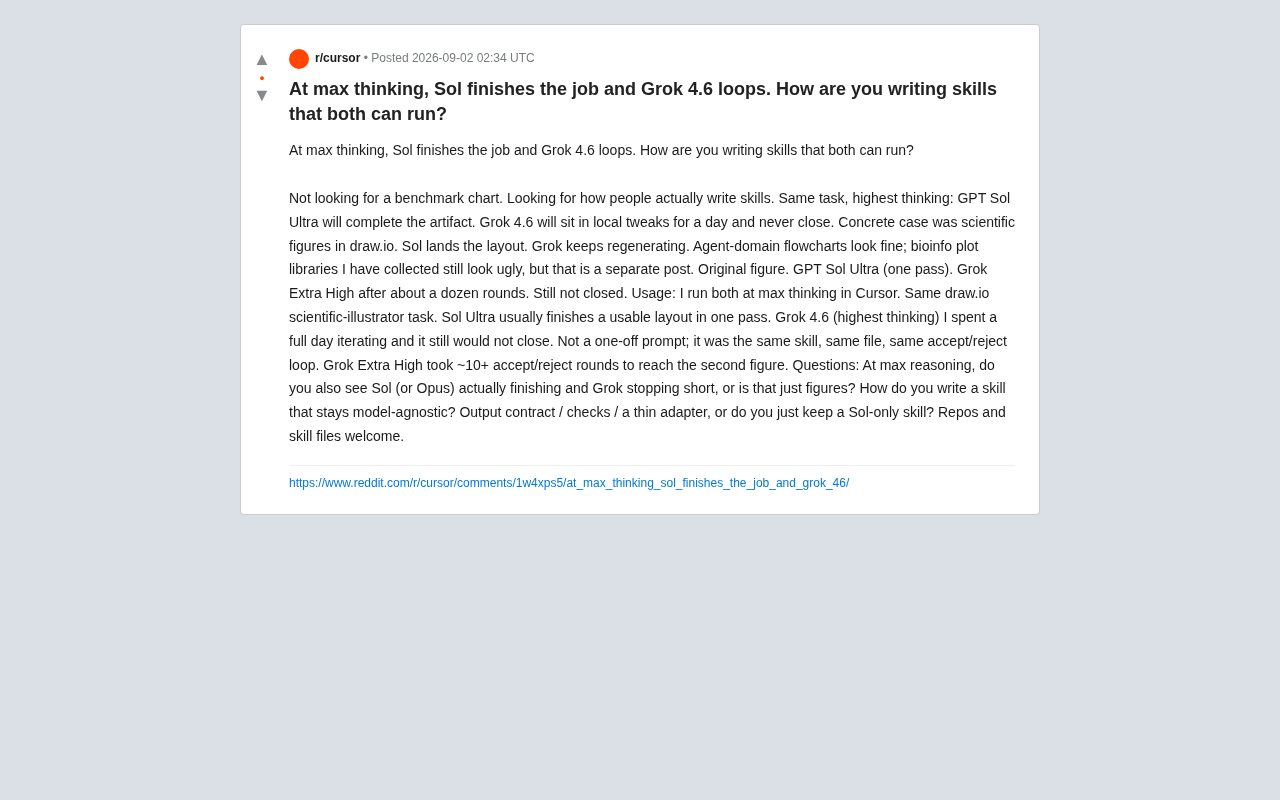
GPT Sol Ultra vs Grok 4.6: Real-World Task Completion Benchmark in Reasoning Mode
Developer benchmark reveals GPT Sol Ultra completes draw.io scientific diagrams in one iteration while Grok 4.6 fails to converge despite maximum reasoning mode, exposing that reasoning depth ≠ task delivery capability.
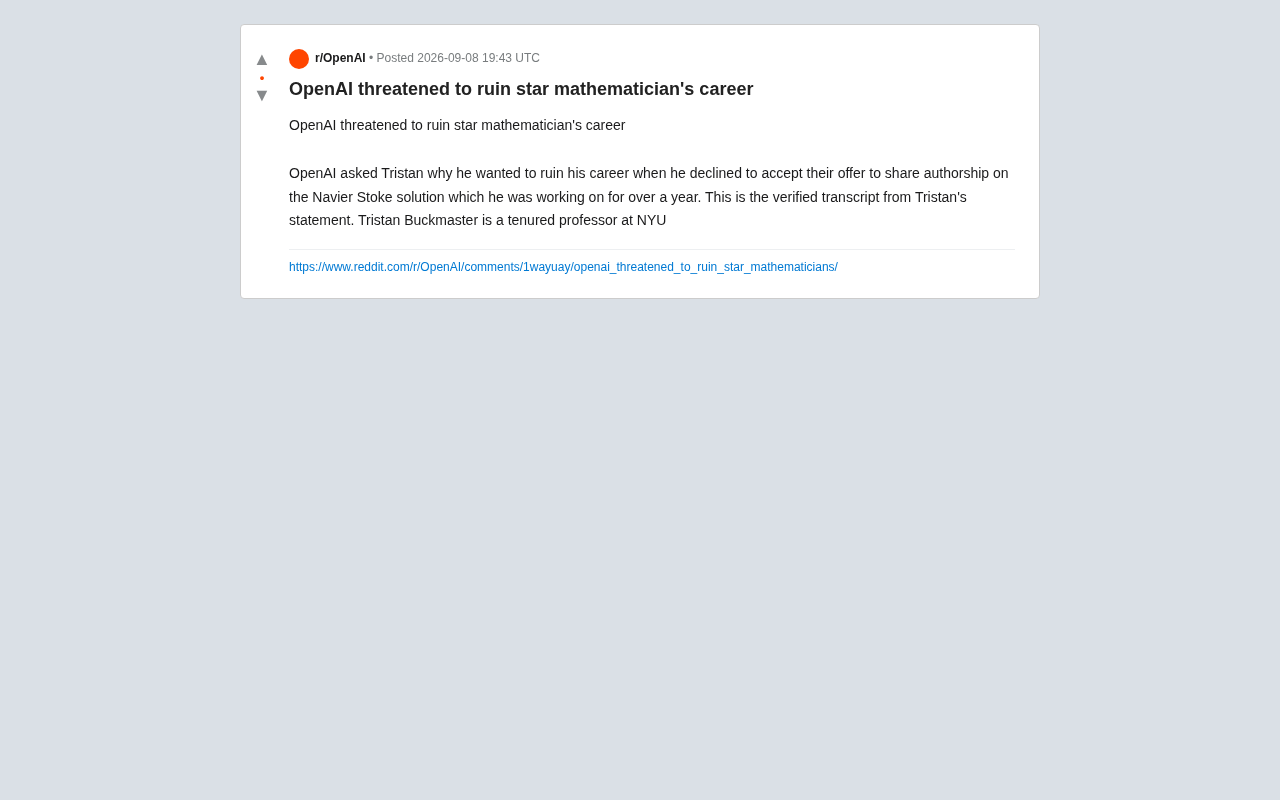
OpenAI Authorship Dispute: The Battle Over Academic Boundaries in the AI Era
OpenAI disputes authorship with mathematician Tristan Buckmaster over Navier-Stokes research, raising ethical questions about AI involvement in science.