Specsight: A New Approach to Product Observability in the AI Era
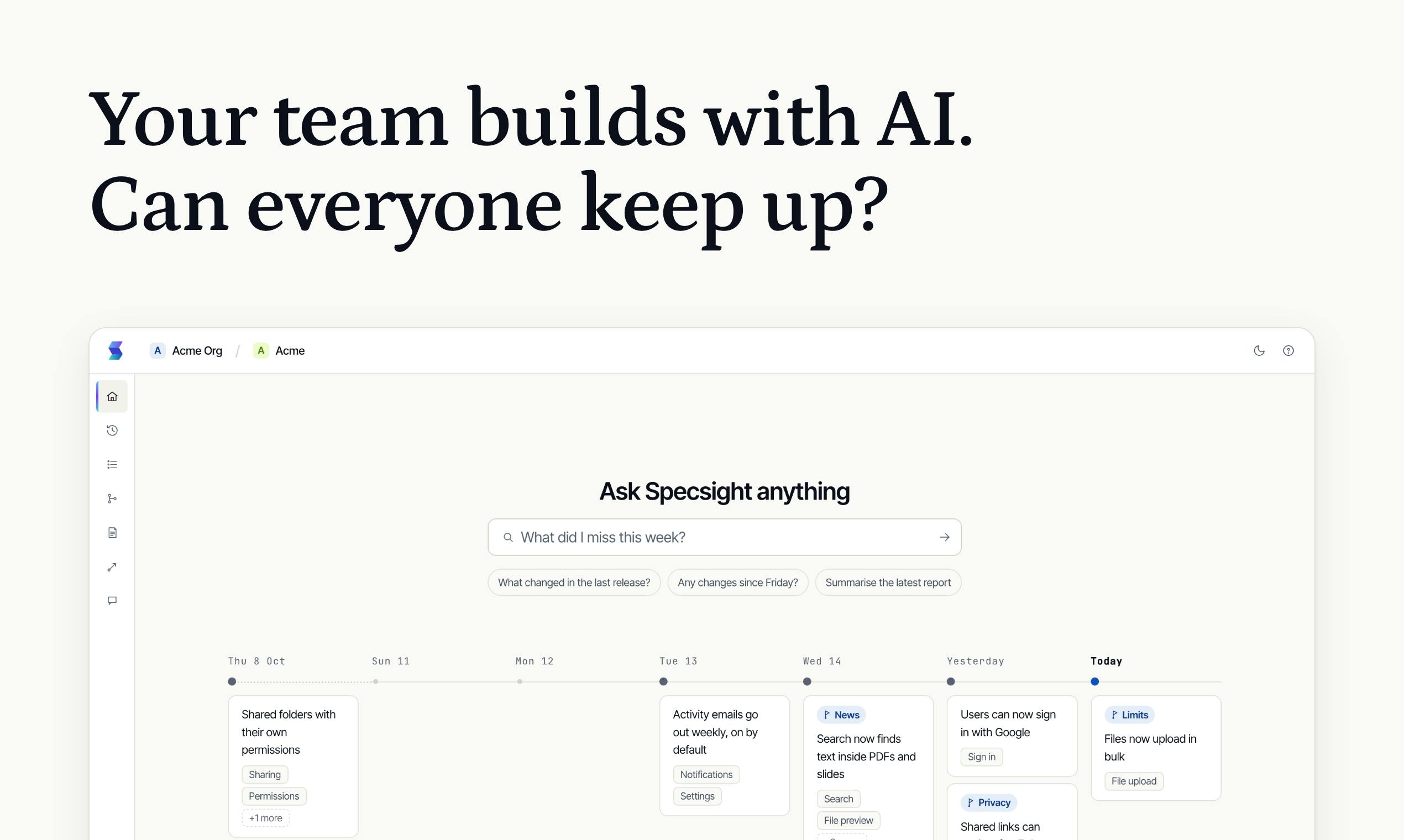
Specsight uses AI to translate code changes into a living product map and release notes, bridging the cross-functional cognition gap
Specsight is the #13 new product on Product Hunt, positioned as a "product observability" tool for fast-shipping teams. Borrowing the engineering concept of observability, it automatically transforms code changes—the most trustworthy source of truth—into a continuously updated product map, feature knowledge base, and release updates, enabling product, sales, and support teams to grasp feature states and changes in real time and reducing reliance on pulling engineers into group chats. Its target scenario is SaaS teams with intensive cross-functional collaboration, and its core value lies in eliminating the time lag between code changes and business understanding. The product is currently in an early exposure stage with 66 upvotes and 2 comments, created by Ola Piętka, and still lacks user reviews and hands-on testing. Its success depends on the accuracy of semantic mapping from code to features, the language quality of release notes, and teams' trust in an automatically generated knowledge source.
When Code Changes Outpace Team Synchronization, Specsight Tries to Draw a Living Product Map with AI
With AI-assisted programming becoming increasingly widespread, development teams are delivering code at a dramatically accelerated pace. But an old problem is being magnified: product, sales, and support teams' understanding of "what the software actually does and what has changed" is falling further and further behind the rhythm of code changes. Specsight, a new product ranked #13 on Product Hunt, is aimed squarely at this gap.
Its positioning is "Product observability for teams shipping fast with AI." The term borrows the engineering concept of "observability," but shifts the object from system runtime state to the product features themselves.
Core Logic: Translating Code Changes into Product Language
Specsight claims to transform code changes into three things: a living product map, feature knowledge, and clear release updates.
The key to this approach is the "translation layer." Traditionally, release notes are written by hand by developers or PMs, often lagging and incomplete; product maps are scattered across documentation tools or whiteboards and quickly go stale. Specsight attempts to start from code changes—the most trustworthy source of truth—and automatically generate product understanding for non-technical teams.
For teams that ship fast, this means Product, Sales, and Support can know in real time "what this feature looks like now" and "what the last update changed," without having to pull engineers into a group chat.
Observability originates from control theory. In software engineering, it typically refers to the ability to infer a system's internal state from external outputs such as logs, metrics, and traces—classic examples being APM and monitoring tools like Datadog and Grafana. Specsight migrates this concept from "system runtime state" to "product feature state": treating the code repository (commits, PRs, release records) as the data source for observability, and inferring the current true shape and evolution trajectory of product features by analyzing changes. The premise of this analogy is that code is the most authoritative source of truth for product behavior. The challenge, however, is that the granularity of code changes (files, functions) and the granularity of product features (user-perceivable capabilities) do not map one-to-one, requiring additional semantic modeling to complete the mapping.
Living product map is an alternative approach to traditional product documentation or feature lists. Traditional product maps are mostly static documents (such as Confluence pages or whiteboard screenshots) that depend on manual maintenance and quickly go stale once iteration accelerates. A living map emphasizes "continuous automatic updating": using code changes as trigger signals to incrementally refresh the feature list, inter-feature dependencies, and the current state of each feature. Implementation typically requires establishing mappings between features and code modules (for example, through tags, directory conventions, or semantic analysis), and handling refactors, feature flags, and other changes that do not alter user behavior, to avoid noise in the map.
Target Scenarios and Potential Value
Judging from the product description, the most direct beneficiaries of Specsight are SaaS teams with intensive cross-functional collaboration. Sales worry about demoing an outdated interface; Support isn't sure whether a certain behavior was changed recently when answering a customer; Product managers need to sync changes to stakeholders—all these scenarios point to the same pain point: there is a time lag between code-level changes and business-level understanding.
With 66 upvotes and 2 comments, the data suggests it is still in an early exposure stage, with limited community discussion. The maker is Ola Piętka, and the official website points to a Product Hunt redirect link, with no additional independent information currently available.
Cross-functional collaboration refers to the model in which different functions—product, engineering, sales, customer support, and others—work in parallel around the same product, and it is particularly common in SaaS teams. AI-assisted programming significantly shortens the cycle from "code merge to feature launch," but information dissemination within the organization still relies on manual synchronization (standups, documents, group chats). The speed gap between the two creates what is known as the "cognition lag." Specsight's value proposition is essentially to automatically translate high-frequency signals from the engineering side into a language consumable by the business side, reducing dependence on engineers as "information intermediaries." This is similar in spirit to the Software Catalog in internal developer portals (such as Backstage), but places more emphasis on readability for non-technical roles.
Questions Worth Watching
There are three core challenges for this type of tool: first, the accuracy of the mapping between code changes and "features"—not every commit corresponds to a product-level change; second, whether the generated release notes can achieve language quality suitable for external publication; third, whether teams are willing to trust and rely on an automatically generated source of product knowledge.
If Specsight can stand firm on these three points, it will occupy a new position between engineering tools and product management tools—exactly the link in the collaboration process most likely to break after AI accelerates delivery.
(Note: The information in this article comes mainly from the Product Hunt product page. User reviews and in-depth hands-on testing are still lacking. It is advisable to follow its subsequent iterations and real-world usage feedback.)
Semantic mapping is the technical core of this type of tool and also the largest source of uncertainty. Mapping from commits to "features" typically requires combining multiple signals: the natural language of commit messages and PR descriptions, code structure (directories, module boundaries), test case names, and requirement items in issue tracking systems. Relying solely on an LLM to summarize diffs easily produces hallucinations or misses cross-file linked changes; relying solely on rules makes it difficult to cover diverse code organization patterns. In addition, generating customer-facing release notes requires distinguishing "internal refactoring" from "user-perceivable changes" and exercising quality control over language style and accuracy, which determines whether the output can be published directly externally rather than serving only as internal reference.
Related articles
AWS AgentCore Gateway: Connecting AI A…
AWS AgentCore Gateway: Connecting AI Agents to Enterprise Backends with MCP
How AWS AgentCore Gateway acts as a primary MCP server to aggregate REST APIs, Lambda, and existing MCP services? Analyzing its AST real-time mapping, zero cold start, semantic search for tool overload, session isolation, and key injection security design, plus the architectural approach to decoupling enterprise AI agents from backends.

One Link Gives Figma AI a New Skill: Hands-On with MCP Connectors
Paste one MCP server link and the AI Agent in Figma gains new tool capabilities. We break down the setup flow, 20+ one-click apps, read/write permissions and execution policies, and the public HTTPS requirement.

Cognition SWE-2 in Practice: One Prompt to Handle the Whole Product Launch Process
Analyzing a YouTube creator's prompt for using Cognition SWE-2 to launch a product: a landing page, seven-email sequence, and non-buyer follow-up tool, plus how the 'test and report' constraint changes AI delivery quality.