SpectrumQuant: Spectral Alignment Makes LLM Quantization More Memory-Efficient

SpectrumQuant constructs covariance-aware orthogonal transforms via closed-form solutions for efficient low-bit LLM quantization.
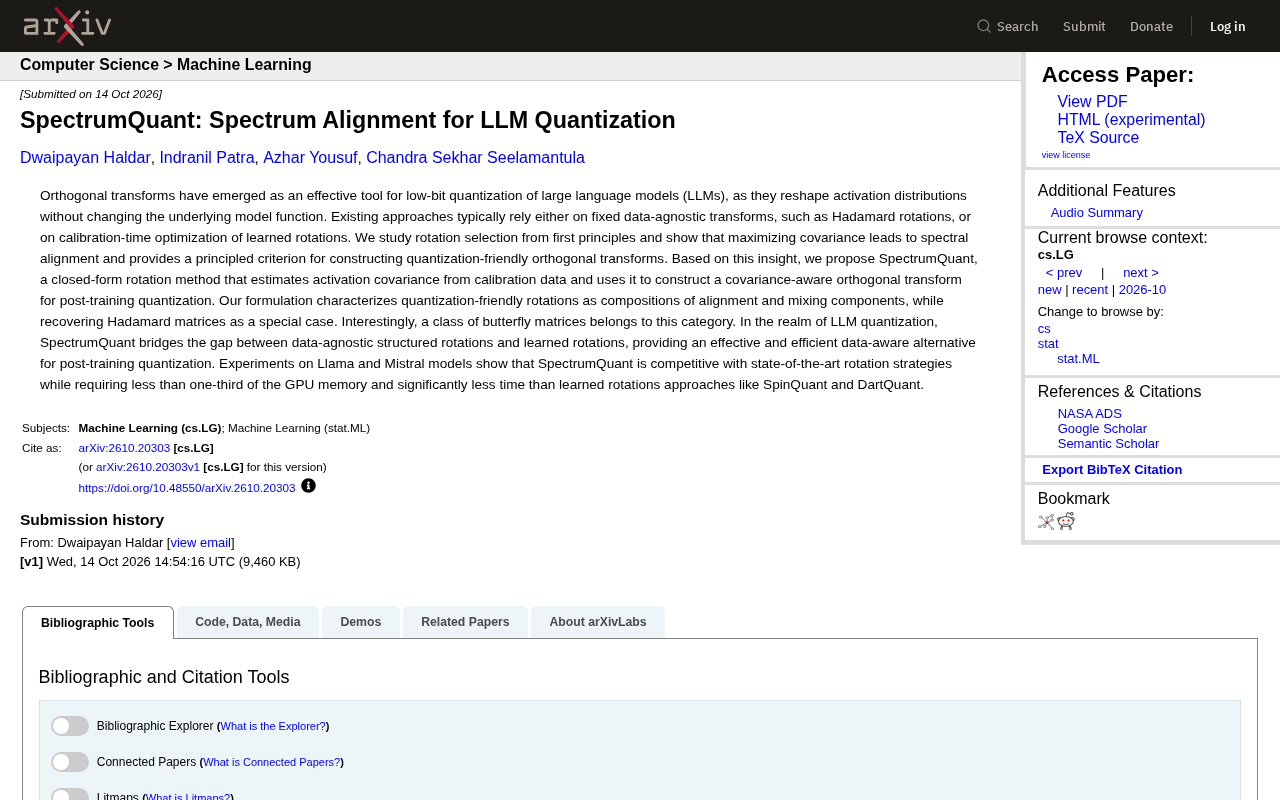
SpectrumQuant tackles error amplification from activation outliers in low-bit LLM quantization with a first-principles closed-form orthogonal transform. It proves maximizing activation covariance equals spectral alignment, providing a theoretical criterion for quantization-friendly rotations, and shows Hadamard and butterfly matrices are special cases. Unlike learning-based rotations like SpinQuant and DartQuant that require iterative optimization, SpectrumQuant estimates activation covariance from calibration data and constructs the rotation matrix in closed form—no gradient descent needed. Experiments on Llama and Mistral show quantization performance on par with SOTA rotations, with GPU memory under one-third that of learning-based methods and significantly less time overhead, filling the gap between data-independent structured and learning-based rotations.
Low-bit quantization of large language models has always been a tough nut to crack in deployment. Outliers in activation distributions can cause enormous errors in simple rounding operations, and orthogonal transforms are regarded as an effective "softening" technique—they don't change the model function itself, but reshape the distribution of activations to make them more quantization-friendly.
Two Approaches, Each with Its Own Cost
Existing orthogonal transform methods roughly fall into two categories. One is data-independent fixed transforms, such as Hadamard rotation, which are computationally simple and require no calibration data, but are not sensitive to the activation distribution of a specific model. The other is rotation matrices learned during the calibration stage, such as SpinQuant and DartQuant, which perform better but require an additional optimization process, incurring non-trivial GPU memory and time overhead.
According to the paper, learning-based rotation methods like SpinQuant and DartQuant require repeated iterative optimization of the rotation matrix before quantization, resulting in high memory usage and long runtimes. This is a considerable burden in practical deployment—especially when you want to quickly complete quantization on limited hardware.
Is there a method that can leverage the information from calibration data without expensive optimization? SpectrumQuant's answer is: use a closed-form solution to construct a covariance-aware orthogonal transform.
From First Principles: Why Covariance Maximization Equals Spectral Alignment
SpectrumQuant's core insight comes from re-examining the problem of rotation selection. Starting from first principles, the authors found that maximizing activation covariance leads to spectral alignment, which provides a principled criterion for constructing quantization-friendly orthogonal transforms.
Put simply, the covariance matrix of activations describes the correlations and energy distribution across dimensions. When outliers are concentrated in a few dimensions, quantization error gets amplified. By constructing an orthogonal transform that matches the covariance structure, energy can be "spread out" across more dimensions, reducing the dynamic range of individual dimensions and making low-bit quantization easier.
This idea is not new, but SpectrumQuant's contribution lies in formalizing it: a quantization-friendly rotation can be decomposed into a combination of an alignment component and a mixing component, and the classic Hadamard matrix happens to be a special case within this framework. More notably, a class of butterfly matrices also falls within this scope—meaning that some existing efficient structures can be incorporated into a unified theoretical explanation.
How SpectrumQuant Works
In terms of implementation, SpectrumQuant estimates the activation covariance from calibration data, then constructs the orthogonal transform in closed form. The entire process requires no gradient descent or iterative optimization, so both memory and time overhead are drastically reduced.
The paper conducted experiments on the Llama and Mistral series of models. Results show that SpectrumQuant's performance is competitive with state-of-the-art rotation strategies, but its GPU memory requirement is less than one-third that of learning-based methods, with significantly less time overhead as well.
This "less than one-third" memory advantage is worth elaborating on. Learning-based rotation methods need to store the gradients of the rotation matrix, optimizer states, and intermediate activations during optimization, whereas SpectrumQuant's closed-form solution directly computes the rotation matrix, eliminating these intermediate overheads. For developers who want to quantize large models on a single GPU, this gap could determine whether a solution is feasible.
In terms of positioning, SpectrumQuant fills the gap between data-independent structured rotations and learning-based rotations—it is both data-aware (using calibration data to estimate covariance) and efficient (closed-form solution, no optimization required).
What It Means for Quantization Practice
If you are working on PTQ deployment for LLMs, SpectrumQuant offers an option worth considering. It doesn't require running a full optimization pipeline like SpinQuant, yet achieves comparable results. For scenarios with limited resources where you still want to leverage calibration data to improve quantization quality, this trade-off is quite attractive.
Of course, the paper has only validated on Llama and Mistral so far, and performance across broader model architectures and quantization configurations remains to be further observed. The theoretical connection between butterfly matrices and the spectral alignment framework also deserves deeper exploration in follow-up work.
From a methodological perspective, SpectrumQuant's value lies not just in a specific rotation construction method, but in providing a theoretical answer to the question of "what makes a good quantization rotation." This first-principles analytical approach may inspire the design of more efficient quantization methods.
One-line Summary
SpectrumQuant uses closed-form solutions to construct covariance-aware orthogonal transforms for efficient low-bit LLM quantization.
Paragraph Summary
SpectrumQuant addresses the problem of error amplification caused by activation outliers in low-bit quantization of large language models by proposing a first-principles-based closed-form orthogonal transform method. The authors prove that maximizing activation covariance is equivalent to spectral alignment, providing a theoretical criterion for quantization-friendly rotations, and reveal that the Hadamard matrix and a class of butterfly matrices are both special cases within this framework. Unlike learning-based rotations such as SpinQuant and DartQuant that require iterative optimization, SpectrumQuant directly estimates activation covariance from calibration data and constructs the rotation matrix in closed form, without gradient descent. Experiments on the Llama and Mistral series show that its quantization performance is on par with current SOTA rotation strategies, while its GPU memory requirement is less than one-third that of learning-based methods and its time overhead is significantly lower, filling the gap between data-independent structured rotations and learning-based rotations.
Related articles

Connecting Dify to WeCom Customer Service: A Plugin-Based Runner in Practice
LangBot 4.11 reduces connecting Dify to WeCom Customer Service to three steps: install the Dify Agent plugin, create an Agent processor, and bind the message.received event route.

Building Daily Healthy Habits with AI Wellness Tools: From Tracking to Personalized Insights
How do AI wellness tools help build daily health habits? This article analyzes small-goal tracking, personalized health insights, and routine embedding logic, using Healnova as an example to discuss the auxiliary role and boundaries of such tools.

Agent Says "Done" But Produces Nothing: Verification Is Not Delivery
Agent says done but produces nothing? This article dissects AI Agents' most common fake-delivery trap: passing off verified existing state as completed work, with three key questions, strong check examples, and creation-ID principles to help developers identify and prevent the "verify-not-produce" problem and build more reliable Agent acceptance workflows.