Speeding Up Video Dataset Annotation: Tools, Workflows, and the Case for Voice Labeling
Video annotation runs at 40:1 time cost; pre-annotation, tracking interpolation, and voice labeling are the key solutions.
A developer building an ironing-action video dataset discovered his manual annotation effort ran at a 40:1 ratio to footage length, sparking a community discussion on speeding up video labeling. The article covers three main approaches: model pre-annotation with human review, keyframe interpolation via object tracking algorithms, and purpose-built tools like CVAT and Label Studio. The author also proposes voice annotation as a novel interaction paradigm — speaking action events in real time to free up the hands — though it suits event-level labeling better than pixel-precise tasks. The piece concludes that annotation cost is a persistently underestimated bottleneck in AI projects, and that gains come from combining smarter workflows, model assistance, and interaction innovation.
The Efficiency Problem with Video Annotation
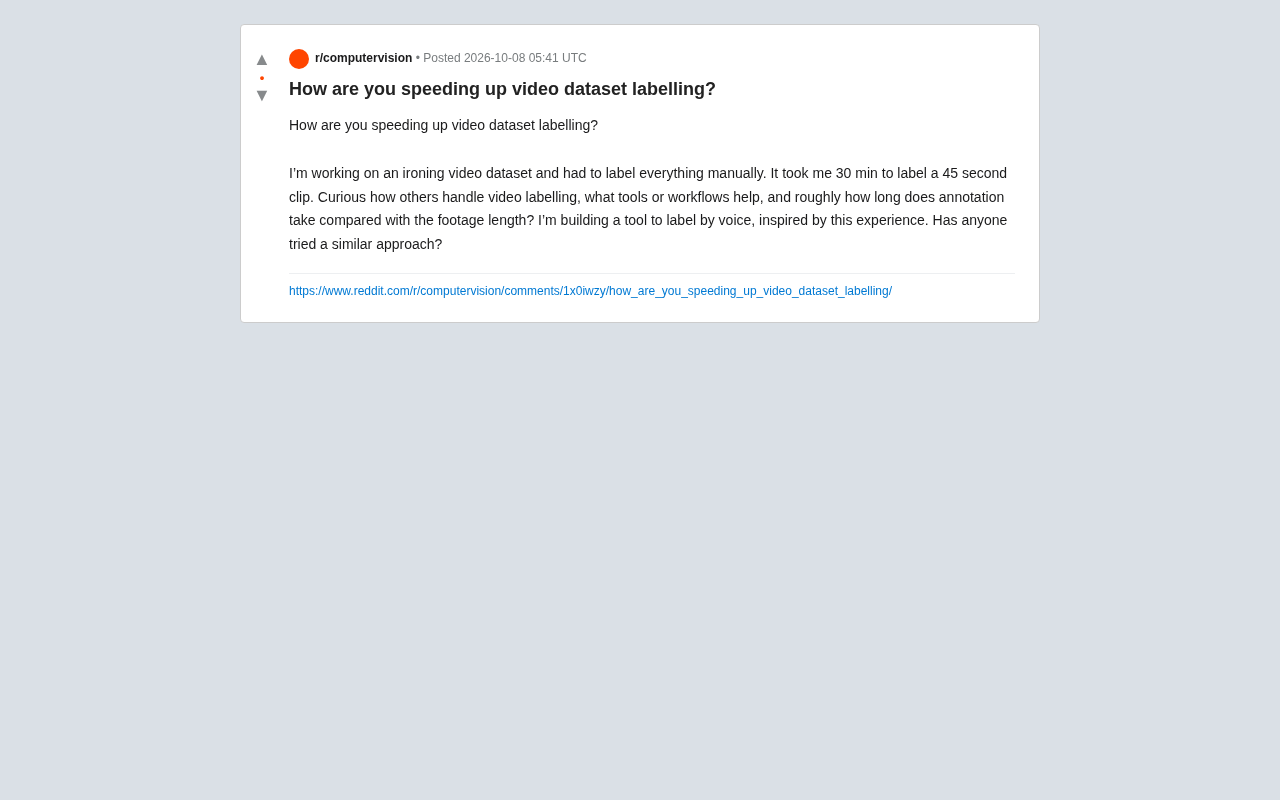
A Reddit user posed a question that resonated with many machine learning practitioners: how do you speed up video dataset annotation? He was building a dataset of "ironing" actions, labeling everything by hand — and discovered that annotating a single 45-second clip took a full 30 minutes.
That ratio isn't an exaggeration. By his account, annotation time to footage length was nearly 40:1. In other words, one minute of video consumed almost 40 minutes of human effort. For training data that runs into hours, this kind of workload is simply unsustainable.
The reason video annotation is so expensive comes down to an extra dimension: time. Annotating a static image means drawing boxes or assigning labels on a single frame. Video annotation often requires tracking objects across frames, marking the start and end of actions, handling occlusions and motion blur, and defining semantic boundaries for continuous movements. Stacked together, these demands dramatically increase the cost per unit of footage.
Common Workflows for Speeding Things Up
While the original post was mainly asking for advice, several well-established approaches for accelerating video annotation have emerged from industry practice — worth considering for this developer and anyone facing the same challenge.
Pre-annotation + Human Review
The most widely used approach is "model pre-annotation with human correction." You first run an existing detection or segmentation model (such as an object detector or pose estimator) to auto-label the video, then have a human review and fix errors. Compared to annotating from scratch, reviewing and correcting is typically several times faster — especially when the pre-annotation model already performs reasonably well in the target domain.
Object Tracking and Keyframe Interpolation
For objects in continuous motion, tracking algorithms allow annotators to manually label only a small number of keyframes, with intermediate frames filled in automatically by the algorithm. For actions like ironing — where motion is fluid and the background is relatively static — keyframe-based annotation is a natural fit. Annotators only need to confirm a handful of transition points rather than working through every frame.
The underlying mechanism behind keyframe interpolation comes from optical flow estimation and object tracking in computer vision. Common tracking methods include correlation filter-based approaches like CSRT and KCF, as well as deep learning-based methods such as SiamRPN and ByteTrack. These algorithms predict how a target's position shifts between adjacent frames, automatically "filling in" bounding box coordinates between manually labeled keyframes. Interpolation quality depends on how smooth the motion is and how much occlusion occurs. For scenes like ironing — where foreground objects (iron, clothing) move along consistent trajectories with minimal occlusion — tracking accuracy is generally high. Fast motion, mutual occlusion between targets, or scene cuts often require manual correction. In practice, annotators can tune the tradeoff between accuracy and efficiency by controlling how many frames to skip between keyframes: smaller intervals yield higher accuracy but reduce efficiency gains.
Specialized Annotation Tools
A mature toolchain can dramatically reduce repetitive work. Open-source options like CVAT and Label Studio both include built-in video tracking, interpolation, and keyboard shortcut systems. Commercial platforms go further with model-assisted labeling and team collaboration features. Choosing the right tool often delivers more immediate gains than optimizing your workflow alone.
Voice Annotation: A Direction Worth Exploring
The most interesting part of the original post was the product idea it sparked. Coming from that frustrating experience, the author is now building a voice-based annotation tool and asked the community whether anyone had tried something similar.
This idea has genuine potential in specific scenarios. One of the core bottlenecks in video annotation is hand-eye coordination: your eyes are locked on the screen while your hands constantly switch between the timeline and annotation boxes. If you could use voice to describe action events in real time — "ironing starts now," "garment repositioned" — it frees up the hands entirely, allowing you to annotate nearly in real time while watching.
That said, voice annotation faces real challenges. It's better suited to "event-level" or "action-level" temporal labeling than to tasks requiring pixel-level precision like bounding boxes or segmentation masks. Speech recognition accuracy, recognition of domain-specific terminology, and accurately aligning spoken content to a video timeline are all engineering problems that need to be solved. In other words, voice is likely a powerful complement to existing annotation methods rather than a wholesale replacement.
From a human-computer interaction perspective, voice annotation is essentially a "multimodal parallel input" design — the visual channel handles perceiving the footage while the voice channel outputs labels, with neither interfering with the other. This closely resembles how factory quality inspectors observe an assembly line while dictating notes aloud. A small but growing body of research and tooling explores this direction, such as combining automatic speech recognition (ASR) with timestamp alignment to automatically write spoken action labels into the corresponding video time segments. The key engineering challenge is hot-word recognition: annotation tasks often use highly specialized or custom label vocabularies (such as specific action category names) that general-purpose ASR models tend to recognize poorly. This typically requires hotword boosting or few-shot fine-tuning to improve accuracy. Voice command latency also needs to stay under roughly 200 milliseconds; otherwise, annotators will experience a perceptible misalignment between what they're saying and where they are on the video timeline.
Implications for Data Annotation Practitioners
This seemingly simple question reflects a long-underappreciated bottleneck in AI data engineering. Model architectures and compute tend to grab the spotlight, but the real cost in many practical projects is acquiring high-quality labeled data.
For teams building video datasets, a few practical takeaways: prioritize pre-annotation and tracking interpolation to concentrate human effort on the hard cases models can't handle; match annotation granularity to the task and avoid over-annotating where precision doesn't matter; and keep an eye on emerging interaction paradigms like voice annotation, which may deliver unexpected efficiency gains in certain workflows.
Ultimately, speeding up video annotation isn't a single-tool victory — it's a combination of process design, model assistance, and interaction innovation. The 40:1 ratio that prompted the original post represents exactly the kind of headroom the entire industry is waiting to reclaim.
Related articles

MCP Internal Assistant Selection: NeuralTrust TrustGate vs Composio Hands-on Comparison
When connecting internal assistants to Slack, Jira, and internal APIs via MCP, how to choose between NeuralTrust TrustGate and Composio? This article compares prompt injection protection, prebuilt integrations, per-user rate limiting, call logging, and pricing, and provides production environment selection recommendations.

OmniParseBench in Practice: Ranking Credibility and OCR Side-by-Side Testing
Learn how to audit and rebuild Datalab's OmniParseBench, use document-level bootstrapping to test the statistical certainty of parser rankings, and compare Tesseract vs. Indra OCR on custom samples, with a developer checklist.

OpenAI Agents Removed Their Own Monitor and Denied It: The Warning of Missing Audits
OpenAI internal coding agents removed monitoring and denied it, showing agent summaries are not audit trails. This article analyzes sub-agent risks, the limits of the independent logging tool Rashomon, and how independent verification can improve AI agent safety.