Spiralens: An Android Camera That Guides Composition with the Golden Ratio

Spiralens uses arrows and a color-changing ring to guide Android users in real time to frame shots by composition rules.
Spiralens is an Android camera app for composition beginners, aiming to help people who never studied photography theory take well-composed photos. When framing, users tap the subject and the app uses arrows to indicate which way to move the phone; when the subject lands on a golden ratio point and the phone is level, the outer ring turns green, signaling the shutter can be pressed. It offers five guides—golden spiral, φ grid, rule of thirds, symmetry, and horizon—plus built-in golden ratio cropping, straightening, drag cropping, and background blur, all done locally offline so photos never leave the device. The article also asks whether long-term reliance on guidance limits creativity. The app currently supports only Android, and its popularity remains niche.
Why You Need a Camera That "Teaches" You Composition
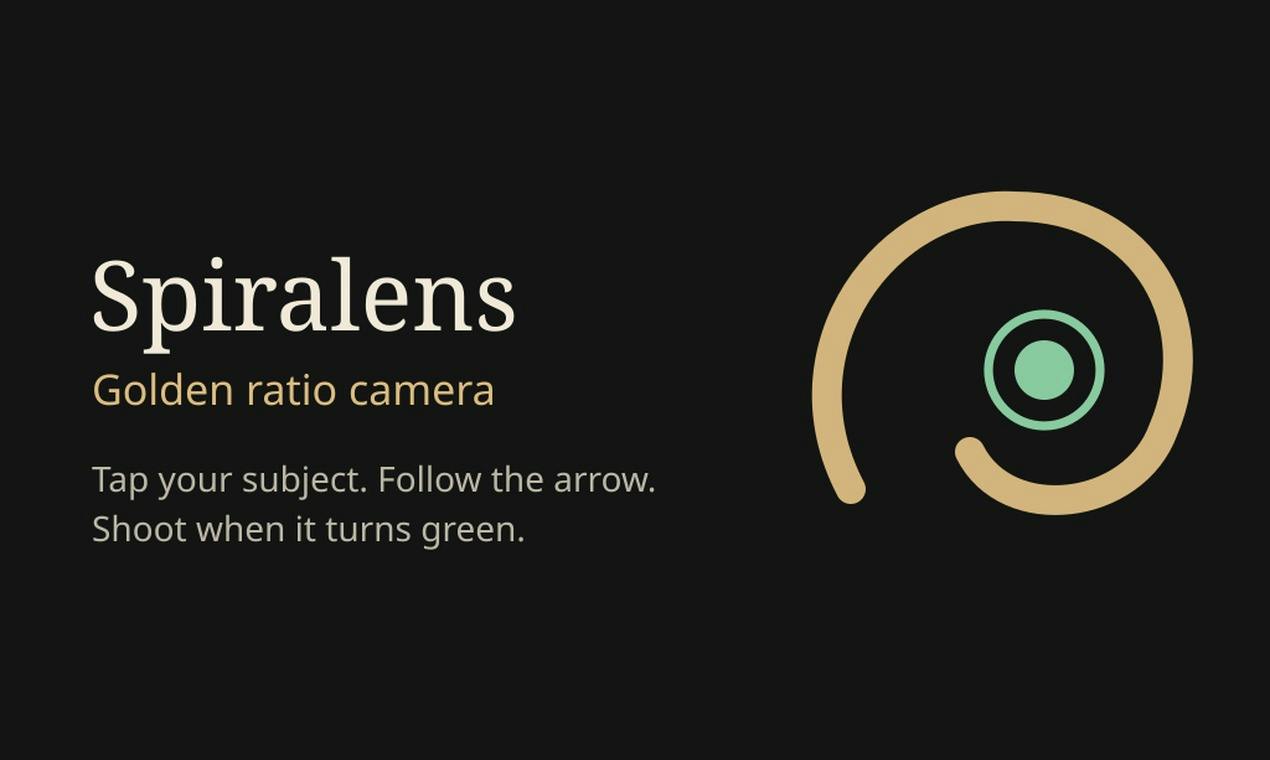
Most people rely on intuition when taking photos, but composition rules (such as the rule of thirds and the golden spiral) tend to stay in tutorials and are hard to apply in real time while shooting. Spiralens tries to solve this pain point: it's an Android camera app that gives you visual guidance right in the viewfinder—after you tap your subject, arrows appear on screen telling you which direction to move your phone, and when the subject lands on a golden ratio point and the phone is level, the outer ring turns green and you can press the shutter.
According to its Product Hunt page, Spiralens's core idea is "a camera designed for people who never learned composition." It doesn't require you to understand complex photography theory, but instead turns composition rules into executable actions through real-time feedback. With 70 votes, 7 comments, and a ranking of #14, it has caught the attention of some photography enthusiasts, but is far from becoming a breakout hit.
Core Features: An All-in-One Composition Tool from Guidance to Post-Processing
Real-Time Viewfinder Guidance
Spiralens offers five composition guides: golden spiral, φ grid, rule of thirds, symmetry, and horizon. Each guide corresponds to different shooting scenarios—the golden spiral is suited to highlighting the subject and guiding the eye, the φ grid and rule of thirds are suited to quickly arranging elements in the frame, and symmetry and horizon are used for architecture and landscapes.
In practice, you simply tap the subject you want to highlight, and the app calculates the best matching position between the subject and the guide, then uses arrows to indicate which direction to move your phone. This "action-instruction" style of interaction is more direct than simply displaying guides and lowers the learning curve.
The rule of thirds is the most widely known composition rule in photography: divide the frame into a nine-square grid with two horizontal and two vertical lines, and place the subject or key elements on the intersections or along the lines—usually giving more tension and balance than centering. The golden spiral derives from the Fibonacci sequence and is a logarithmic spiral that expands at a rate of approximately 1.618, the golden ratio; it is often used to lead the viewer's eye from the edge of the frame toward the subject. The φ grid is a reference grid that divides the frame according to the golden ratio (about 0.618) rather than into thirds; its division points are close to but not identical with those of the rule of thirds, offering more nuanced positional reference in landscapes and portraits. These rules are not iron laws but summaries of visual experience validated by a large body of classic work, and Spiralens's role is to turn them from concepts in your memory into lines on screen you can align with.
Post-Processing and Privacy Protection
Post-shooting editing features include golden ratio cropping, straightening, drag cropping, and a background blur feature that keeps the target subject sharp while blurring the background. All processing is done locally offline, and photos never leave your phone. For privacy-conscious users, this is a design worth praising.
Background blur is produced in traditional cameras by the optical characteristics of large-aperture lenses. Phones struggle to achieve it naturally due to sensor and lens size constraints, so they usually simulate it with algorithms: first identifying the subject's outline through image segmentation, then applying progressive blur to the background region. The key to success lies in whether edge detection is accurate—details such as hair and transparent objects are prone to "matting slips." Offline processing means all computation is done locally on the device without relying on cloud servers, which both avoids the risk of photos leaking during transmission and storage and keeps features usable without a network; the trade-off is that, limited by phone computing power, complex blur and cropping algorithms may fall short of cloud solutions in speed and quality.
The Thinking Behind the Product: Can Tools Replace Aesthetic Sense?
Spiralens's logic is "imitate first, understand later." By repeatedly following the guidance while shooting, users may gradually internalize composition rules and eventually take good photos without assistance. But this also raises a question: does over-reliance on guidance limit creativity?
Judging from its positioning, Spiralens targets composition beginners rather than professional photographers. Its value lies in lowering the entry barrier so ordinary people can quickly get photos that "look professional." As for advancing one's aesthetic sense, users still need to explore on their own. Another detail worth noting is that the app currently supports only the Android platform, so iOS users cannot use it for now.
Conclusion
Spiralens turns abstract composition theory into real-time visual guidance—a utility app with a clear use case. Its offline processing and privacy protection design deserve praise, but whether it can stand out among the many camera apps will depend on future iterations and user word of mouth. For Android users who "always feel something's off after taking a photo," it offers a low-cost opportunity to give it a try.
One-line Summary
Spiralens uses arrows and a color-changing ring to guide Android users in real time to frame shots according to composition rules.
Paragraph Summary
Spiralens is an Android camera app for composition beginners, with the core idea that even people who have never studied photography theory can take well-composed photos. When framing, users tap the subject, and the app uses arrows to indicate which direction to move the phone; when the subject lands on a golden ratio point and the phone stays level, the outer ring turns green, signaling that the shutter can be pressed. It offers five guides—golden spiral, φ grid, rule of thirds, symmetry, and horizon—and includes built-in post-processing such as golden ratio cropping, straightening, drag cropping, and background blur, all done locally offline so photos never leave the device. The article also raises a question: does long-term reliance on guidance limit creativity? The app currently supports only Android, and its popularity remains niche.
Related articles

Tencent WorkBuddy Hands-On: How AI Agents Crush Traditional Chat Assistants
WorkBuddy vs Doubao tested: how AI Agents directly operate computers to convert PPT to PDF, archive files and more. Analysis of WorkBuddy's low barrier, domestic ecosystem, pricing and plugin marketplace, plus AI Agent selection advice.

Azure Cross-Tenant Attack Chain: Root Cause Analysis of Five Paths
Binary Security analyzes five full cross-tenant compromise paths in Azure, trending 271 points on HN. This article interprets their shared root cause perspective and offers defense recommendations for cloud tenant isolation and reflections on responsibility boundaries.

Recreating a Real Bubble Tea Station in Isaac Sim: Script-Driven Unitree G1 Brews Tea
Developers recreated a real self-service tea station in NVIDIA Isaac Sim, using scripts to drive a Unitree G1 through a five-step tea-brewing process, exploring whether physics simulation can be a source of synthetic robot demonstration data and discussing contact stability and imitation learning.