Spotify Launches Its First Native In-Car App, Breaking Free from CarPlay

Spotify releases its first fully native in-car app, running directly on Android Automotive, debuting with Audi.
Spotify has launched its next-generation fully native in-car app, built directly on Google's Android Automotive OS, rolling out on select Audi models starting today without phone pairing, Bluetooth, or cables. This marks Spotify's shift from CarPlay/Android Auto projection to a native in-car experience, reducing latency, deepening system integration, and enabling vehicle sensor access. Choosing Android Automotive over a self-developed system or Apple's ecosystem gives automakers differentiated cockpit entertainment and Spotify more controllable UX and data feedback. However, the debut is limited to Audi with unclear expansion paths; given Android Automotive's much smaller installed base, a dual-track approach is a transitional strategy. The move reflects streaming platforms competing for the native smart cockpit entry point, potentially diluting CarPlay's intermediary value and reinforcing Google's in-car entertainment platform position.
Spotify on Wednesday released its next-generation fully native in-car app, built directly on Google's Android Automotive operating system. This standalone app is rolling out starting today on select Audi models, running directly on the vehicle's infotainment hardware without the need for phone pairing, Bluetooth connection, or auxiliary cables. It is the clearest signal yet that Spotify is trying to move away from reliance on phone projection solutions in the in-car scenario.
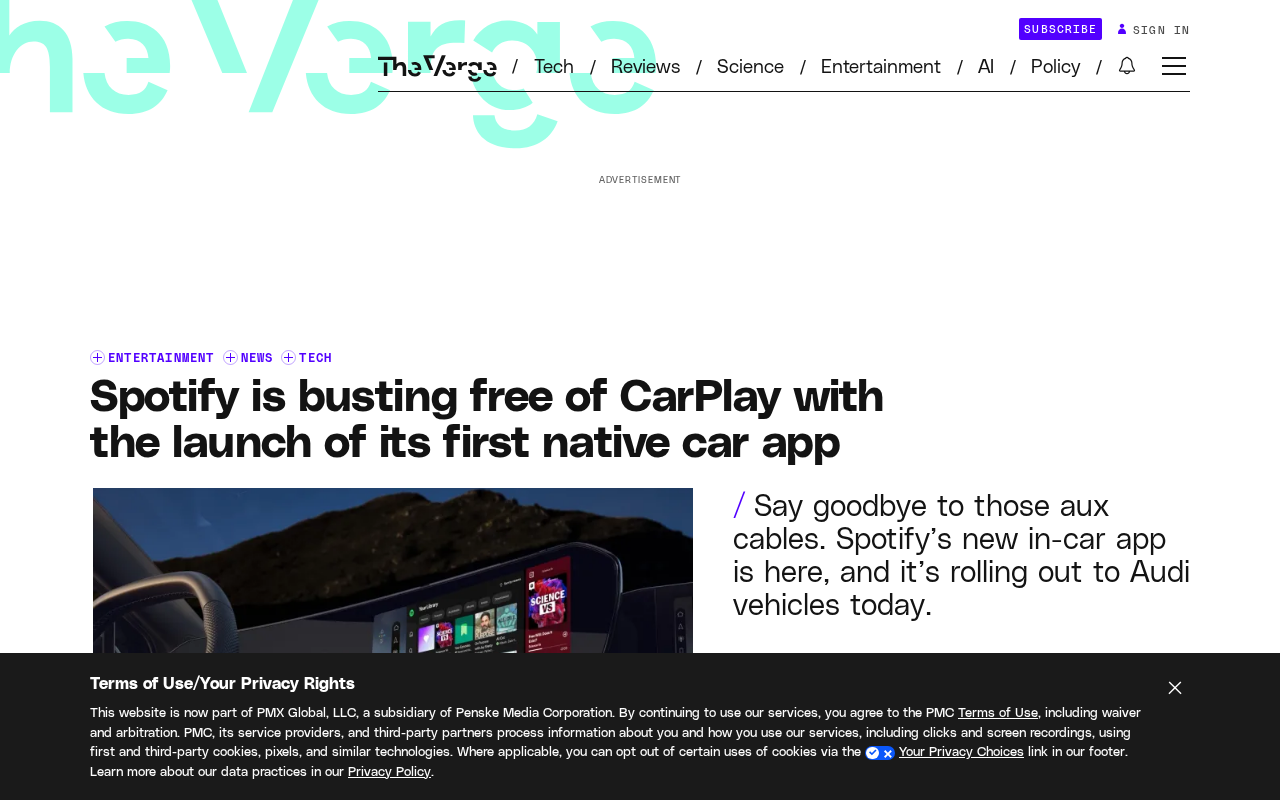
From Projection to Native: Spotify's In-Car Strategy Shift
Over the past few years, Spotify's in-car presence has primarily relied on CarPlay and Android Auto—essentially projecting the phone app onto the vehicle's screen. While this approach is widespread, it is limited by phone performance, connection stability, and simplified interaction in driving scenarios. The newly launched native app runs entirely on the vehicle's hardware, meaning lower latency, deeper system integration, and an independent experience unaffected by phone battery or signal.
In its announcement, Spotify emphasized that the app "eliminates the need for phone pairing, Bluetooth connection, or auxiliary cables." For users who have long endured connection drops or cable clutter, this is a substantial improvement. More importantly, the native app allows Spotify to directly access vehicle sensors and system APIs, opening up possibilities for context-aware recommendations (such as music selection based on driving status or road conditions).
Projection mechanisms of CarPlay and Android Auto: Both use a "phone-driven, vehicle-display" model. CarPlay maps the iPhone interface to the vehicle's screen via Apple's Lightning or USB-C port (or wireless connection), with the iPhone's processor running the app logic; Android Auto similarly relies on an Android phone for computation. The advantage is a mature app ecosystem and fast phone iteration, but the disadvantages are also clear: connection stability is affected by cable quality and wireless interference; phone battery, heat, and performance constrain the experience; and interaction in driving scenarios is simplified to limited templates, making it difficult to deeply leverage vehicle hardware. Native apps directly utilize the vehicle's SoC, memory, and network modules, resulting in lower response latency, and can run persistently in the background, starting with the vehicle. Additionally, native apps can access vehicle CAN bus data (such as speed, steering angle, driving mode) to provide context for context-aware recommendations, while projection solutions cannot directly obtain these signals.
Android Automotive: The Intersection of Automakers and Streaming Platforms
It is worth noting that Spotify chose Android Automotive as its first native landing point, rather than a self-developed system or Apple's ecosystem. Android Automotive is a complete operating system embedded directly in vehicle hardware, not a phone projection solution. Google has been actively promoting this platform in recent years, attracting adoption from multiple automakers including Volvo, Polestar, and General Motors. Spotify's participation adds a high-frequency entertainment entry point to this ecosystem.
From the automaker's perspective, native streaming apps help enhance cockpit experience differentiation; from Spotify's perspective, eliminating the phone intermediary means a more controllable user experience and more direct data feedback. The demands of both sides converge on Android Automotive.
Android Automotive OS (AAOS) is often confused with Android Auto, but the two are architecturally completely different. Android Auto is an app running on a phone, projecting the interface to the vehicle's screen via USB or Wi-Fi—essentially a phone projection solution. Android Automotive OS, on the other hand, is a complete operating system installed directly in the vehicle's infotainment hardware, with independent computing resources, storage, and network connectivity, not dependent on a phone. AAOS is deeply integrated with the vehicle bus, able to access vehicle data such as speed, gear, battery level, and sensors, and supports Google service frameworks (such as Google Assistant, Google Maps, Play Store). Automakers can customize their own user interfaces based on AAOS (such as Volvo's Sensus and GM's Ultium platform), while introducing third-party apps through the Google Play Store. For developers, AAOS provides a standardized Android development environment, but they must follow driving safety regulations (such as the template-based UI of the Car App Library). Spotify's native app leverages this environment to achieve independent operation and vehicle data access.
Audi First, But Expansion Path Unclear
The launch partner is Audi, and the app is rolling out on select Audi models starting today. Spotify did not disclose in the announcement the specific model list, future partner automakers, or whether it plans to support other in-car systems (such as Apple's CarPlay or automakers' self-developed systems). This ambiguity leaves a key question: Is the native app a pilot, or will it gradually cover mainstream models?
Considering that Android Automotive's installed base is still far smaller than CarPlay and Android Auto, Spotify's native strategy is unlikely to fully replace projection solutions in the short term. A more likely path is dual-track parallel operation: providing a native experience on vehicles supporting Android Automotive while retaining CarPlay/Android Auto projection support.
Android Automotive's installed base and ecosystem status: As of 2024, Android Automotive OS has been mass-produced and deployed in select models from brands including Volvo (XC40 Recharge, EX90), Polestar (Polestar 2/3/4), General Motors (Cadillac Lyriq, GMC Hummer EV), Renault, Nissan, and Honda, but global cumulative installations remain in the millions, far below the hundreds of millions of users covered by CarPlay and Android Auto. Google plans to expand AAOS to more automakers and has introduced the "Google built-in" brand identifier. However, automakers have concerns about deep binding to Google's ecosystem, and some manufacturers (such as Ford and Toyota) still insist on self-developed systems or Linux-based solutions. Spotify's entry at this time aims to seize the early native entry point, but short-term user reach is limited; a dual-track approach (native + projection) is a pragmatic strategy.
Industry Impact: Streaming Platforms Compete for the In-Car Entry Point
Spotify's move reflects the growing ambition of streaming platforms in the in-car scenario. As smart cockpits become a focus of competition among automakers, audio content such as music, podcasts, and audiobooks has become the core entertainment format in driving scenarios. Whoever controls the native entry point controls user attention and subscription conversion opportunities.
For Apple, Spotify's move may be a reminder: the value of CarPlay as a projection intermediary may be diluted as the native app ecosystem matures. For Google, Spotify's participation reinforces Android Automotive's position as an in-car entertainment platform. For users, a smoother, more independent in-car music experience is coming, but widespread adoption will take time.
One-line Summary
Spotify releases its first fully native in-car app, running directly on Android Automotive, debuting with Audi.
Paragraph Summary
Spotify has launched its next-generation fully native in-car app, built directly on Google's Android Automotive operating system, rolling out on select Audi models starting today without the need for phone pairing, Bluetooth, or cables. This marks Spotify's shift from relying on CarPlay/Android Auto projection to a native in-car experience, which can reduce latency, deepen system integration, and access vehicle sensors. Choosing Android Automotive over a self-developed system or Apple's ecosystem provides automakers with differentiated cockpit entertainment while giving Spotify a more controllable user experience and data feedback. However, the debut is limited to Audi, with specific models and future expansion paths unclear; given that Android Automotive's installed base is far smaller than projection solutions, a dual-track approach will be a transitional strategy. This move reflects streaming platforms' competition for the native entry point of smart cockpits, potentially diluting CarPlay's intermediary value and reinforcing Google's position as an in-car entertainment platform.
Related articles

Trump's Request to Rename the Atlantic Rejected by Google; 1Password Lets AI Agents Log In Securely
The Vergecast roundup: Trump's request to rename the Atlantic the 'Trump Ocean' was politely declined by Google's CEO; 1Password's new feature lets AI agents log into accounts without touching passwords; OPPO launches the world's first 200-megapixel phone, the Find X10 Pro Max. All three point to the boundaries of tech authorization and trust.

The Truth About American College Party Culture: The Risks Schools Won't Admit
Behind American college party culture, the administration's "don't ask, don't tell" attitude is amplifying freshman risks. This article analyzes how the pandemic strengthened Greek dominance, freshmen's difficulty accessing safety information, and the chain reactions caused by a culture of denial.

OpenAI Reportedly Raising $30B at $1.25T Valuation Ahead of IPO
OpenAI is planning a $30B funding round at a possible $1.25T valuation, paving the way for an IPO. If completed, it would set a private company valuation record. This article analyzes the funding size, pre-IPO logic, and industry signals.