Spring AI Alibaba Graph in Practice: A Deep Dive into a Full-Process HR Recruitment Agent

Using the full HR recruitment process as an example to demonstrate the design and deployment of Workflow-style enterprise-level Agents
The article centers on Bilibili creator Xu Shu's tutorial, introducing an HR recruitment Agent built on Spring AI Alibaba Graph. It points out that general conversational applications are saturated, while Agent projects embedding into vertical industry workflows are scarcer and more distinctive on resumes. The HR recruitment chain has clear steps and definable rules, making it a typical deployment scenario. Technically adopting the Workflow paradigm with programmer-predefined execution paths, the article breaks down the complete process from resume parsing, screening and scoring, interview question generation, human intervention, answer scoring, multi-round interviews, to offer issuance, highlighting breakpoint resume and state rollback as two key mechanisms, and connecting 20 technical points into a reusable industry template.
Why Is HR Recruitment the Perfect Scenario for Agent Deployment?
Bilibili creator Xu Shu opens this tutorial with a pointed question: is writing "intelligent customer service RAG" on your resume already a cliché? This isn't fear-mongering—it highlights a reality in current AI application development: general-purpose conversational applications are fiercely competitive, while what's genuinely scarce are Agent projects that embed into vertical industry workflows and solve specific repetitive labor.
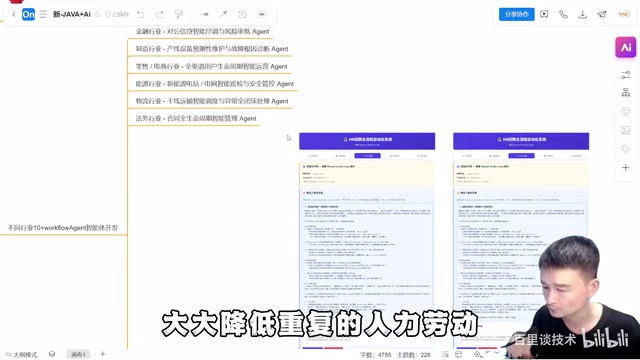
HR recruitment fits this perfectly: from resume submission, parsing, initial screening, scoring, to interview question generation, scoring, multi-round interview scheduling, and offer issuance—the entire chain has clear steps and definable rules, while still requiring flexible adjustment based on candidate situations. According to Xu Shu's assessment in the video, Workflow-style Agent applications currently represent the largest demand among enterprise-level Agent scenarios, because almost every industry has numerous repetitive processes—finance and manufacturing especially so. Writing such a project into your resume gives you far more distinction than a cookie-cutter customer service bot.
The Workflow Paradigm: Trading Controllability for Enterprise-Grade Deployment
The technical foundation of this system is Spring AI Alibaba Graph, adopting a Workflow-style design approach. The so-called Workflow paradigm means that programmers pre-define the overall execution path, and AI exercises flexibility within the established track. This contrasts with Autonomous Agents that let large models freely plan the next step: the latter is more flexible but uncontrollable, while the former sacrifices some autonomy in exchange for process determinism and auditability.
Xu Shu emphasizes in the video that it is precisely this combination of "controllability + flexibility" that makes the Workflow paradigm the mainstream choice for enterprise vertical Agents. What enterprises need isn't wild, unconstrained conversation, but an automated pipeline where every step is predictable, intervenable, and traceable. The graph-structured orchestration capabilities provided by Spring AI Alibaba Graph precisely match this requirement.
Full Process Breakdown: From Resume Submission to Offer Issuance
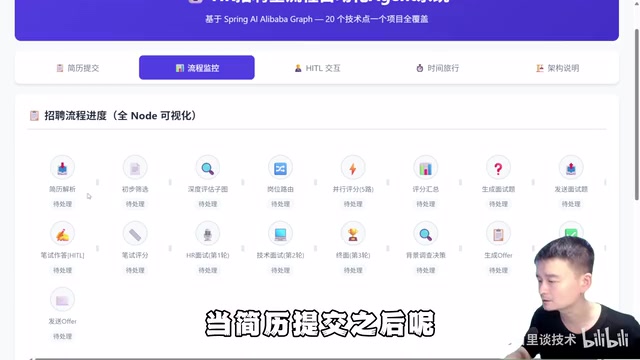
The entire HR recruitment Agent process can be broken down into several key stages, each corresponding to a node in the Graph.
Resume Parsing and Initial Screening Scoring
After a candidate submits their resume, the system automatically parses it, extracting basic information such as years of work experience and age, and determines whether the basic thresholds for the position are met. After passing initial screening, the system scores the candidate based on job requirements, with scoring dimensions including technical ability and project experience, and generates differentiated evaluation criteria based on the candidate's level—junior, mid-level, or senior programmer.
Interview Question Generation and Human Intervention
After scoring is complete, the system automatically generates interview questions based on the candidate's level and sends them to the applicant. At this point the process pauses, waiting for the applicant to submit answers. Xu Shu specifically highlights this mechanism as human intervention or breakpoint resume: not all Agent application processes can run fully automatically—many times human intervention is needed to continue. The "human" at this step is the applicant—only after receiving answers does the process move forward.
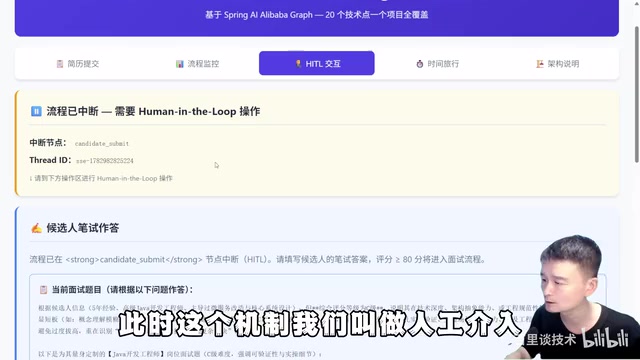
Breakpoint resume relies on two things in engineering terms: persisted execution state and recoverable process instances. When the process reaches a node requiring external input, the framework serializes and saves the current graph state (which node has been executed, what data has accumulated in the shared context) and suspends that process instance; when an external event—here, the applicant submitting answers—is triggered, the system continues traversing from the breakpoint based on the saved state. This means the Agent's "pause" is not simple blocking wait, but can resume across requests, across sessions, and even across service restarts. For enterprises, this mechanism allows long-cycle, multi-participant business processes to be carried by Agents without worrying about process interruptions wasting prior work.
Answer Scoring and Multi-Round Interviews
After receiving answers, the system scores the responses, then proceeds to offline first-round, second-round, and third-round interviews. Each interview round's results can likewise be submitted manually, and the process continues. Finally, if the candidate meets requirements, the system generates an Offer and sends it to the applicant.
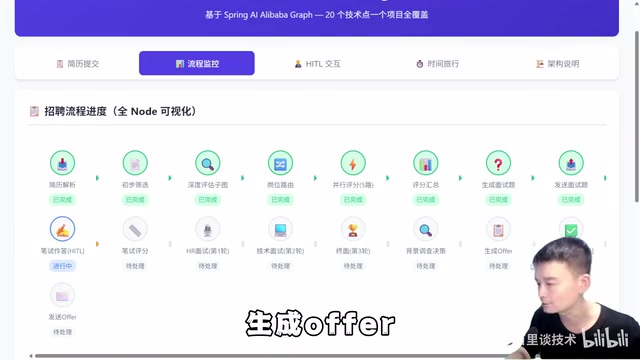
Nodes are the basic execution units in the graph structure, each encapsulating a specific piece of business logic or a model invocation—for example, "resume parsing," "scoring," and "interview question generation" each correspond to a node. Nodes are connected via Edges, which define the direction of control flow: regular edges represent fixed transitions, while conditional edges dynamically select the next node based on node output—this is precisely how Workflow retains flexibility within an established track. In Spring AI Alibaba Graph, the entire Agent is modeled as a directed graph, and at runtime the framework traverses nodes in topological order, passing shared state. Understanding the division of labor between "what nodes are responsible for" and "what edges determine about where to go next" is the prerequisite for understanding the subsequent breakdown of each stage and the state rollback mechanism.
State Rollback: The "Undo Button" for Agent Processes
Beyond the forward process, this system also implements time travel, i.e., state rollback. When the process is halfway through and you want to re-execute from a certain node, you can accomplish this through state rollback. This capability has high value in real business: interviewers may want to re-evaluate a candidate, or a node's scoring criteria may need adjustment—the rollback mechanism lets the process avoid starting over from scratch. For developers learning Spring AI Alibaba Graph, understanding state management and graph traversal is key to mastering this framework.
Time Travel is an advanced form of state management capability in graph orchestration frameworks: since each node execution leaves a snapshot in the state history, the framework can locate any historical node by version number and re-execute subsequent processes starting from that snapshot, forming a new execution branch. Its difference from breakpoint resume lies in direction—breakpoint resume is "forward recovery," while time travel is "going back and re-walking." Implementation typically requires the framework to maintain a checkpoint list and ensure node logic idempotency, otherwise replay may produce duplicate side effects (such as sending duplicate emails). This is also an engineering constraint that must be noted when using state rollback.
Technical Coverage and Learning Path
According to Xu Shu, the entire project involves 20 technical points of Spring AI Alibaba Graph, connected through one complete project. This "project-driven technical points" approach is more efficient than reading documentation in isolation. For engineers who want to quickly get up to speed with enterprise-level Agent development, this tutorial provides a reusable template: change the industry, change the business rules, and the Workflow skeleton still holds.
Viewers who need project notes and code can leave comments below the video to obtain them.
One-line Summary
Using the full HR recruitment process as an example, demonstrating the design and deployment of Workflow-style enterprise-level Agents
Paragraph Summary
The article centers on Bilibili creator Xu Shu's tutorial, introducing an HR recruitment Agent built on Spring AI Alibaba Graph. The author first points out that general-purpose conversational applications have become saturated, while Agent projects that embed into vertical industry workflows and solve repetitive labor have greater scarcity and resume distinction. The HR recruitment chain has clear steps and definable rules, making it a typical deployment scenario. Technically, it adopts the Workflow paradigm, with programmers pre-defining execution paths, trading controllability for enterprise-grade determinism. The article breaks down the complete process from resume parsing, initial screening scoring, interview question generation, human intervention, answer scoring, multi-round interviews, to offer issuance, and emphasizes two key mechanisms—breakpoint resume and state rollback—ultimately connecting 20 technical points into a reusable industry template.
Related articles

Gemini 4 Neon Leak: A Potential Strong Contender Against Opus 5.5
A Hacker News thread suggests Gemini 4 Neon looks like an Opus 5.5 competitor. This article unpacks the product positioning behind this community signal, shifts in the top-model competitive landscape, and what it means for developers' model selection strategy.

Claude Fable 5.2's Self-Authored Short Film 'Fable' Sparks Discussion
A short film 'Fable,' credited to Claude Fable 5.2 for script, visuals, and directing, appears on Hacker News. This article analyzes the significance of full-pipeline AI creation, community reactions, and what it means for content creators.

Anthropic IPO Pricing: A Signal of AI Giants Going Public
Anthropic's IPO pricing draws attention. This article analyzes its potential impact on AI industry valuation, commercialization paths, and the competitive landscape, and highlights public-market expectations and challenges for AI companies.