Spring AI Alibaba Graph in Practice: Building a Full-Process HR Recruitment Agent

How to build a controllable, full-process HR recruitment Agent using Spring AI Alibaba Graph.
This article explains how to build a full-process HR recruitment Workflow Agent with Spring AI Alibaba Graph. It covers resume parsing, multi-dimensional screening, tiered interview questions, human-in-the-loop breakpoint resumption, and state rollback—showing Java developers how to create production-grade enterprise Agents.
Why Workflow-Style Agents Are an Enterprise Necessity
While most AI job seekers' resumes are still crammed with homogeneous projects like "intelligent customer service" and "RAG Q&A," the capabilities that enterprises truly need for vertical scenarios are often overlooked—namely, Agent application development based on the Workflow paradigm.
According to a tutorial shared by Bilibili content creator Xu Shu, the core idea of the Workflow paradigm is this: programmers pre-define the Agent's overall execution path, thereby ensuring the AI application's controllability while preserving the AI's flexibility in specific steps. This stands in sharp contrast to Autonomous Agents that let large models make decisions entirely on their own.
To truly understand why the Workflow paradigm has become an enterprise necessity, we first need to clarify the two major paradigm divisions in current Agent architectures. Autonomous Agents, represented by AutoGPT and BabyAGI, are built around letting large models autonomously plan, decompose tasks, and loop through tool calls based on goals. In theory they offer extremely high flexibility, but in real production they often face problems such as unpredictable paths, uncontrolled token consumption, and amplified error accumulation—making it difficult to meet enterprise requirements for deterministic outcomes. The Workflow paradigm, on the other hand, has developers draw out the execution directed acyclic graph (DAG) in advance, with the large model exercising its reasoning and generation capabilities only within clearly defined nodes. This "intelligence on rails" avoids the business risks caused by the model running wild, while retaining its strengths in areas like text comprehension and content generation. Mainstream industry platforms such as LangGraph, Dify, and Coze are all essentially converging toward Workflow orchestration—precisely because enterprises place greater value on controllability, auditability, and reproducibility.
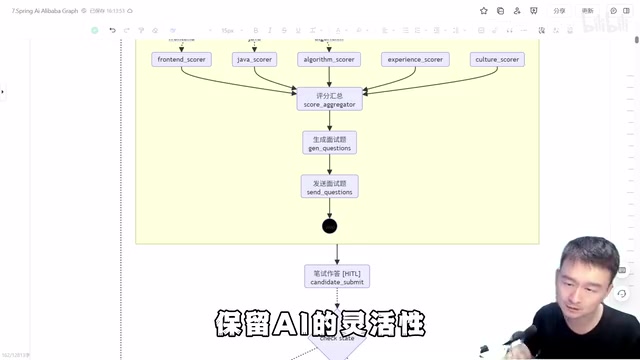
The reason this is the scenario with the greatest demand for enterprise-level Agents is straightforward: almost every industry—whether finance, manufacturing, or human resources—has large amounts of repetitive, process-driven work. In the past, these steps required substantial manpower to perform repeatedly, but now they can be fully automated through Agent orchestration, drastically reducing the cost of repetitive labor. For job seekers, mastering this kind of project is far more competitive than stacking up AI customer service demos.
The Full-Process HR Recruitment Agent: A Transferable Universal Paradigm
This project uses the "Full-Process HR Recruitment Agent" as its vehicle, and its value lies in the fact that it is not limited to the HR industry—it is an automation process paradigm that can be transferred to any industry.
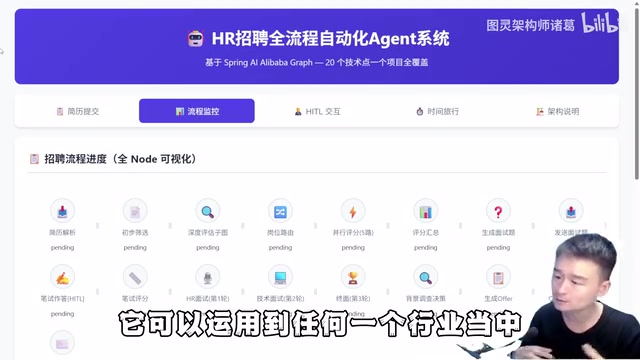
Its goal is to free HR professionals from tedious, repetitive tasks like resume screening and interview scheduling, allowing them to focus on more valuable judgment and decision-making. The complete automation pipeline includes the following key stages.
Resume Submission and Automatic Parsing
The process begins when a job seeker submits a resume, after which the system automatically completes resume parsing and extracts key structured information.
Automatic resume parsing may seem simple, but it is in fact one of the technical challenges of the entire pipeline. Resume formats in real-world scenarios are extremely chaotic—PDFs, Word documents, and scanned images coexist; layouts vary between single-column, double-column, and table formats; and languages are mixed between Chinese and English. Traditional parsing relies on regex matching and rule templates, which easily fail when faced with non-standard formats. LLM-based parsing solutions, by contrast, leverage the powerful semantic understanding capabilities of LLMs together with structured output constraints (such as Function Calling or JSON Schema) to directly map unstructured text into standardized data containing fields like name, years of experience, skill tags, and project history. This step forms the data foundation for all subsequent screening and scoring stages, and its accuracy directly determines the usability of the entire Agent. Therefore, engineering practice usually also introduces field validation and confidence assessment mechanisms.
Multi-Dimensional Progressive Screening
After parsing is complete, the Agent screens candidates layer by layer according to hard criteria such as years of experience and age, quickly filtering out those who do not meet basic requirements and avoiding the inefficiency of manually reviewing each resume.
Position Matching, Scoring, and Grading
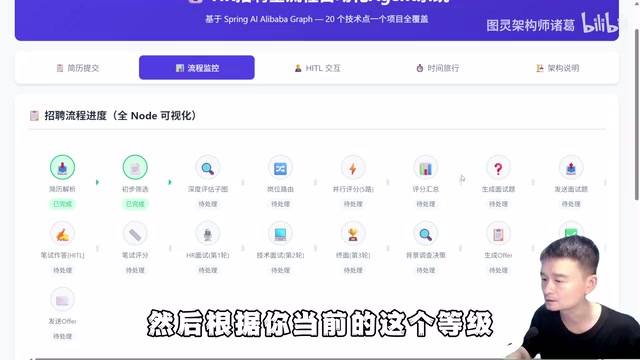
Resumes that pass the initial screening are scored for matching against the current recruitment position, giving a comprehensive evaluation across dimensions such as technical ability and project experience. Based on this, the system determines whether the candidate is a junior, mid-level, or senior programmer.
Tiered Interview Question Generation
The system dynamically generates interview questions of corresponding difficulty based on the candidate's level and sends them to the job seeker. This step fully demonstrates the flexibility of AI within a Workflow—the same process node produces differentiated content for candidates at different levels.
Human Intervention and State Rollback: The Key to Agent Controllability
A common misconception in Agent applications is that all processes should be fully automated. In fact, in real enterprise scenarios, many critical nodes precisely require human intervention.
Breakpoint Resumption (Human-in-the-loop)
After the interview questions are sent, the process actively pauses and waits for the job seeker to submit answers before continuing with subsequent steps. This mechanism is called human intervention or breakpoint resumption. It ensures that at stages requiring human judgment or input, the Agent does not blindly advance but instead suspends and waits for an external signal.
Breakpoint resumption (Human-in-the-loop, HITL) is conceptually intuitive, but its engineering implementation is far from as simple as merely pausing. When the process suspends at the "waiting for candidate to answer" node, it might be minutes or even days, and the service cannot possibly occupy memory waiting the entire time. Therefore, the framework must serialize and persist the complete current execution state (including processed data, the next node to point to, context variables, etc.) to a database or cache. When an external signal (such as a callback for answer submission) arrives, it then restores the state from the persistence layer and continues execution. This is essentially an "interruptible, resumable" stateful computation model, fundamentally different from traditional stateless HTTP request handling. Spring AI Alibaba Graph solves this problem through a built-in Checkpoint mechanism, and it is precisely this persistence capability that also supports the state rollback feature mentioned later.
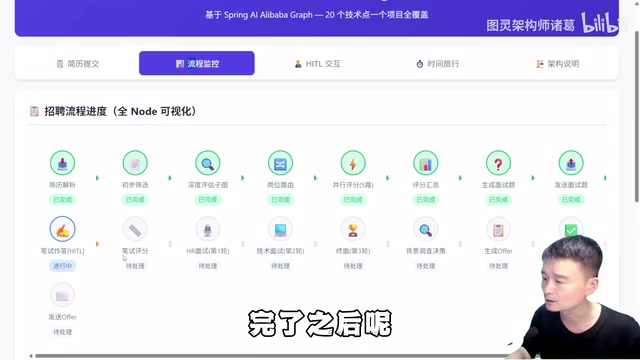
Subsequent stages such as answer scoring and recording the results of offline first, second, and third interviews likewise support human submission of interview results. Ultimately, the system automatically generates and sends offers to candidates who meet the requirements. The entire pipeline strikes a balance between automation and human decision-making.
Time Travel: State Rollback Capability
The project also implements the engineering-valuable "Time Travel" feature, namely state rollback. When the process is midway through execution and certain steps need to be undone, you can specify that execution restarts from a particular historical node. This capability is extremely important for debugging complex Agents and correcting erroneous decision paths, and it is one of the core features of the Spring AI Alibaba Graph framework.
Tech Stack: An Analysis of the Spring AI Alibaba Graph Framework
The entire project is built on Spring AI Alibaba Graph. According to the tutorial, it links together around 20 technical points, helping developers quickly master Agent application development under this framework through a complete project.
Spring AI Alibaba is an AI application development framework launched by Alibaba for the Java ecosystem, and the Graph module is specifically designed for orchestrating multi-node, stateful Agent workflows. It is naturally suited to the needs of the Workflow paradigm:
- Node orchestration: Define steps such as resume parsing, screening, scoring, and question generation as nodes in the graph
- State management: Pass and persist process state between nodes, supporting breakpoint resumption and rollback
- Human intervention support: Actively suspend at nodes requiring external input
For a long time, AI application development has been almost exclusively Python's domain, with mainstream frameworks like LangChain and LlamaIndex all Python-centric. This has left Java developers—who occupy half of the enterprise backend landscape—in an awkward position. Spring AI is precisely the framework the Spring team officially launched to fill this gap. It draws on Spring's consistent abstraction design philosophy, encapsulating capabilities such as large model invocation, vector storage, prompt management, and tool calling into APIs that align with Java developers' habits. Spring AI Alibaba is Alibaba's enhanced version, built on Spring AI and deeply integrating domestic models like Qwen and the Alibaba Cloud ecosystem. Its Graph module benchmarks against LangGraph, providing graph orchestration and state machine capabilities. For enterprises with substantial existing Java microservice investments, adopting Spring AI Alibaba means AI capabilities can be seamlessly embedded into their existing Spring Boot tech stack, reusing mature monitoring, transaction, and security systems—without having to separately maintain a Python service and operations pipeline for AI.
For developers with a Java background, this framework lowers the barrier to transitioning from traditional backend development to AI application development, enabling the construction of production-grade Agents without fully switching to the Python ecosystem.
Final Thoughts
The value of this course lies not only in the technical implementation itself, but more importantly in the way of thinking it provides: how to break down repetitive industry processes into orchestrable, controllable, and traceable Agent workflows.
For developers who want their resumes to reflect real enterprise-level AI capabilities, a complete Workflow Agent featuring human intervention, state rollback, and multi-dimensional scoring is far more convincing than yet another "intelligent customer service demo." Mastering frameworks like Spring AI Alibaba Graph is a practical starting point for breaking into the enterprise vertical Agent field.
Key Takeaways
Related articles

The Truth Behind Codex 'Build a Website in 5 Minutes': AI Isn't Creating Sites—It's Helping You Copy Them
Exposing the truth behind viral Codex 5-minute website videos: creators aren't building original sites with AI—they're copying shared prompts or scraping others' work. Learn AI coding tools' real limits.

Getting Started with AI Agent Development: A Complete Guide from Concept to Practice
A comprehensive guide to AI Agent architecture and development, covering automated marketing, intelligent customer service, and investment analysis scenarios with single and multi-agent collaboration.

The Truth Behind Codex 'Build a Website in 5 Minutes': AI Isn't Creating Sites — It's Helping You Copy Them
Exposing the truth behind viral Codex 5-minute website videos: creators aren't building original sites with AI — they're copying shared prompts or scraping others' work.