Spring AI Alibaba: The Core Framework for Integrating LLMs into Java Applications

Spring AI Alibaba bridges Java microservices and large models, just as JDBC once bridged Java and databases.
Spring AI Alibaba is an enterprise-grade Java AI development framework that acts as the intermediary layer between Java microservices and large language models — much like JDBC does for databases. Built on top of Spring AI by Alibaba Cloud, it provides unified abstractions for LLM calls, RAG pipelines, and vector storage, enabling Java engineers to integrate AI capabilities into existing distributed systems with minimal learning curve and code changes.
Why Java Developers Should Pay Attention to Spring AI Alibaba
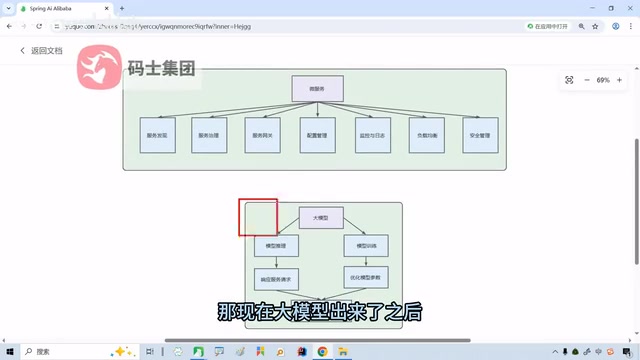
Before large language models (LLMs) matured into production-ready technology, Java engineers and AI engineers lived in almost entirely separate worlds. Developers building microservices spent their days working with Redis, MySQL, and Spring Cloud Alibaba's distributed architecture stack. AI engineers, on the other hand, focused on model training, fine-tuning, and deployment. The two technical paths rarely intersected.
But as LLMs move from research into real-world applications, a practical challenge has emerged for every Java developer: How do you integrate large model capabilities into a familiar Java microservices architecture? This is precisely why frameworks like Spring AI Alibaba exist.
Understanding Spring AI Alibaba Through the JDBC Analogy
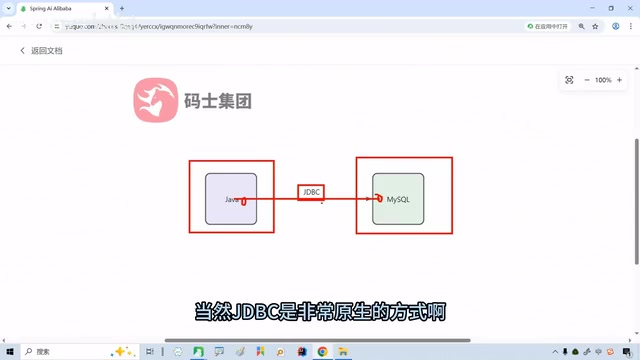
The clearest way to understand Spring AI Alibaba's role is to revisit a scenario every Java developer knows well — database access.
Java and Databases: Two Independent Technologies Bridged by JDBC
Java and MySQL are fundamentally two separate technology stacks with no built-in awareness of each other. The reason Java applications can interact with databases at all is because of a bridge in the middle — JDBC. If JDBC feels too verbose, you can use MyBatis instead, but the underlying logic is the same: you need an intermediary layer to connect "Java" and "the database," otherwise the two simply cannot communicate.
It's worth noting that JDBC was released in 1997 with JDK 1.1, and its core design philosophy was "programming to interfaces" — defining unified abstract interfaces (Connection, Statement, ResultSet) that each database vendor (MySQL, Oracle, PostgreSQL) implements through their own drivers. This allows Java developers to remain agnostic about the underlying database. That principle of "coding against abstractions, not implementations" was later carried forward by MyBatis, Hibernate, and Spring Data JPA. Spring AI Alibaba follows the exact same design philosophy: it defines unified abstract interfaces like ChatClient and EmbeddingModel to shield developers from the API differences between Qwen, OpenAI, ERNIE Bot, and other LLMs — so switching the underlying model requires virtually no changes to business code.
The AI Era Needs the Same Kind of Bridge
Shift the perspective to the AI domain, and the logic is identical. Java microservices are one technology stack; large models are another. They're naturally independent and have no built-in way to communicate. Enabling a Java application to call LLM capabilities requires the same kind of bridge.
LangChain4j, Spring AI, and Spring AI Alibaba are exactly these kinds of frameworks — they play the same role in the AI era that JDBC played in the database era: they pave the road between Java and large models.
These three frameworks have distinct origins. LangChain4j is a Java port of Python's LangChain framework, born in early 2023 with the goal of bringing chain-of-thought, Agent, and tool-calling concepts to the Java world. Spring AI is led by the official Spring team and aligns closely with Spring Boot's auto-configuration and dependency injection model. Spring AI Alibaba is Alibaba Cloud's enterprise-grade extension built on top of Spring AI, with deep integration of the Qwen model family and the Alibaba Cloud Bailian platform, purpose-built optimizations for enterprise deployment scenarios in China, and enhanced interoperability with the Spring Cloud Alibaba microservices ecosystem (Nacos, Sentinel).
Spring AI Alibaba's Core Identity: An Enterprise-Grade Java AI Development Framework
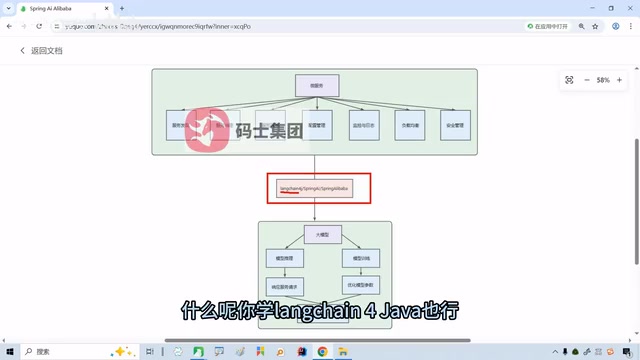
Whether you choose LangChain4j, Spring AI, or Spring AI Alibaba, their core responsibility is the same: acting as an intermediary layer between Java applications and large models, encapsulating the complex details of LLM invocation and exposing interfaces that feel native to the Spring ecosystem.
To put it precisely, Spring AI Alibaba is an enterprise-grade Java AI application development framework. Its value isn't in turning you into a model training expert — it's in letting Java engineers integrate large models into business systems quickly, from a familiar technical foundation, with minimal learning overhead.
In enterprise AI deployments, simply calling an LLM API is rarely enough. Large models have a knowledge cutoff date and have no awareness of a company's internal data. RAG (Retrieval-Augmented Generation) has therefore become a standard pattern: enterprise documents are chunked and converted into vector embeddings via an embedding model, then stored in a vector database (such as Alibaba Cloud Vector Search, Milvus, or Redis Vector). When a user asks a question, relevant document chunks are retrieved first and injected as context into the prompt before it's sent to the LLM — enabling accurate, grounded responses. Spring AI Alibaba provides out-of-the-box abstractions for the full RAG pipeline, including DocumentReader, TextSplitter, and VectorStore components, so Java developers don't have to manually wire together complex retrieval logic.
Injecting AI Capabilities into Traditional Java Microservices
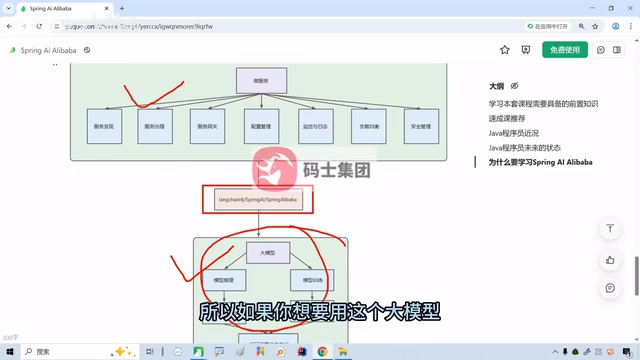
For the vast number of mature Java microservice systems already in production, large models represent a valuable opportunity for capability upgrades. With Spring AI Alibaba, developers can seamlessly inject intelligent Q&A, content generation, semantic understanding, and smart decision-making capabilities into existing distributed architectures — delivering genuine AI empowerment for legacy business systems.
In practice, this integration typically follows one of three progressive approaches. The first is the "AI Gateway" pattern: integrating LLMs at the existing API gateway layer to enable intelligent routing and semantic rate limiting. The second is the "AI Microservice" pattern: packaging capabilities like intelligent Q&A or document parsing into standalone Spring Boot services that communicate with existing systems via RPC or HTTP. The third is the "Embedded AI Capability" pattern: injecting a ChatClient Bean directly into existing business Service layers and using annotation-driven invocation to call LLMs — the approach with the smallest footprint on existing code. All three patterns have mature starter support; at minimum, adding a single Maven dependency is enough to complete a basic integration.
The advantages of this approach are clear: there's no need to tear down existing architecture, no need to pivot into studying model training and deployment internals, and costs and timelines remain manageable. This is the fundamental reason more and more Java developers are turning to Spring AI Alibaba — it represents the smoothest path from traditional backend development into AI application development.
Summary
JDBC connected Java to databases. Spring AI Alibaba connects Java to large models. For Java engineers who want to stay competitive in the AI era, mastering this kind of framework means being able to inject genuinely useful intelligence into existing systems — using the tech stack you already know, with minimal migration cost.
Key Takeaways
Related articles

SeaTicket: An AI Agent That Automatically Resolves GitHub and Discord Issues
SeaTicket is an AI Agent that automatically resolves GitHub Issues and Discord questions. This article analyzes its architecture, use cases, challenges, and value for open-source maintenance.

Breaking Through CI/CD Storage Bottlenecks: Why Senior Engineers Are Returning to the Storage Domain
Exploring overlooked storage and caching bottlenecks in CI/CD pipelines, how Blacksmith redesigns storage architecture to accelerate builds, and why storage is a rebirth opportunity in cloud-native.

SeaTicket: An AI Agent That Automatically Resolves GitHub and Discord Issues
SeaTicket is an AI Agent that automatically resolves GitHub Issues and Discord questions. This article analyzes its architecture, use cases, challenges, and value for open-source maintenance.