Spring AI Explained: Unified API, RAG, and Enterprise AI Development Practical Guide

A comprehensive guide to Spring AI's unified API, RAG capabilities, and enterprise AI development for Java developers.
This guide explores Spring AI, the official Spring framework for AI engineering, covering its provider-agnostic unified API abstraction (similar to JDBC for databases), comprehensive RAG support with vector databases, structured output with POJO mapping, and seamless integration with the Spring ecosystem. It helps Java developers build enterprise-grade AI applications efficiently.
What is Spring AI
Spring AI is an AI engineering application framework officially released by Spring, currently iterated to version 2.0. As a native member of the Spring ecosystem, its greatest advantage lies in seamless integration with the entire Spring system—developers don't need to abandon their existing Spring Boot foundation to build AI-native applications in a familiar way.
Spring AI's core design philosophy brings mature design elements from the Spring ecosystem—consistency, modularity, POJO-first approach, and auto-configuration—into the AI domain. It's worth elaborating here: Spring ecosystem consistency refers to the entire Spring family (Spring Boot, Spring Data, Spring Security, Spring Cloud, etc.) sharing a unified programming model, configuration approach, and dependency injection mechanism, allowing developers to master one paradigm and seamlessly switch between different sub-projects. POJO (Plain Old Java Object) first has been Spring's core philosophy since its inception—business logic should not depend on framework-specific base classes or interfaces, but rather be expressed using plain Java objects, with the framework handling assembly behind the scenes through annotations and auto-configuration. This philosophy means that model calls, prompt templates, output parsing, and other operations in Spring AI can all be defined using simple Java classes, greatly reducing code intrusiveness. As a result, Java developers can quickly get started with AI capabilities just like using any other Spring component, significantly lowering the learning curve and implementation costs.
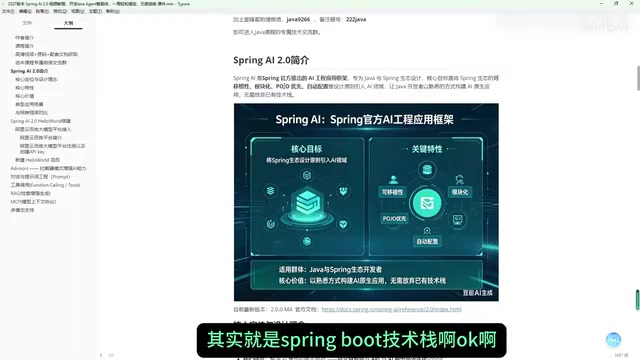
It's important to clarify that Spring AI itself is not a large language model—it doesn't provide the core algorithms for generative AI. Instead, it serves as a middleware layer between the Spring ecosystem and various AI models, providing unified access standards. Its core mission is to solve the fundamental challenges of AI integration—in the era without frameworks, prompt management, model connectivity, and data integration were all extremely tedious. Spring AI aims to efficiently connect enterprise data, APIs, and AI models.
Core Positioning and Design Inspiration
Spring AI's design draws inspiration from two well-known projects in the Python ecosystem: LangChain and LlamaIndex. LangChain is the most popular LLM application development framework in the Python ecosystem, with its core concept being "Chains"—linking prompt templates, model calls, output parsing, tool calls, and other steps into reusable processing pipelines, and achieving autonomous decision-making and multi-step reasoning through Agent mechanisms. LlamaIndex (formerly GPT Index) focuses on the data connection layer, offering rich data loaders (supporting hundreds of data sources including PDFs, databases, APIs), multiple index structures (tree indices, keyword indices, vector indices, etc.), and query engines, excelling at efficiently transforming private data into LLM-consumable context. The two are frequently used together in the Python community—LangChain handles orchestration logic while LlamaIndex handles data retrieval. Spring AI absorbs the design essence of both, providing orchestration capabilities and data indexing capabilities simultaneously in the Java ecosystem, with custom optimizations for Java and the Spring ecosystem.
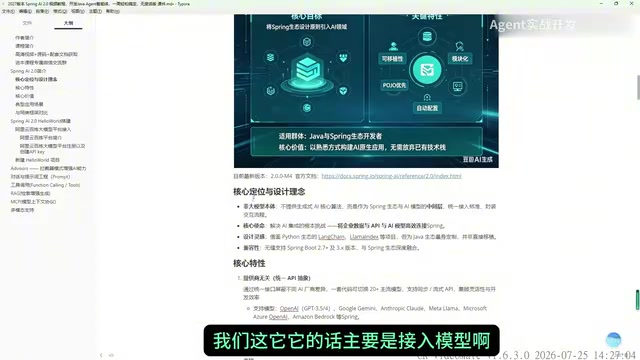
Regarding model compatibility, Spring AI supports a wide range of mainstream model providers. Interestingly, as versions evolve, some documentation descriptions of certain models have become slightly outdated. Taking current practice as an example, when integrating domestic Chinese LLMs, the DeepSeek series (such as DeepSeek-V4) is more recommended, which also reflects the need for developers to make flexible choices based on actual circumstances as the framework rapidly develops.
Provider-Agnostic Unified API Abstraction
One of Spring AI's most valuable features is its "provider-agnostic" unified API design. "Provider-Agnostic" is an important principle in enterprise software design, with its core concept similar to how JDBC abstracts databases—applications program against unified interfaces while the underlying implementation can be freely replaced. In the AI domain, different model providers (OpenAI, Anthropic, Google, Alibaba Cloud Bailian, DeepSeek, etc.) have differences in API formats, authentication methods, parameter naming, and response structures. In traditional development, integrating each model often meant a separate set of calling code, making code difficult to reuse and expensive to maintain.
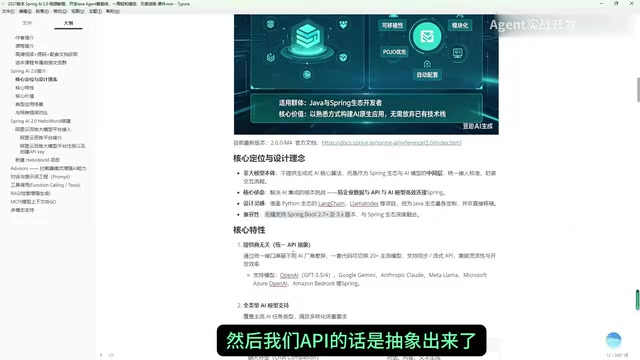
Spring AI defines unified interfaces like ChatModel and EmbeddingModel, encapsulating different vendors' differences within their respective Starter implementations. Developers can migrate from OpenAI to DeepSeek by switching a single configuration item in application.yml, with zero changes to business code. This design not only reduces vendor lock-in risk but also makes A/B testing different models extremely convenient—particularly friendly for enterprise scenarios that need flexible switching between multiple models or want to avoid single-vendor dependency.
Full-Type AI Model Support
Spring AI's capability coverage is quite extensive, encompassing virtually all mainstream AI application development needs:
- Chat Completion: Conversational Q&A, text generation
- Embedding Model: Text vectorization. Embedding models are neural network models that convert natural language text into high-dimensional numerical vectors. After embedding, each piece of text yields a fixed-dimension (typically 768, 1024, or 1536 dimensions) array of floating-point numbers, where semantically similar texts are closer in vector space. This technology is the foundation of semantic search, recommendation systems, and RAG. Common embedding models include OpenAI's text-embedding-3-small, BAAI's bge series, and Alibaba's GTE series. Spring AI's EmbeddingModel interface unifies the calling methods of different embedding services, allowing developers to conveniently vectorize documents and store results in vector databases for subsequent retrieval.
- Text-to-Image Generation: Multimedia content creation
- Speech-to-Text and Text-to-Speech: Audio processing capabilities
- Content Moderation: Safety and compliance assurance
- Structured Output: Supports POJO mapping, directly converting model output into Java objects
Among these, structured output with POJO mapping is a feature Java developers will particularly appreciate. Structured output means having the LLM return data in a predefined JSON Schema format rather than free-form text. Spring AI's structured output mechanism leverages Java's reflection and generics capabilities: developers define a Java Record or POJO class (e.g., record WeatherInfo(String city, double temperature, String description)), the framework automatically infers the JSON Schema from the class structure and injects it into the prompt to guide the model's formatted output, then deserializes the response into strongly-typed objects using JSON libraries like Jackson. This approach is more reliable than manually parsing model text output. Especially when building API services that need to interface with downstream systems, structured output guarantees data format consistency and predictability, significantly improving development efficiency and code maintainability.
RAG (Retrieval-Augmented Generation) and Vectorization Capabilities
Among its many features, RAG (Retrieval-Augmented Generation) is an extremely important component of Spring AI. RAG's core workflow is divided into three stages: Indexing, Retrieval, and Generation. During the indexing stage, enterprise documents are split into appropriately sized text chunks, converted to vectors via embedding models, and stored in vector databases (such as Milvus, Pinecone, PgVector, Chroma, etc.). During the retrieval stage, the user's query is also vectorized, and Approximate Nearest Neighbor (ANN) algorithms find the Top-K most semantically relevant text chunks from the vector store. During the generation stage, the retrieved text chunks are sent to the LLM as context along with the user's question, and the model generates well-grounded answers based on this "evidence." This approach effectively mitigates the LLM's "hallucination" problem (i.e., fabricating non-existent information) while addressing knowledge gaps after the model's training data cutoff date.
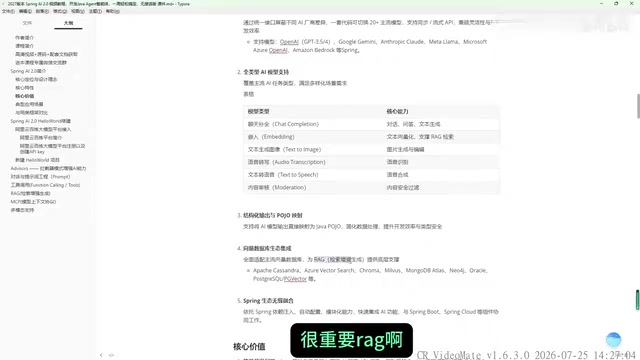
Spring AI provides comprehensive support for RAG, offering a complete API chain including DocumentReader, DocumentTransformer, VectorStore, and more, covering key steps such as text vectorization and vector database integration. Combined with local deployment tools like Ollama, developers can build a complete pipeline from data vectorization and storage to retrieval augmentation. Ollama is an open-source local LLM runtime tool that allows developers to download and run open-source models like Llama 3, Qwen, and DeepSeek on local machines with one click, without connecting to cloud APIs. Ollama is built on the llama.cpp inference engine, supports CPU and GPU acceleration, and provides OpenAI-compatible REST API interfaces. This means Spring AI can directly connect to a local Ollama instance via spring-ai-ollama-spring-boot-starter, achieving zero-cost model calls during development and debugging while avoiding sending sensitive data to external services. For enterprise scenarios with strict data security requirements, Ollama combined with Spring AI provides a fully privatized AI application deployment path. This capability also integrates seamlessly with Spring Data and other components in the Spring ecosystem, further lowering the development barrier for enterprise knowledge base applications.
Core Value and Typical Application Scenarios
Spring AI's core value can be summarized in three points:
- Lower development barriers: Developers can quickly build applications without deep knowledge of AI internals, with strong portability
- Full-process encapsulation: Complex AI capabilities wrapped into concise APIs
- Enterprise-grade capabilities: Support for production-level deployment, observability, and security assurance
In practical application scenarios, the most common deployment directions for Spring AI include:
- Intelligent Q&A (AI QA): One of the most frequently used scenarios
- Intelligent Customer Service: Development efficiency significantly improved with the framework's tool capabilities
- Content Generation and Multimedia AI: Unified processing of text, image, and voice
- Enterprise AI Development: Complete solutions for production environments
Spring AI vs. LangChain and Other Frameworks
Compared to mainstream frameworks like LangChain, Spring AI's core advantage lies in its deep binding with the Spring ecosystem, allowing Java technology stack teams to introduce AI capabilities at minimal cost. Of course, in purely functional dimensions, different frameworks each have their strengths, and other frameworks may perform better in certain scenarios.
Interestingly, the AI framework space is still in the early stages of rapid development, with all frameworks continuously iterating versions. There's no definitive winner yet. For developers, rather than agonizing over choosing a single framework, it's more pragmatic to understand both Spring AI and mainstream solutions like LangChain simultaneously, and make flexible choices based on specific project requirements.
Key Takeaways
Related articles

The Era of AI Capability Overhang: Why You Need to Reset Your Ambition Every 3 Months
Understanding Capability Overhang in the AI era: when model capabilities far exceed application imagination, how teams should reset feasibility boundaries quarterly to avoid ceding advantages to competitors.

Firemaps Spain: Real-Time Wildfire Monitoring Map with Wind Flow Visualization
Firemaps Spain is an open-source real-time wildfire monitoring tool for Spain and Portugal, combining fire hotspot data with wind flow visualization to help assess fire spread direction.

Google AI Studio Hiring TPM Lead: Decoding the Three Key Criteria Including 'AI Pilled'
Google DeepMind's AI Studio team is hiring a TPM lead with three key criteria: AI pilled, high agency, and pushing the frontier. A deep dive into Google's acceleration strategy and AI talent trends.