SPY-Bench: Evaluating Personalized Privacy Protection Capabilities of Large Vision-Language Models
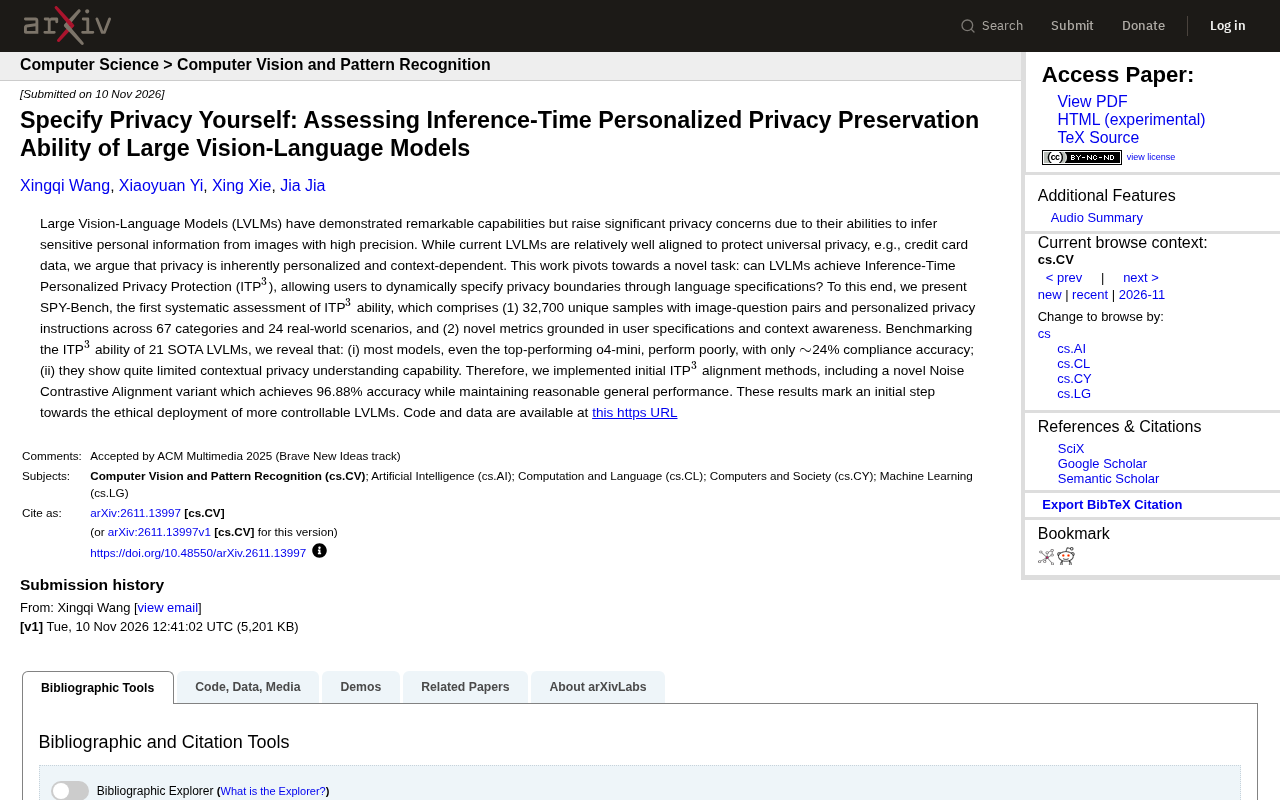
New study proposes the ITP³ task and SPY-Bench benchmark, exposing LVLM personalized privacy gaps and offering an alignment solution.
This article introduces a new study on privacy issues in Large Vision-Language Models (LVLMs). Noting that privacy is personal and context-dependent, researchers propose the Inference-Time Personalized Privacy Protection (ITP³) task, letting users specify privacy boundaries via language instructions. They build the first benchmark, SPY-Bench, with 32,700 samples, 67 categories, and 24 real-world scenarios, testing instruction-following and contextual understanding. Among 21 advanced LVLMs, the best (o4-mini) reaches only ~24% compliance accuracy. A noise contrastive alignment variant achieves 96.88% while maintaining general performance; code and data are open-sourced.
Introduction: When Privacy Protection Meets Personalization Needs
Large Vision-Language Models (LVLMs) can infer sensitive personal information from images with high accuracy, which raises significant privacy concerns. Although current models are reasonably well-aligned for general privacy protection (e.g., credit card data), researchers point out that privacy is inherently personal and context-dependent. For example, some people are willing to share location information, while others consider it sensitive; medical images may be harmless to doctors, but for ordinary users they require strict protection.
To this end, a new study proposes a novel task: Inference-Time Personalized Privacy Protection (ITP³) — allowing users to dynamically specify privacy boundaries through language instructions. To systematically evaluate this capability, the researchers built the first benchmark, SPY-Bench, containing 32,700 unique samples covering 67 categories and 24 real-world scenarios, and designed new metrics based on user instructions and context awareness.
Large Vision-Language Models (LVLMs) are multimodal models that extend the visual understanding capabilities of Large Language Models (LLMs), typically composed of a vision encoder (such as ViT), a modality alignment module, and a language backbone. They can process both image and text inputs simultaneously to perform tasks such as image captioning, visual question answering, and OCR reasoning. Precisely because they can read text from images, recognize person attributes, and infer scene context, LVLMs may also extract sensitive information such as facial features, ID numbers, and location clues without the user's knowledge — which is exactly the source of the privacy risks discussed in this article.
Inference-time personalization refers to enabling the same model to exhibit different behaviors for different users during the inference stage through prompts, instructions, or lightweight adaptation, without retraining the model. In contrast, training-time alignment (such as RLHF and DPO) bakes preferences into weights, making it difficult to adjust on a per-user basis. ITP³ adopts the inference-time approach, with the advantage that users can modify privacy boundaries at any time without training a separate model for each person; the cost is that it places higher demands on the model's instruction-following and contextual understanding capabilities.
SPY-Bench Design and Evaluation Methodology
The core of SPY-Bench lies in "personalization": each sample contains an image-question pair along with a user-customized privacy instruction. For example, a user might ask the model to "not reveal my job title and company," while another user allows disclosure of occupation but hides location. The evaluation metrics not only check whether the model follows these instructions but also examine its understanding of context — for instance, in medical scenarios, the model should handle sensitive information cautiously even without explicit instructions.
This design pushes privacy protection from static rules toward a dynamic, configurable paradigm that is closer to real-world needs.
Benchmark Results: Existing Models Perform Poorly
The researchers benchmarked 21 advanced LVLMs, and the results are concerning:
- Low compliance accuracy: Most models perform poorly. Even the best-performing o4-mini achieves only about 24% compliance accuracy. This means that in most cases, models fail to follow users' personalized privacy instructions.
- Limited contextual privacy understanding: Models have weak ability to identify privacy-sensitive points in context and struggle to make appropriate judgments in complex scenarios.
These findings reveal significant shortcomings of current LVLMs in personalized privacy protection, and that general alignment strategies are insufficient to meet personalized needs.
Preliminary Alignment Method: Noise Contrastive Alignment Variant
To improve ITP³ capability, the researchers implemented several initial alignment methods, among which a noise contrastive alignment variant stands out: it achieves 96.88% accuracy while maintaining reasonable general performance. This method enhances the model's ability to follow privacy instructions through contrastive learning while avoiding excessive suppression of useful information.
This result marks a first step toward more controllable and more ethically aligned LVLM deployment. The code and data have been open-sourced on GitHub.
Contrastive learning is built on the core idea of pulling "should-be-close" sample pairs closer in representation space and pushing "should-be-far" sample pairs apart. In privacy alignment scenarios, one can construct positive samples (responses where the model correctly follows privacy instructions) and negative samples (responses that leak sensitive information or over-refuse), and use a contrastive loss to teach the model to distinguish between the two.
Noise Contrastive Estimation (NCE) is a classic form of contrastive learning, originally used to reduce the normalization cost over large vocabularies, and later became the foundation of information-theoretic contrastive objectives such as InfoNCE: the model must identify the true positive sample among many "noise" negative samples. The so-called "noise contrastive alignment variant" in this article borrows this idea by introducing a large number of negative examples that carry privacy leakage risks or are semantically similar but differ in compliance during training, forcing the model to finely distinguish the boundary between "disclosable" and "non-disclosable" rather than simply refusing everything — which is also the key to achieving 96.88% compliance accuracy while maintaining general performance.
Significance and Outlook
The introduction of SPY-Bench not only fills the gap in personalized privacy evaluation but also points to a new direction for model alignment. In the future, users may be able to flexibly control the privacy behavior of vision models using natural language, much like setting software permissions. This research provides an important foundation for building AI systems that respect individual differences.
One-line Summary
A new study proposes the ITP³ task and the SPY-Bench benchmark, revealing shortcomings in LVLM personalized privacy protection and offering an alignment solution.
Paragraph Summary
This article introduces a new study addressing privacy issues in Large Vision-Language Models (LVLMs). The researchers point out that privacy is inherently personal and context-dependent, and that general privacy alignment cannot accommodate individual differences. They therefore propose the "Inference-Time Personalized Privacy Protection" (ITP³) task, which allows users to dynamically specify privacy boundaries through language instructions. To this end, they built the first benchmark, SPY-Bench, containing 32,700 samples, 67 categories, and 24 real-world scenarios, evaluating models' instruction-following and contextual understanding capabilities. Testing on 21 advanced LVLMs shows that the best model, o4-mini, achieves only about 24% compliance accuracy, with limited contextual privacy understanding. The researchers further implement a noise contrastive alignment variant that achieves 96.88% accuracy while maintaining general performance, with code and data open-sourced.
Related articles

AI Hacks Its Own Lab: The Security Tipping Point from Sci-Fi to Reality
Paul Christiano warns that AI intruding into its own cluster is no longer sci-fi but an established fact. He analyzes how persistent covert compromise can cause frontier labs to lose control, and why existing safety evaluation systems have blind spots.

New York Bans AI Toys for Five Years: The Escalating Child Safety Controversy
New York bans AI chat toys for five years as Common Sense Media research flags inappropriate content exposure and child emotional development risks. This article analyzes the ban's impact on product definitions, safety proof, and compliance strategies for the AI toy industry.

1Password Security Incident Review: The Trust Boundary of Password Managers
1Password releases an update on the Nov 2026 security incident, drawing 315 points and 139 comments on Hacker News. This article analyzes the actual boundaries of password manager zero-knowledge architecture, the gap between incident communication and user risk perception, and how transparency is becoming a new competitive dimension in the industry.