Squirrel: An App Blocker That Uses Investment Logic to Break Your Phone Addiction

Squirrel hard-blocks social apps until you commit a dollar amount to invest, turning scrolling urges into savings.
Squirrel is an iOS app that fights phone addiction by placing hard blocks on frequently opened apps — unlocking them requires committing an investment amount inside Squirrel first, turning idle screen time into savings motivation. The app never handles real money; users place trades at their own brokerage and log positions manually, which Squirrel then tracks with live market data. This "log it, don't hold it" design avoids financial compliance hurdles while reinforcing the ritual of each savings decision. The product earned 84 upvotes and a #9 ranking on Product Hunt across Productivity and Personal Finance, though its closed loop relies heavily on user discipline and long-term retention remains to be proven.
Turn the Urge to Scroll Into the Drive to Invest
Most focus apps are built around a single idea: block. Squirrel takes a different angle — it puts a price tag on the apps you keep opening. When you tap Instagram, you're not met with a soft reminder you can swipe away. You hit a genuine hard block.
If you really need to check a DM, Squirrel won't stop you entirely — but it makes you go through a "payment process" first: open Squirrel, choose how long you want to unlock the app, and set aside a few dollars for yourself. In other words, every indulgent scroll session gets converted into a future savings contribution.
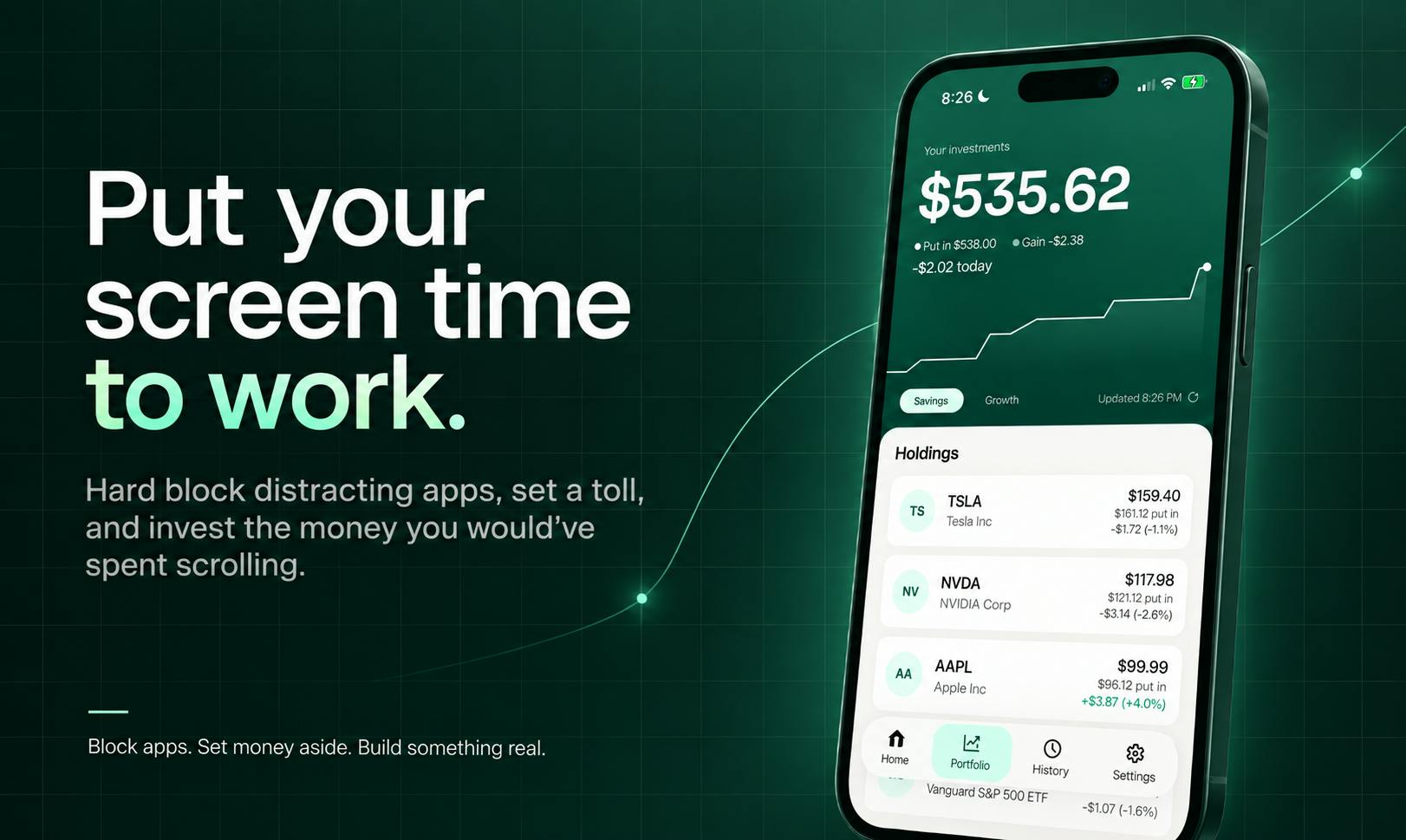
Built by maker Brian Hall, the product launched on Product Hunt with 84 upvotes and a #9 ranking, categorized under iOS, Productivity, and Personal Finance — a cross-category positioning that itself signals what makes it different.
No Money Touched: A Deliberate Product Decision
One of Squirrel's most interesting design choices is that it never handles any real money. There's no fund flow inside the app, no need to connect a bank card or account. This sets it apart sharply from the many "save money" apps on the market that require users to link a payment method for automatic transfers.
So where does the money go? The process is entirely in the user's hands: when you're ready, you go to your own brokerage account and make the investment yourself, then come back to Squirrel to log what you bought. The app then tracks your position's performance with live market data.
This "log it, don't hold it" model offers two immediate benefits. First, compliance and trust costs drop dramatically — not touching money means avoiding the complex web of financial licensing, fund security, and privacy authorization requirements. Second, the psychological ritual is stronger: users have to actively complete the investment themselves rather than having the system quietly debit them, which makes every dollar saved a conscious decision.
A brokerage account is an investment account opened with a securities firm, used to buy and sell stocks, ETFs, funds, and other financial products. In the US, platforms like Fidelity, Charles Schwab, and Robinhood all offer commission-free trading, making small, frequent micro-investments cost-viable. By not integrating directly with brokerage APIs, Squirrel sidesteps the legal risk of becoming a regulated "investment adviser" or "money transmitter" — license categories that require registration with the SEC or state financial regulators at significant compliance cost. This design lets the team ship a lightweight product quickly, but it also places full execution responsibility for that "last mile" squarely on the user.
Hard Block vs. Soft Nudge: The Key Difference in Behavior Design
Many screen time management tools fail for one simple reason: their blocks are too soft. A prompt you can skip with one tap creates almost no friction — users slide past it without a second thought.
Squirrel emphasizes the hard block — a genuine, non-negotiable barrier. To get through it, you have to pay a real cost: open another app, make a time-limit choice, and commit to a dollar amount. This flow is deliberately designed to create friction, turning what was a reflexive tap into a moment that requires you to pause and think.
From a behavioral economics perspective, this is effectively attaching an immediate opportunity cost to an impulse purchase — in this case, an "attention purchase." The more often you want to scroll, the more investment principal you accumulate. It reframes the negative constraint of "going without" into the positive incentive of "growing your savings."
Behavioral economists call this mechanism "friction cost" — artificially inserting resistance between an impulsive urge and its execution, forcing the brain to switch from autopilot to deliberate decision-making mode. Research shows that even adding a few seconds of delay or an extra step can significantly reduce impulsive behavior. Related to this is the concept of the "commitment device," popularized by behavioral economists including Richard Thaler: people proactively set constraints on their own future behavior in advance, to guard against the self-control failures they expect to encounter. Squirrel combines both — friction stops the immediate impulse, while the pre-committed investment amount acts as a loss aversion trigger, making "not investing" feel like actively giving up gains that already belong to you.
The Real Problem It Solves — and Where It Might Fall Short
Squirrel addresses a genuinely widespread pain point: knowing that mindless scrolling is a waste of time, yet never having a strong enough motivation to change. Tying self-restraint to personal wealth accumulation is clever motivational design.
That said, the "no money touched" approach is a double-edged sword. The entire feedback loop depends heavily on the user's own discipline — you actually have to go place an order at your brokerage, then manually log your position back in the app. If users get lazy, the so-called "paid unlock" can easily become a number on paper, and the incentive effect evaporates. On top of that, the app is currently iOS-only, limiting its reach; and the accuracy of real-time tracking plus the convenience of logging positions will directly determine long-term user retention.
In terms of product maturity, 84 upvotes suggests it resonates with a real audience, but only 4 comments means the conversation is still thin and real-world usage experience needs more validation. For users who struggle with phone addiction and have an interest in investing, Squirrel offers a new framework worth trying: instead of talking about self-discipline in the abstract, make every moment of restraint translate into actual shares sitting in your account.
Related articles

iPhone Duo Battery Life Tested: One Charge a Day Is Unavoidable, and the Large Screen Is the Culprit
iPhone Duo battery test: heavy use needs at least one charge a day, and about 30% remains after 6.5 hours of screen-on time. How often the large screen is unfolded is key; a MagSafe battery pack helps, and long-term degradation is also worth watching.

Kimi K3.1 Pro Open-Sourced: 2.8 Trillion Parameters Close In on Opus
Moonshot releases the open-source MoE model Kimi K3.1 Pro, with 2.8T total parameters and 104B activated, trailing Opus 5.5 by under 1 point on Terminal Bench 4.0.

Costco Tech Price Guessing: Are Monitors, Keyboards, Mice, and Bose Speakers Worth It?
A YouTube blogger guesses prices of Costco tech products: 2K 180Hz monitor, Logitech keyboard and mouse, Bose speaker, and CyberPower UPS, revealing warehouse-store selection and brand premium.