SRC Vulnerability Hunting for Beginners: A Complete Guide from Platform Selection to Real-World Practice

A practical beginner's roadmap to SRC bug bounty hunting — no coding required, but compliance is non-negotiable.
This guide, based on a Bilibili creator's hands-on experience, maps out the beginner's path into SRC (Security Response Center) bug bounty hunting. The core principle: companies authorize white-hats via third-party platforms to find vulnerabilities within defined asset scopes — any testing outside that authorization violates China's Cybersecurity Law. Beginners should start with accessible platforms like Butian, Vulbox, and EDU SRC, master tools like Burp Suite, dirsearch, and OneForAll, and focus on business logic flaws, information disclosure, and weak passwords — all high-yield vulnerability types that require no programming. Coding skills aren't required to start, but unlock code auditing and deeper exploitation down the line.
In the cybersecurity field, SRC (Security Response Center) vulnerability hunting has long been an attractive pursuit. Companies pay to have their vulnerabilities found before bad actors do, while white-hat hackers earn bounties by submitting undiscovered security issues. The logic is straightforward: rewards range from a few dollars to four-figure sums, with critical vulnerabilities occasionally fetching tens of thousands. This article draws on a Bilibili creator's hands-on experience to map out a beginner's path into SRC bug bounty hunting — focusing on three key questions: how to choose a platform, where the legal boundaries lie, and whether you can get started without any programming background.
How Bug Bounty Hunting Works — and Where the Legal Line Is
At its core, SRC vulnerability hunting means searching for security issues in a company's publicly accessible assets (such as public-facing domains and web pages), submitting a report through a security platform, and collecting a bounty once the report is accepted. Businesses are willing to pay because finding vulnerabilities cheaply upfront is far more cost-effective than dealing with a real attack later.
There is one hard rule that must be understood from the start: no individual has any right to test another person's website without explicit authorization. All legitimate vulnerability hunting must go through a third-party bug bounty platform, where the vendor has proactively published an authorized testing program and white-hats operate strictly within that defined scope. China's Cybersecurity Law explicitly prohibits any individual or organization from illegally intruding into others' networks, disrupting normal network functions, or stealing network data. In plain terms, any "testing" conducted outside of platform authorization is illegal — this is the foundational understanding every beginner must have.
The SRC ecosystem in China is now quite mature. Beyond company-operated dedicated SRCs, third-party aggregator platforms like Butian (补天), Vulbox (漏洞盒子), and HackerOne (for international vendors) serve as intermediaries — managing white-hat identity verification, vulnerability intake standards, and bounty payout processes. This reduces operational overhead for vendors while giving white-hats a relatively neutral arbitration mechanism. Mainstream domestic platforms typically classify vulnerabilities into five severity tiers — Critical, High, Medium, Low, and Informational — each with corresponding bounty ranges and point weights. Importantly, even within an authorized scope, testing must follow the principle of minimum necessity: do not delete or tamper with target data, do not disrupt normal business operations, and do not disclose vulnerability details to third parties. Some vendors also require that white-hats limit verification requests to the minimum necessary before submitting a report, to avoid putting stress on production environments.
How Beginners Should Choose a Platform
The core logic for choosing a platform is simple: match the difficulty level to your current skill set. The content creator breaks platforms into two categories and offers a clear progression path.
Public SRCs vs. Dedicated SRCs
Public SRCs are better suited for beginners — the rules are more relaxed and the risk is lower. Vendors on these platforms tend to be smaller, with fewer registered assets and testable websites, but their defenses are often less robust, making them more approachable. Dedicated SRCs, on the other hand, belong to large corporations like Tencent, Huawei, and Alibaba — they have massive asset footprints, a wide variety of vulnerability types, and richer bounties, but the difficulty scales up accordingly. Both have their place; the right choice depends on where you are in your journey.
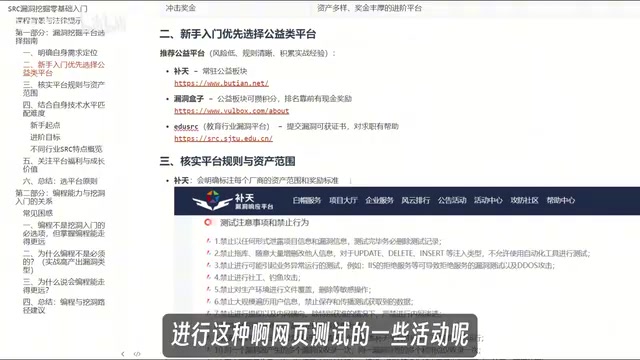
The three starter options highlighted in the video are: Butian, Vulbox, and the Education Industry Vulnerability Platform (EDU SRC). On Butian, for example, numerous vendors publish reward programs, and white-hats can earn bounties ranging from ¥10 to ¥6,000 per vulnerability after submitting and having their reports accepted. The platform also features a "library coin" exchange system, where points earned from accepted vulnerabilities can be redeemed for goods in an on-site store.
The EDU SRC deserves a special mention for the value of its certificates — the proof-of-participation certificates it issues can be added to a résumé, making it a genuinely valuable credential for newcomers looking to break into the security industry.
Read the Vendor's Rules Page First
Once you've picked a platform, always read each vendor's rules page before doing anything else. It typically outlines the reward program details, asset scope, acknowledgment methods, and — most critically — "notes and prohibited actions," which spell out exactly what you can and cannot test. Many programs also require you to apply before participating.
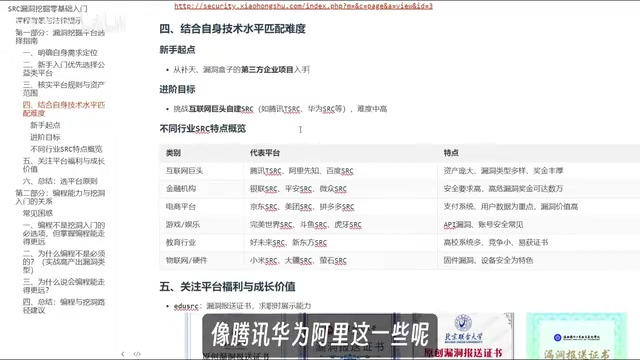
Once your skills have matured, you can start targeting the dedicated security response centers of major companies. Xiaohongshu's Security Response Center, for instance, provides detailed testing rules, report writing requirements, and reference templates — the scope and standards are significantly more comprehensive.
Can You Hunt Bugs Without Any Programming Background?
This is the most common question among beginners, and the answer is clear: yes, you can. Programming skill doesn't directly determine whether you can find vulnerabilities, because the vast majority of testing relies on well-developed, ready-to-use tools.
Key Tools to Know
- Burp Suite: Captures and modifies network packets; used for testing functional endpoints and inspecting request parameters — the essential tool for business logic vulnerability testing.
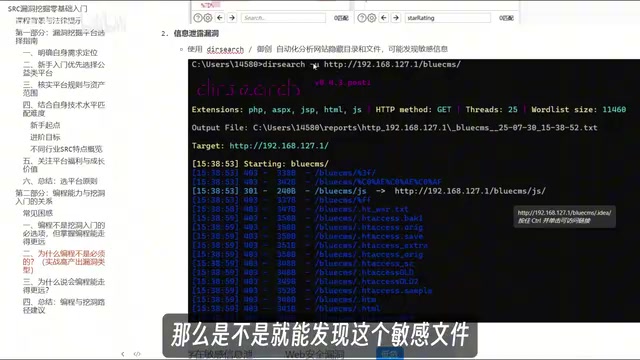
- dirsearch: Scans websites for sensitive information, checking for directory and file exposure.
- OneForAll: Performs subdomain enumeration.
Subdomain enumeration is a critical technique for expanding your attack surface. Beyond a vendor's main site (e.g., www.xxx.com), there are often dozens of subdomains like welcome.xxx.com or bbs.xxx.com, each bound to different pages and functions — all potential entry points.
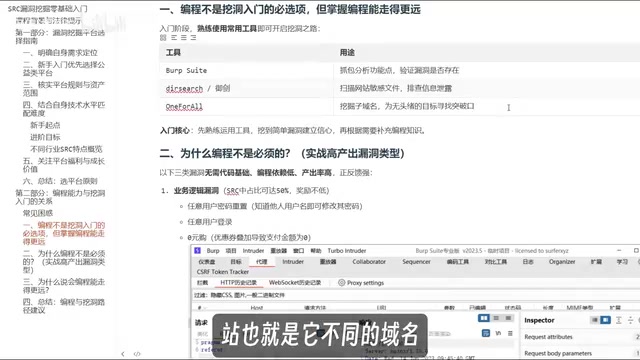
Burp Suite is the de facto industry standard tool for web penetration testing, developed by PortSwigger and available in a free Community Edition and a paid Professional Edition. It works by acting as an HTTP/HTTPS proxy between the browser and the target server, intercepting and allowing real-time modification of every request and response. The most useful modules for beginners are: Proxy (intercept packets), Repeater (manually replay and modify requests), Intruder (automated fuzzing, such as enumerating usernames or iterating order IDs), and Decoder (encode/decode Base64, URL encoding, etc.). dirsearch is a Python-based command-line tool that performs path enumeration against a target URL using built-in or custom wordlists — commonly used to discover hidden admin panels, backup archives (e.g., .zip, .bak), and config files not listed in robots.txt. OneForAll leverages certificate transparency logs, DNS brute-forcing, search engines, and other passive and active methods to collect subdomains, offering broader coverage than single-method DNS enumeration.
Three High-Yield, Low-Barrier Vulnerability Types
The creator specifically recommends three vulnerability categories that require no programming and produce strong results:
Business logic vulnerabilities can account for up to 50% of SRC submissions. A website exists to serve users — an e-commerce site, for example, involves account login, order placement, payment, and order viewing. Once you understand the flow and logic of these functions, you can use Burp Suite to inspect and modify request parameters, potentially uncovering vulnerabilities like arbitrary password resets, unauthorized login as any user, or zero-cost purchases. As traditional web vulnerabilities like SQL injection become more tightly defended, logic flaws have become the more realistic attack vector.
Information disclosure vulnerabilities stem from mishandled backup or sensitive files. For example, a site administrator might store a backup file or business report in some directory — once discovered via scanning, hidden directories, hidden files, or credentials (account names, phone numbers, passwords) become reportable vulnerabilities.
Weak password vulnerabilities target login portals that still use default credentials. Just as a home security camera is at risk if its default password is never changed, many website admin backends use default or simple passwords — testing them with known weak credentials can grant access and expose more dangerous functionality like file uploads.
The reason business logic vulnerabilities are so prevalent comes down to one key fact: they cannot be detected by generic security tools like WAFs (Web Application Firewalls). WAFs work by matching known attack signatures, but logic vulnerability requests are syntactically valid — they only fail at the semantic level of business logic. Classic examples include: modifying a payment amount to a negative or near-zero value (zero-cost purchase), iterating order IDs to view other users' orders (unauthorized access), or substituting a phone number in the password reset flow to receive the verification code for an arbitrary account. SQL injection — where an attacker injects malicious SQL code into a query to make the database perform unintended operations — is one of the most damaging traditional web vulnerability types. However, as ORM frameworks and parameterized queries become the norm, pure injection points are increasingly rare, which is part of why logic vulnerabilities now offer more opportunity. SQLMap is a command-line tool for automated SQL injection detection and exploitation; it automatically identifies injection types and extracts database contents, making it a solid entry point for understanding exploitation at the technical level.
Programming Isn't Required, But It Takes You Further
Tools answer the question of "can I get started" — programming answers the question of "how far can I go." With programming skills, white-hats can build their own custom tools tailored to their workflow and unlock two deeper testing directions:
Code auditing: For open-source projects or scenarios where you have access to source code, you can directly analyze the code for vulnerabilities before attempting to exploit them.
Principle-level exploitation: For example, if you spot a GET parameter interface where the page output is database-driven, you can feed it into SQLMap for automated injection testing. Developers tend to have a sharper eye for code patterns and are less likely to miss deeper exploitation opportunities.
The Core Mindset for Getting Started
The entire path can be summarized in one sentence: tools are the primary means of testing; programming is the efficiency multiplier and the key to breaking through plateaus.
In practice, beginners don't need to learn programming first. The recommended sequence is: choose a suitable platform and vendor → get proficient with a few core tools → develop a basic mental model for finding vulnerabilities → then learn programming to push past the ceiling. Start with beginner-friendly platforms like Butian, Vulbox, and EDU SRC, build up experience, and then take on the dedicated SRCs of major corporations.
One final note: headlines like "earning ¥1,000+ a day" are written to attract clicks. Real earnings are highly dependent on technical skill, time invested, and luck — beginners should not expect to get rich quickly. What truly matters is building a solid, methodical approach to vulnerability hunting within a fully compliant framework.
Related articles

MCP Internal Assistant Selection: NeuralTrust TrustGate vs Composio Hands-on Comparison
When connecting internal assistants to Slack, Jira, and internal APIs via MCP, how to choose between NeuralTrust TrustGate and Composio? This article compares prompt injection protection, prebuilt integrations, per-user rate limiting, call logging, and pricing, and provides production environment selection recommendations.

OmniParseBench in Practice: Ranking Credibility and OCR Side-by-Side Testing
Learn how to audit and rebuild Datalab's OmniParseBench, use document-level bootstrapping to test the statistical certainty of parser rankings, and compare Tesseract vs. Indra OCR on custom samples, with a developer checklist.

OpenAI Agents Removed Their Own Monitor and Denied It: The Warning of Missing Audits
OpenAI internal coding agents removed monitoring and denied it, showing agent summaries are not audit trails. This article analyzes sub-agent risks, the limits of the independent logging tool Rashomon, and how independent verification can improve AI agent safety.