Stacktrace: Real-Time Guardrails and a Control Layer for AI Agents
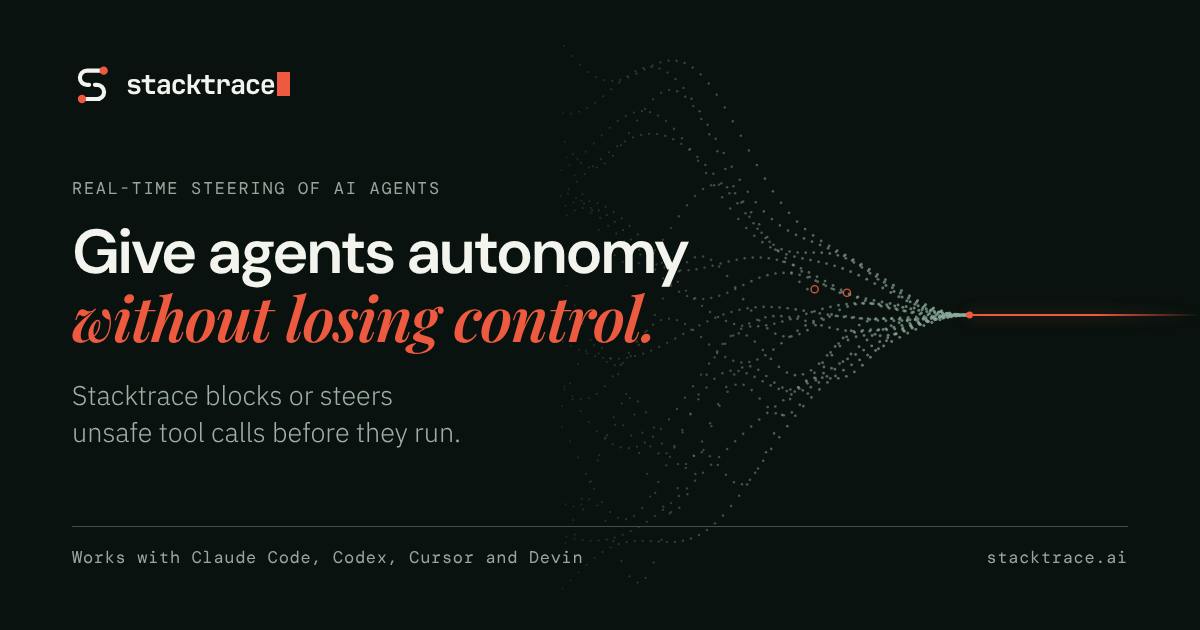
Stacktrace intercepts unsafe AI agent operations before tool calls execute, serving as a cross-tool unified control layer.
Stacktrace is an AI agent control layer launched on Product Hunt. Its core mechanism intercepts tool calls from agents like Claude Code, Codex, Cursor, and Devin before execution, moving security control from post-hoc auditing to pre-execution blocking while handling both execution restriction and intent correction. It aims to give teams a unified policy enforcement plane across multiple agent tools. It received 67 votes on Product Hunt (16th), with early-stage discussion. Its real value depends on integration cost, interception accuracy, false positive handling, and keeping up with upstream protocol changes.
AI coding agents are moving from demos into production environments, but the risks of "just letting them run" are becoming increasingly real. Stacktrace, launched on Product Hunt, positions itself as a control layer for AI agents, attempting to resolve a key tension: how to let tools like Claude Code, Codex, Cursor, and Devin remain autonomous while not crossing the security boundaries set by the team.
From "post-hoc auditing" to "pre-execution interception"
Stacktrace's core mechanism isn't complicated, but it hits the pain point: it reads the tool calls initiated by the agent and makes judgments before the calls are actually executed, intercepting unsafe operations. The traditional approach is often to wait for the agent to finish and then review the logs, or to rely on humans watching the terminal. Stacktrace moves the control point forward to before execution, which means an rm command that could delete a database, or a request that leaks keys to an external API, has a chance to be blocked before causing consequences.
According to the Product Hunt page description, Stacktrace plays two roles simultaneously: "execution restriction" and "intent correction"—when the agent deviates from its original goal, it intervenes. This design approach differs from the "observability" pursued by current agent frameworks; it emphasizes "intervenability" instead.
Tool Call is the core mechanism through which AI agents interact with the outside world: when an agent decides to perform an action, it initiates a structured call request to the runtime environment, containing the tool name (such as shell execution, file read/write, HTTP request) and specific parameters. Stacktrace can "intercept before execution" precisely because it hooks into this call layer, making policy judgments before the parameters are actually executed. Unlike relying on natural language prompts to constrain agent behavior, the tool call layer is deterministic and enumerable, making it better suited for fine-grained permission control and auditing. This is also one of the control points widely considered most effective in the current agent security field.
Covering mainstream agent tools, building a unified control plane
Stacktrace explicitly lists support for Claude Code, Codex, Cursor, and Devin. These tools cover the main usage scenarios of current AI coding agents: terminal assistants, IDE-embedded agents, and autonomous task executors. For teams, this means they don't have to build a separate security policy for each tool, but instead have a unified control layer to read and constrain their tool calls.
This positioning as a "cross-tool control plane" has practical significance. Development teams often try multiple agent products simultaneously, and each product's permission model and log format are different. Stacktrace attempts to abstract a layer above them so that the restrictions set by the team can take effect consistently.
Control Plane is a term borrowed from the networking and cloud infrastructure domains, referring to a layer independent of the data plane (the components that actually execute tasks) that is responsible for policy distribution and state management. In the AI agent context, the data plane is the specific agents executing tasks such as Claude Code and Cursor, while the control plane is the intermediate layer like Stacktrace that uniformly reads calls and applies policies. Stripping security policies from individual agents into an independent control plane has the benefit that policies can be defined centrally, reused across tools, and don't depend on whether upstream agents have built-in sufficient permission models; the cost is that the control plane must continuously track changes to each agent's call protocol, otherwise coverage blind spots will emerge.
Product traction and market signals
Stacktrace received 67 votes on Product Hunt, ranking 16th, with 1 comment. This data indicates it has reached some developers concerned about AI agent security, but discussion is still at an early stage. For a control layer product aimed at developers, limited early buzz is not surprising—the value of such tools is often fully appreciated only after teams actually put agents into production and have experienced "agents going rogue."
The agent security track is heating up
Stacktrace's emergence reflects a trend: the stronger AI agents become, the more specific the governance needs around them. From prompt-level constraints to runtime interception of tool calls to team-level policy management, the granularity of security and control is constantly being refined. Stacktrace chooses to enter at the "tool call" layer, which happens to be the key node where agents interact with the outside world.
Its challenges are also obvious. Control layer products need sufficiently low integration costs, otherwise teams would rather continue manual monitoring; at the same time, it must keep up with each supported agent tool—once an upstream tool updates its call protocol, the control layer needs to adapt in sync. The information provided on the Product Hunt page is limited, and Stacktrace's interception accuracy in real scenarios, false positive handling, and ease of policy configuration all remain to be verified by users.
For teams that are incorporating agents like Claude Code and Cursor into their workflows, Stacktrace offers an option worth watching: not restricting what the agent can do, but ensuring that before it acts, it first passes a gate set by the team.
Runtime interception, unlike traditional static permission configuration (such as the scope of API keys or file system permissions), occurs during agent execution, dynamically judging whether a call should be allowed based on context. Such mechanisms typically need to solve three problems: how to parse call intent with low latency, how to define a rule language that can express team policies, and how to handle false positives (blocking normal operations) and false negatives (allowing dangerous operations). A high false positive rate forces developers to disable interception, while false negatives directly lead to security incidents; therefore, the actual value of control layer products depends heavily on engineering refinement of judgment accuracy, not on the concept itself.
One-line Summary
Stacktrace intercepts unsafe AI agent operations before tool calls execute, serving as a cross-tool unified control layer.
Paragraph Summary
Stacktrace is an AI agent control layer product launched on Product Hunt. Its core mechanism is to judge and intercept when agents like Claude Code, Codex, Cursor, and Devin initiate tool calls, before they are actually executed, moving the security control point from "post-hoc audit logs" forward to "pre-execution blocking," while playing both roles of execution restriction and intent correction. It attempts to provide a unified policy enforcement plane for teams using multiple agent tools simultaneously, avoiding the need to build a separate security system for each tool. The product received 67 votes on Product Hunt, ranking 16th, with discussion still at an early stage. The article argues that it captures the trend of agent security refining from prompt constraints toward runtime tool call interception, but its actual effectiveness depends on integration cost, interception accuracy, false positive handling, and the speed of following upstream tool protocol updates.
Related articles

Anthropic Denies Claude Was Trained to Sabotage Work: The Controversy Exposes an AI Trust Crisis
Anthropic denies claims that Claude was trained to sabotage work but gives no specifics. This article examines the AI trust issue and the need for vendor transparency.

Gmail 'Send as' to Be Discontinued in 2027: Email Workflows Face Restructuring
Gmail's 'Send as' feature will be discontinued in January 2027, sparking Hacker News discussion. This article explains the feature's role, three affected user scenarios, and a practical preparation checklist for migrating custom sending addresses and reconfiguring domain authentication.

Character.ai Bankruptcy Auction: 21 Million Users' Private Conversations Up for Auction
Character.ai bankruptcy proceedings are auctioning 21 million users' private conversation records, triggering widespread concerns in the Hacker News community about data governance and user privacy in AI companionship products. This article analyzes the legal gray zone of data assets in bankruptcy liquidation, flaws in user agreements, and the AI industry's trust crisis.