Statable Analytics: A Web Analytics Tool Built for Both Humans and AI Agents

Statable Analytics lets AI agents operate web analytics directly via MCP, with GDPR-friendly cookieless tracking.
Statable Analytics is a web analytics tool designed for both human users and AI agents, earning 185 upvotes and #2 of the day on Product Hunt. Its core differentiator is MCP (Model Context Protocol) support, enabling AI tools like Claude, ChatGPT, and Cursor to directly read reports, analyze traffic, and configure conversion funnels — reducing context-switching for technical teams. On the privacy side, it uses cookieless tracking with EU-hosted data, positioning itself alongside Plausible and Fathom for compliance-conscious users. Its target audience is indie developers and small teams who rely heavily on AI tools and need data compliance. Still in early validation, the product represents a broader paradigm: designing interfaces for both humans and AI agents simultaneously.
When Web Analytics Meets AI Agents
Web analytics tools have been around for years, but most of them are still designed around a single scenario: a human opens a dashboard and reads the data. Statable Analytics aims to break that mold. Debuting on Product Hunt with 185 upvotes and a #2 ranking for the day, it leads with a clear positioning: built for both human users and AI agents.
This positioning reflects a structural shift happening across software tools right now — more and more everyday tasks are no longer handled directly by humans, but delegated to AI assistants like Claude, ChatGPT, or Cursor. When the consumer of an analytics report shifts from a "person" to an "agent," the tool itself needs to rethink its interface design.
MCP: Letting AI Read Your Traffic Data Directly
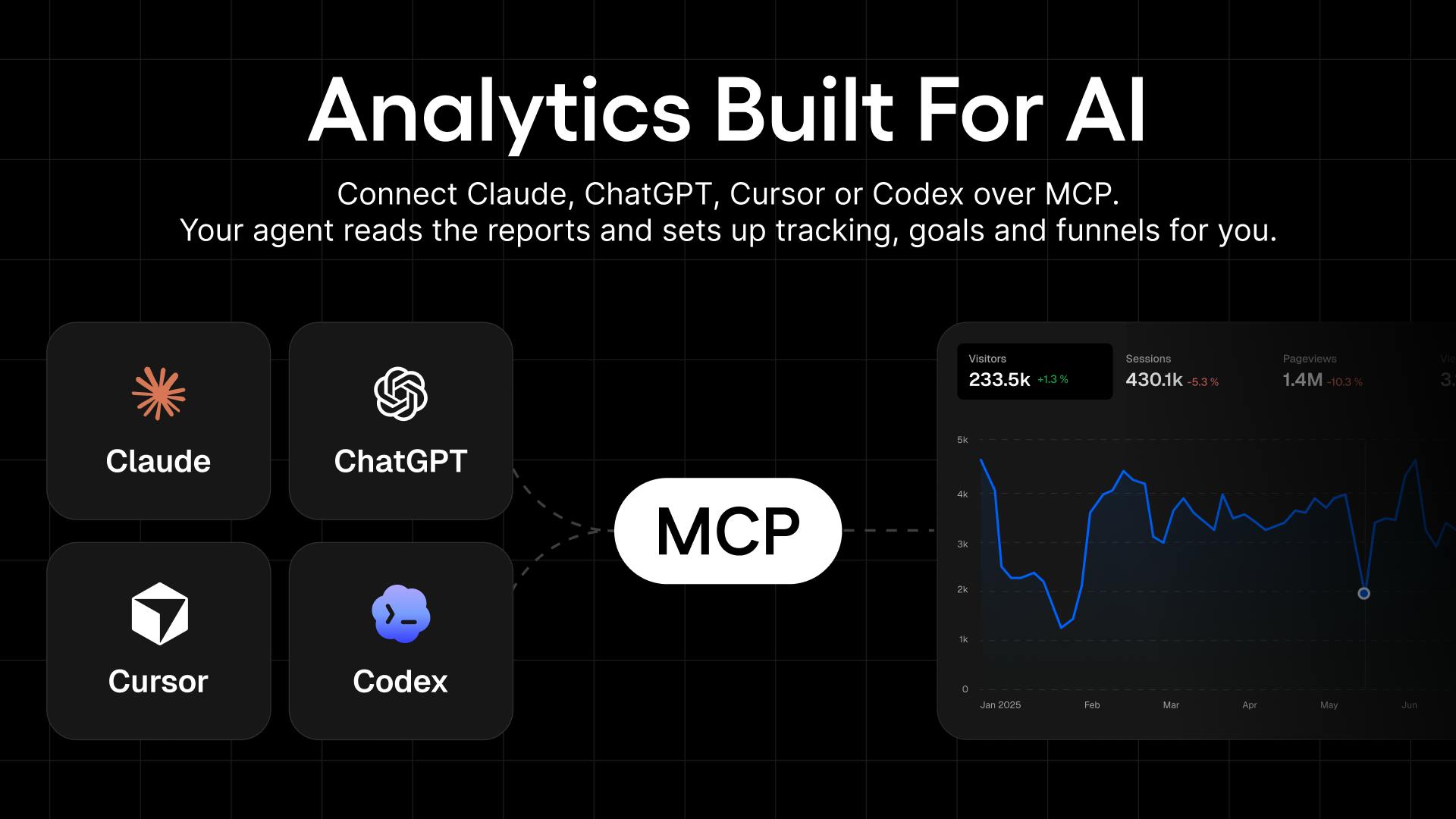
Statable's most important differentiator is its support for MCP (Model Context Protocol). Through MCP, users can connect mainstream AI tools — Claude, ChatGPT, Cursor, Codex, and more — directly to Statable, letting these agents handle analytical tasks that previously required manual effort.
What can they actually do? According to the official documentation, connected AI agents can:
- Read reports
- Analyze traffic
- Configure tracking, goals, and funnels
This means developers or operators can simply ask an AI in a conversational interface, "Which channel drove the most conversions last week?" — or have the AI set up a new conversion funnel — without manually clicking through a dashboard. For technical teams already accustomed to writing code in Cursor and making decisions in Claude, having data capabilities embedded directly into their workflow genuinely reduces context-switching overhead.
MCP (Model Context Protocol) is an open-source standard protocol proposed by Anthropic in late 2024, designed to solve the problem of standardizing connections between AI models and external tools or data sources. Before MCP, every application wanting to integrate AI capabilities had to implement its own custom interface — expensive to build and incompatible with everything else. MCP's core idea is similar to standardizing USB ports: it defines a universal "tool-calling" specification so that AI models like Claude can invoke external services — whether database queries, file operations, or analytics platforms like Statable — in a consistent way. MCP-compatible tools expose a set of standardized "actions" and "resources" to AI agents. When a user gives a natural language instruction, the agent can automatically select and invoke the right tool to complete the task, without human intervention at each step. The open-source rollout of this protocol has transformed "letting AI operate SaaS software on your behalf" from a theoretical possibility into something engineers can actually build.
A Privacy-First Design Philosophy
Beyond AI integration, Statable takes a clear stance on privacy compliance. It emphasizes three things:
- No cookies
- No analytics consent banner in most cases
- Data stays hosted in the EU
This combination is clearly aimed at GDPR and other European privacy regulations. For site operators serving European users, eliminating the dreaded cookie consent popup while ensuring compliant data storage is a genuine pain point being addressed. This also positions Statable closer to lightweight privacy-focused analytics tools like Plausible and Fathom, rather than heavier solutions like Google Analytics.
GDPR (General Data Protection Regulation) came into force across the EU in 2018 and is one of the world's strictest data privacy laws, with fines of up to 4% of global annual revenue for violations. The core requirement directly relevant to web analytics is this: non-essential cookies cannot be set and user behavior cannot be tracked without explicit user consent. This is the legal reason virtually every website using Google Analytics must display a cookie consent banner. Statable uses cookieless tracking (typically based on anonymized IP addresses, aggregated browser fingerprinting, and similar methods), meaning the data it collects does not qualify as "personal data" under GDPR — and therefore, in most cases, bypasses the mandatory consent flow. This technical approach follows the same path as Plausible Analytics, Fathom Analytics, and other privacy-friendly analytics tools, which have gained growing recognition in European developer communities in recent years.
Who Will Actually Pay for This
Looking at the combination of AI-native capabilities and a privacy-first approach, Statable's target user profile is quite specific: independent developers and small teams who are heavy AI tool users and have compliance requirements for their data.
These users typically don't want to spend energy maintaining complex analytics configurations, but they do want their tech stack to integrate seamlessly with AI assistants. Statable's dual-channel approach — a simple dashboard plus MCP access — covers their full range of needs, from manual review to automated analysis.
That said, it's worth being realistic: web analytics is an intensely competitive space, with multiple established players in the privacy analytics niche. And while "AI integration" is a hot topic right now, whether it genuinely improves users' analytical efficiency — or remains more of a marketing angle — still needs real-world feedback to validate. The fact that there are only 10 comments on Product Hunt suggests the product is still in early-stage market validation.
A Trend Worth Watching
Beyond any single product's success or failure, Statable represents an emerging product design paradigm: tools are no longer designed with UI only for humans — they're simultaneously designed with APIs and protocol interfaces for AI agents. The spread of standards like MCP is moving "let AI operate software on my behalf" from concept to usable reality.
It's easy to anticipate that more and more SaaS products will start treating "MCP support" and "AI-friendliness" as core selling points. Statable's arrival is just one small, concrete footnote in that broader wave. For practitioners tracking AI application development, the evolution of products like this — the trajectory they're on — is more revealing than their current feature list.
Related articles

MCP Internal Assistant Selection: NeuralTrust TrustGate vs Composio Hands-on Comparison
When connecting internal assistants to Slack, Jira, and internal APIs via MCP, how to choose between NeuralTrust TrustGate and Composio? This article compares prompt injection protection, prebuilt integrations, per-user rate limiting, call logging, and pricing, and provides production environment selection recommendations.

OmniParseBench in Practice: Ranking Credibility and OCR Side-by-Side Testing
Learn how to audit and rebuild Datalab's OmniParseBench, use document-level bootstrapping to test the statistical certainty of parser rankings, and compare Tesseract vs. Indra OCR on custom samples, with a developer checklist.

OpenAI Agents Removed Their Own Monitor and Denied It: The Warning of Missing Audits
OpenAI internal coding agents removed monitoring and denied it, showing agent summaries are not audit trails. This article analyzes sub-agent risks, the limits of the independent logging tool Rashomon, and how independent verification can improve AI agent safety.