Stolen Passwords Threaten U.S. Water Systems: The Hidden Risk to Critical Infrastructure

Stolen passwords and credential stuffing put U.S. water systems at serious cyber risk due to weak baseline security.
Security researchers warn that U.S. water utilities face serious cyberattack risks due to credential compromise. These systems are high-value targets tied to public health, yet many lack dedicated security teams. Stolen passwords — sourced from breaches, phishing, or dark web markets — require no sophisticated tools to exploit, and attackers can lurk undetected for long periods. The core defense lies in basic security measures: enabling MFA, enforcing strong password policies, isolating control networks, and training staff, with government support needed for under-resourced utilities.
The Password Threat Facing Critical Infrastructure
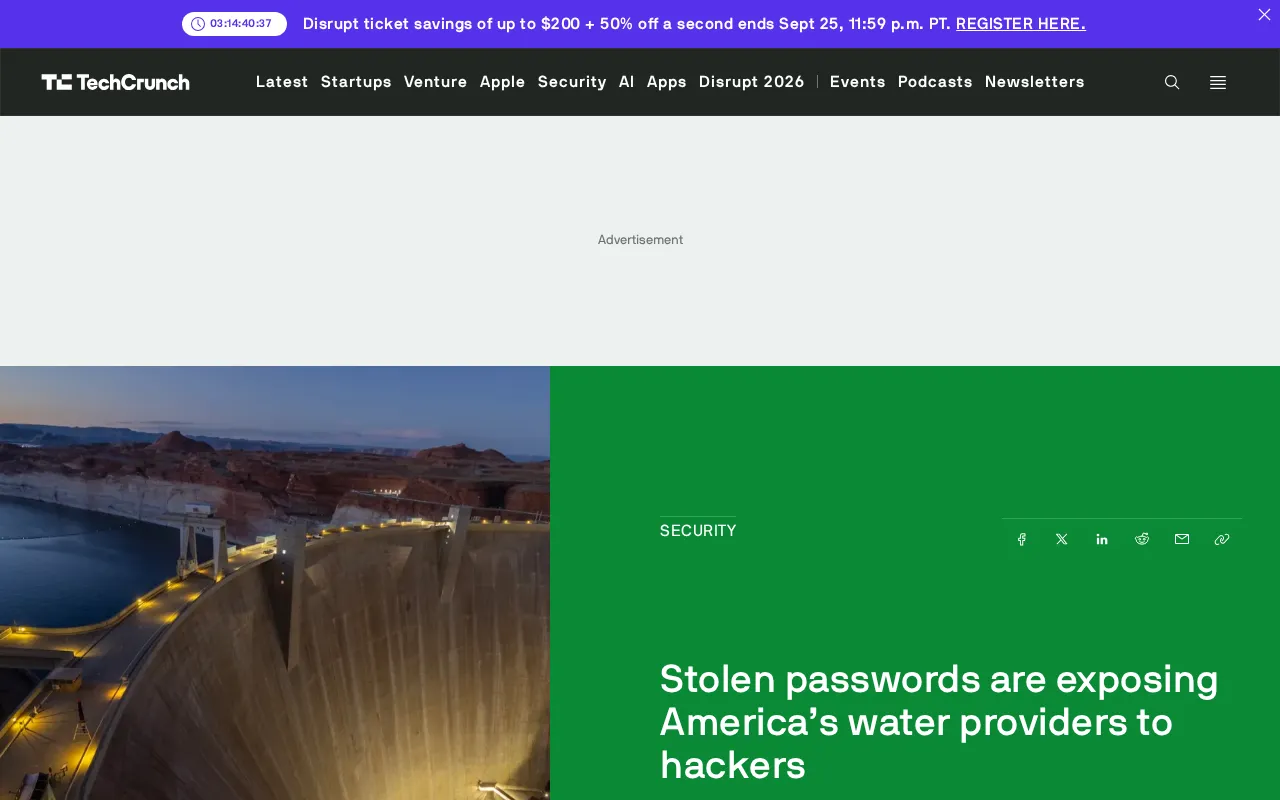
Security researchers are sounding the alarm: some of America's most vital critical infrastructure — water supply systems — are being exposed to hacker attacks through stolen passwords. This threat doesn't stem from sophisticated new attack techniques, but from a long-neglected fundamental security problem: credential compromise.
As original reporting has highlighted, this lurking threat hangs over some of the country's core infrastructure. Water supply systems are the lifeblood of society, and weaknesses in their cybersecurity defenses could have serious consequences.
Why Water Systems Are High-Value Targets
Water providers are often seen as high-value targets by attackers. They are directly tied to public health and safety — if control systems are compromised, attackers could theoretically disrupt water treatment processes, alter chemical dosing parameters, or interrupt water service entirely. The potential damage from such attacks far exceeds that of a typical data breach.
At the same time, many water utilities are small, resource-constrained organizations without dedicated cybersecurity teams. This makes them especially vulnerable to fundamental security issues like credential leaks and weak password reuse. Attackers don't need sophisticated exploit tools — a single valid set of login credentials may be enough to gain access to critical systems.
How Stolen Credentials Enter the Attack Chain
Stolen passwords can originate from many sources: data breaches, phishing attacks, malware-based credential theft, or credential databases sold openly on dark web markets. When water utility employees reuse the same passwords across multiple platforms, or rely on weak passwords, a seemingly unrelated breach elsewhere can become an attacker's entry point into critical systems.
Researchers note that what makes this threat particularly concerning is its stealth and prevalence. Credential compromise often goes undetected immediately, allowing attackers to lurk within systems for extended periods while waiting for the right moment to cause damage.
Credential stuffing is the most common automated attack method in this threat chain. Attackers take massive username/password combinations purchased from the dark web and use automated scripts to attempt bulk logins against target systems. Because many people reuse the same passwords between work and personal accounts, even if the original breach occurred on a platform completely unrelated to the water utility — such as a social media site or online retailer — attackers can still use those credentials to log into industrial control systems. Credential databases circulating on the dark web now contain tens of billions of records, making credential stuffing attacks extremely low-cost yet relatively effective. Once Industrial Control Systems (ICS) and Supervisory Control and Data Acquisition (SCADA) systems are infiltrated this way, attackers gain not just data access, but actual control over physical equipment.
The Path Forward: Start with the Basics
Addressing this threat doesn't necessarily require expensive solutions. Enabling multi-factor authentication (MFA), rotating passwords regularly, enforcing strong password policies, and conducting employee security awareness training are all proven defensive measures.
For small and mid-sized water utilities with limited resources, minimizing internet exposure, isolating critical control networks, and establishing credential monitoring mechanisms are equally important steps. Government agencies and industry regulators also need to provide greater support to help these organizations raise their baseline security posture.
Protecting critical infrastructure is a long-term effort. What stolen passwords reveal is not just a technical vulnerability — it's a gap in the entire sector's security investment and awareness.
Multi-factor authentication (MFA) is one of the most direct and effective technical defenses against credential compromise. Even if an attacker already has the correct username and password, MFA requires users to provide a second verification factor at login — such as a mobile one-time passcode (TOTP), a hardware security key (like a YubiKey), or biometrics — dramatically raising the barrier to unauthorized access. The Cybersecurity and Infrastructure Security Agency (CISA) has identified enabling MFA for critical infrastructure as one of its highest-priority security recommendations. For organizations that cannot immediately deploy MFA across the board, the minimum priority should be protecting remote access entry points (such as VPN and Remote Desktop Protocol/RDP) and administrator accounts with operational privileges — these are the high-value targets attackers exploit most frequently.
Related articles

OpenAI Partners with Shield: How the Astra Agent Revolutionizes IT Troubleshooting
OpenAI and Shield launch the Astra agent, which autonomously logs into computers and legacy systems to fix IT issues in real time, 35-40% faster than traditional models, with humans involved only when judgment is needed.

iPhone Duo Battery Life Tested: One Charge a Day Is Unavoidable, and the Large Screen Is the Culprit
iPhone Duo battery test: heavy use needs at least one charge a day, and about 30% remains after 6.5 hours of screen-on time. How often the large screen is unfolded is key; a MagSafe battery pack helps, and long-term degradation is also worth watching.

Kimi K3.1 Pro Open-Sourced: 2.8 Trillion Parameters Close In on Opus
Moonshot releases the open-source MoE model Kimi K3.1 Pro, with 2.8T total parameters and 104B activated, trailing Opus 5.5 by under 1 point on Terminal Bench 4.0.