StopWatch: How Goal Grounding Breaks the Success-Rate Bottleneck in Object-Goal Navigation

StopWatch diagnoses goal grounding as the bottleneck in object-goal navigation, achieving SOTA on six benchmarks via explicit grounding.
StopWatch systematically diagnoses low success rates in object-goal navigation, finding goal grounding failure—policies miss visible goals and misjudge distance—as the root cause. By making grounding explicit, it achieves SOTA on six benchmarks without complex architectures. It also corrects benchmark annotation flaws and shows perception, not policy learning, is the performance ceiling.
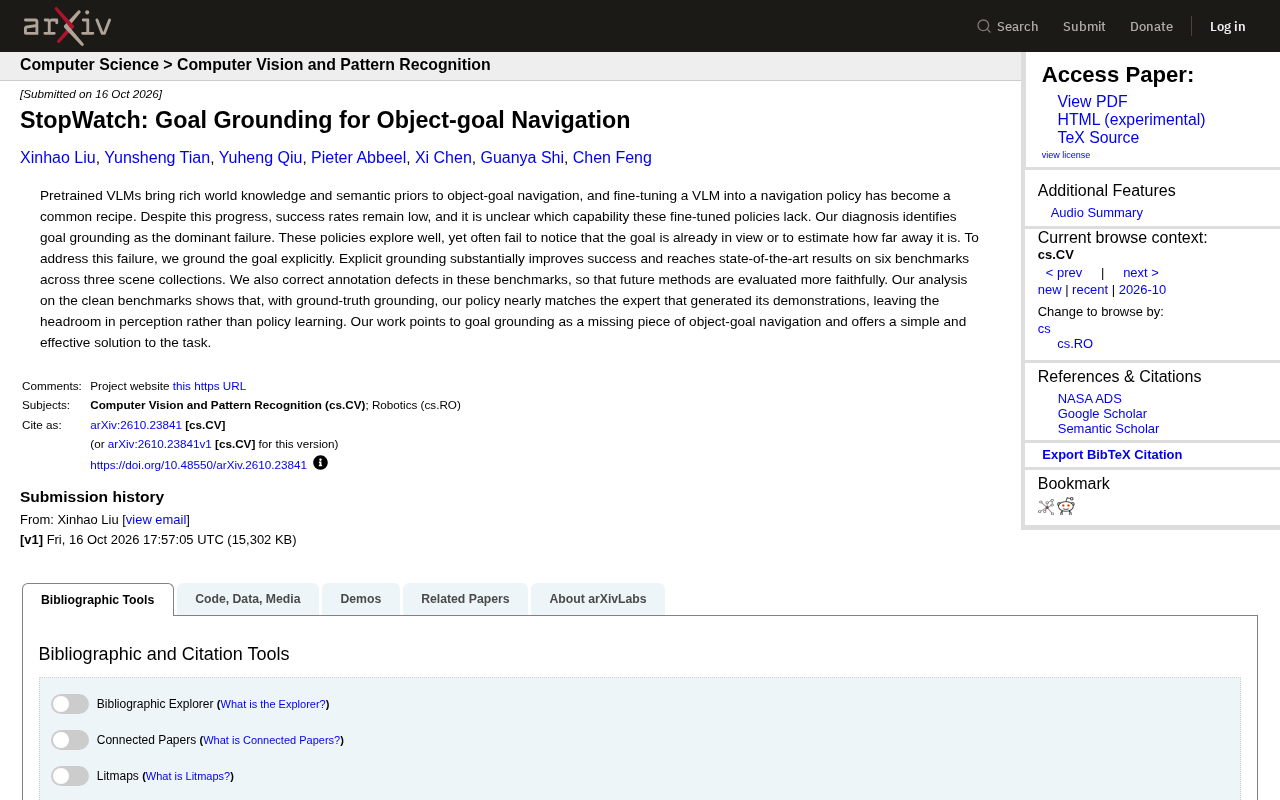
Object-goal navigation requires an agent to find a specified object in an unfamiliar environment and is one of the core tasks of embodied intelligence. In recent years, researchers have often fine-tuned pretrained vision-language models (VLMs) into navigation policies, leveraging their rich world knowledge and semantic priors to improve performance. However, an awkward fact remains: even after fine-tuning, navigation success rates are still low, and the reasons for failure have lacked systematic diagnosis. The StopWatch work provides a clear answer—Goal Grounding is the main bottleneck constraining success rates—and proposes a simple yet effective solution.
Problem Diagnosis: Policies Explore but Do Not "See" the Goal
The StopWatch authors conducted an in-depth analysis of existing fine-tuned policies and found that while these policies perform reasonably well at exploring the environment, they generally lack two key capabilities: first, when the target object is already in view, the policy cannot "notice" it; second, it is difficult to accurately estimate the distance between the target object and itself. In other words, the agent "passes by but misses it," or "sees it but does not know how far away it is." This failure mode is attributed to goal grounding failure—the policy fails to establish an explicit association between the goal in the language instruction and the object in the visual observation.
This diagnosis explains why simply adding data or extending training yields limited gains: the problem is not exploration capability but goal perception and localization.
Goal Grounding is a core concept in vision-language navigation and embodied intelligence, referring to the agent's ability to establish a correspondence between the goal described in a natural language instruction (e.g., "find a chair") and a specific object instance in the visual observation. It involves three levels: goal detection (whether the goal exists in view), goal recognition (which object is the one referred to by the instruction), and goal localization (the goal's position in space and its relative distance to the agent). Goal grounding failure means the semantic bridge between language and vision is broken, and the agent cannot associate the goal with the task even if it "sees" it. This concept differs from visual grounding, which is typically done in static images, whereas goal grounding in embodied settings must be performed online and continuously, and is affected by viewpoint changes, occlusion, and motion, making it significantly harder.
Inductive Bias refers to the prior constraints a model imposes on its hypothesis space during learning, making it more inclined to learn a certain class of solutions. For example, the local connectivity and translation invariance of convolutional networks are inductive biases, and the assumptions of recurrent networks about temporal dependencies are also inductive biases. In embodied navigation, embedding "goal grounding" as an explicit intermediate representation into the policy is equivalent to injecting a structural inductive bias of "first localize the goal, then decide" into the model, rather than hoping the VLM implicitly learns this association from massive data. The effectiveness of StopWatch shows that when the task itself has clear structure (e.g., goal visibility judgment, distance estimation), explicitly modeling that structure improves generalization and sample efficiency more than merely scaling up the model. This forms a useful complement to the "scale is all you need" scaling-law mindset.
Solution: Explicit Goal Grounding, Simple yet Effective
In response to the above diagnosis, StopWatch chooses to make the goal grounding process explicit rather than relying on the VLM to implicitly learn this association. Specifically, the policy is made to explicitly localize the goal, determine whether the goal is visible, and estimate relative distance when making decisions. This explicit grounding brings significant performance gains, achieving State-of-the-Art results on six benchmarks across three scene collections.
You may not have noticed that the method introduces no complex network architecture or large-scale additional training; its effectiveness precisely demonstrates that in object-goal navigation, the right inductive bias matters more than model scale.
State-of-the-Art (SOTA) refers to the best performance achieved among currently published methods on a given benchmark. In object-goal navigation, common benchmarks include scene datasets such as HM3D, MP3D, and RoboTHOR, with evaluation metrics primarily being Success Rate and Success weighted by Path Length (SPL). Notably, SOTA comparisons must be based on consistent evaluation benchmarks and reliable annotations; otherwise, comparisons between different methods may be distorted. StopWatch both corrects benchmark annotation flaws and reports SOTA. Its significance lies in two aspects: on one hand, the performance gains are supported by clean evaluation; on the other hand, it suggests that some previously reported results may have been affected by annotation noise, and the community needs to re-examine the reliability of historical results.
Correcting Annotation Flaws: Making Evaluation More Trustworthy
Another contribution of StopWatch is correcting annotation flaws in existing benchmarks. The authors found annotation errors in these benchmarks that could distort evaluation results—some "failure" cases were actually annotation problems rather than policy problems. The corrected clean benchmarks make comparisons between different methods fairer and more trustworthy, and provide a more reliable evaluation foundation for future research. This work reminds the community: before pursuing higher success rates, first ensure the evaluation itself is accurate.
Analysis: Perception Is the Real Ceiling
Further analysis on the clean benchmarks reveals a key conclusion: when provided with ground-truth goal grounding information, the StopWatch policy's performance nearly matches the expert policy that generated its demonstration data. This means the current system's performance ceiling is mainly limited by perception capability, not policy learning itself. In other words, the navigation policy learning framework is already good enough; the bottleneck lies in how to accurately and robustly perform goal grounding from raw visual input.
This finding points the way for future research: rather than continuing to compete on policy optimization, it is better to invest more effort in solving perception-level goal localization and distance estimation.
Expert Policy in the imitation learning paradigm refers to the reference policy used to generate demonstration data, typically a planner or human operator based on ground-truth environment state information (e.g., true object positions, maps). Because the expert policy can access privileged information, its performance is often regarded as an upper-bound reference for the task. StopWatch finds that when the policy is provided with ground-truth goal grounding information, its performance approaches the expert policy. This comparison reveals two things: first, the policy learning framework (learning decisions from demonstrations) is already powerful enough and is not the bottleneck; second, the output error of the perception module is the main source of performance loss. This analysis paradigm—using privileged information for ablation to locate the bottleneck—has general methodological value in embodied intelligence research.
Implications for Embodied Intelligence Research
The value of StopWatch lies not only in setting records on six benchmarks but also in providing a research methodology: first diagnose the root cause of failure, then design a targeted solution. At a time when VLMs are widely used for embodied tasks, this work reminds researchers that the semantic priors brought by pretrained models cannot automatically solve all problems, and explicit task structure design remains irreplaceable. Goal grounding, as the missing link in object-goal navigation, may also have solutions that transfer to broader vision-language navigation tasks.
One-line Summary
StopWatch diagnoses goal grounding as the main bottleneck in object-goal navigation, achieving SOTA on six benchmarks after explicit grounding.
Paragraph Summary
StopWatch systematically diagnoses the low success rates of VLM fine-tuned policies in object-goal navigation and finds the root cause is goal grounding failure: policies struggle to notice goals already in view and cannot accurately estimate goal distance. To address this, the authors make goal grounding explicit, enabling the policy to explicitly localize the goal, judge visibility, and estimate relative distance, achieving SOTA on six benchmarks across three scene collections without complex network architectures. Additionally, the work corrects annotation flaws in existing benchmarks, making evaluation more trustworthy; analysis on clean benchmarks shows that with ground-truth grounding information, policy performance approaches expert demonstrations, indicating the performance ceiling lies in perception rather than policy learning and pointing the way for future research.
Related articles

A Single Prompt Triggers a Global PHP Security Storm: Is AI a Savior or a Hidden Risk?
A single AI prompt triggered a global PHP security crisis affecting Wikipedia and the Internet Archive. This article reviews the incident, analyzes the OpenAI-Amazon controversy, and explores the security paradox of lowered vulnerability discovery barriers in the AI era and developer response strategies.

When AI Is Taken Away: How Reliance on Shortcuts Undermines Your Problem-Solving Resilience
A study of 1,222 people found that after using AI to answer questions, once AI was removed, people gave up on more problems than a control group that never used AI. The article analyzes the impact of AI reliance on learning resilience and metacognition, and explores design implications for AI learning tools.

Carta and NewView Partner to Let Startup Employees Cash Out Equity Early
Carta and NewView Capital partner to simplify startup tender offers, helping employees sell equity early. Analysis of the mechanism, liquidity pain points, and impact.