Strict: Turn Idle Mac and Linux Machines into Free GitHub Actions Compute

Strict turns idle Mac and Linux machines into a self-healing GitHub Actions runner cluster, cutting CI compute costs to zero.
Strict is a new tool on Product Hunt that connects idle Mac or Linux machines to GitHub Actions, forming a self-healing, auto load-balanced runner cluster that cuts CI compute costs to $0/min, especially for expensive macOS builds. It adds 7-level disk cleanup, preflight Doctor, Tailscale-native networking, a zero-account design, and a native macOS app. It suits developers with spare hardware who are sensitive to macOS CI costs, though hardware, power, and network stability remain their own responsibility.
From Idle Hardware to Free CI Compute: Strict's Positioning
GitHub Actions' hosted runners are convenient, but the per-minute cost of macOS instances has always been a hidden expense for development teams. Strict, a new tool that appeared on Product Hunt, aims to change this: it connects your idle Mac or Linux machines to GitHub Actions, forming a self-healing, automatically load-balanced runner cluster that pushes compute costs down to $0/min.
The project's core proposition is straightforward—you no longer need to pay for CI macOS minutes. As long as you have a spare machine with internet access, Strict can turn it into a GitHub Actions execution node. The product received 76 votes and ranked #18 on Product Hunt, showing that it hits a real need among developers for CI cost reduction and hardware reuse.
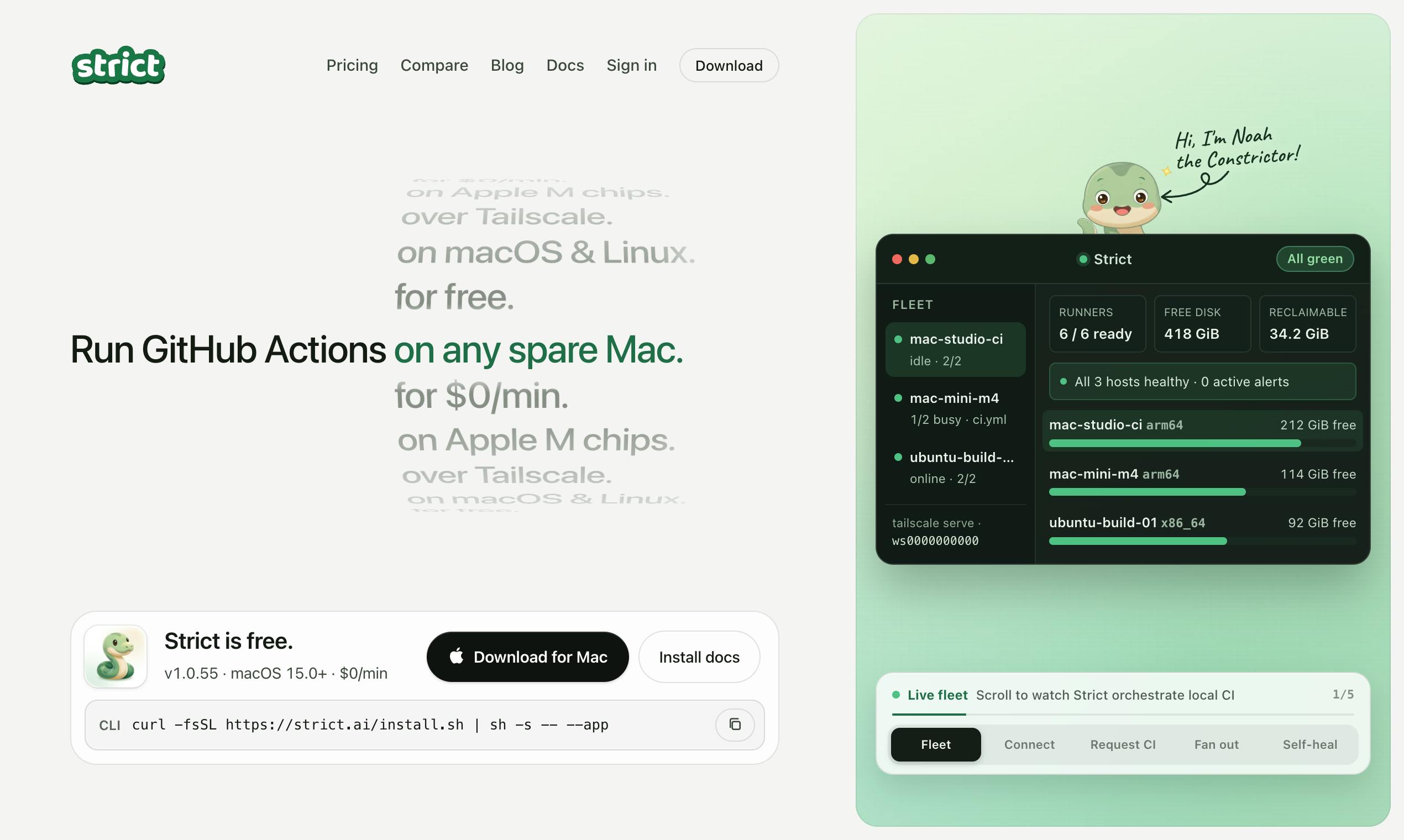
GitHub Actions self-hosted runners are a mechanism GitHub provides: pipeline tasks no longer run on GitHub-hosted machines but are executed by machines you register yourself. Developers just run the runner program provided by GitHub on the target machine and complete registration; the machine then appears in the repository or organization's runner list, available for workflows to target via runs-on. Self-hosted runners themselves don't incur GitHub minute charges, but the execution environment, system updates, dependency caches, and disk space are all maintained by the user. Strict essentially adds an orchestration layer on top of this mechanism: it handles registration of multiple machines, task distribution, and health management on the user's behalf, turning "manually maintaining several runners" into "hosting a runner cluster." Understanding this makes it clear that Strict doesn't bypass GitHub Actions—it reuses its self-hosted channel.
Core Capabilities: More Than Just "Connecting Machines"
Self-Healing and Automatic Load Balancing
Strict organizes multiple machines into a runner cluster and has built-in automatic load balancing that distributes tasks to relatively idle nodes. The self-healing mechanism means that when a node goes offline or misbehaves, the cluster can handle it on its own rather than letting the pipeline stall. For anyone building their own CI, these two points determine whether the system can truly run unattended over the long term.
7-Level Disk Cleanup
The most common operational pain point for self-hosted runners is disks being blown out by build caches and dependencies. Strict provides a 7-level disk cleanup mechanism that reclaims redundant data at different tiers. This is a classic "only someone who has actually run self-hosted runners would think of this" feature, and it also shows the author has given real thought to long-term stability.
Preflight Doctor
Preflight doctor checks the health of the environment before formally taking on tasks, surfacing configuration issues early. Rather than waiting for a pipeline to fail and then investigating, preflight catches problems at the startup stage.
Tailscale-Native Integration
Strict uses a Tailscale-native networking approach, so runners don't need to be exposed directly to the public internet, and there's no need to set up complex network relays. Combined with a "zero-account" design—no Strict account registration required—the deployment barrier is further lowered.
Tailscale is a zero-config virtual networking service built on WireGuard. It connects devices scattered across different networks into a flat private network (a tailnet), with devices connecting directly through encrypted tunnels—no public IP, port forwarding, or central gateway required. For self-hosted CI runners, this solves a long-standing pain point: GitHub needs to be able to reach the runner, but runners are often located on home networks or internal networks. The traditional approach is to use tunneling tools like ngrok or to expose ports directly—the former adds extra dependencies, the latter poses security risks. Tailscale-native means Strict directly leverages this networking capability to make runners reachable within a private network, eliminating the need to set up network relays and avoiding exposing machines to the public internet.
Product Form: A Native macOS App
Strict offers a native macOS app, and its description uses the "Liquid Glass" UI style. For Mac users, this means managing a runner cluster doesn't have to be all command-line; the graphical interface lowers the operational cost of daily maintenance. Combined with the GitHub category and the Mac and developer tools tags, Strict's target users skew toward individual developers and small teams who develop on Macs.
Who Should Use Strict
The first group is developers with an idle Mac mini or old Linux box, especially teams that need to run macOS build tasks (such as iOS-related pipelines)—hosted macOS runners are usually the most expensive, so self-hosting delivers the most obvious value there.
The second group is teams that are sensitive to CI costs but don't want to sacrifice the GitHub Actions workflow experience. Strict doesn't replace GitHub Actions; it replaces the compute source behind it, so migration costs are relatively manageable.
Keep in mind that self-hosting runners means you're responsible for hardware, power, and network stability. Strict's self-healing and preflight features reduce operational burden but can't eliminate physical-layer risks. Also, product information currently comes mainly from the Product Hunt launch page, so the long-term maintenance cadence and community ecosystem remain to be seen.
On cost comparison, it's important to distinguish between two types of runners. GitHub-hosted Linux runners are free for public repositories and billed per minute for private repositories at a relatively low rate; whereas macOS hosted runners have a significantly higher billing multiplier, typically several times to ten times the Linux rate, with very limited free allowances. For teams that frequently run Xcode builds, iOS signing, and simulator tests, macOS minutes often make up the bulk of the CI bill. This is exactly where self-hosted Mac runners shine: a single idle Mac mini can cover a small-to-medium team's daily build volume, with marginal compute cost approaching zero—trading off against hardware depreciation, electricity, and operational effort. When evaluating whether it's worth it, these hidden costs should be weighed together with the minute charges saved.
One-Line Summary
Strict combines "idle hardware reuse" with "GitHub Actions cost optimization," filling in the engineering details of self-hosted runners with self-healing clusters, disk cleanup, preflight checks, and Tailscale integration. For developers with spare machines who want to cut their CI bills, it's a tool worth adding to the watchlist.
One-line Summary
Strict turns idle Mac and Linux machines into a self-healing GitHub Actions runner cluster, driving CI compute costs to zero.
Paragraph Summary
Strict is a new tool that appeared on Product Hunt. It connects idle Mac or Linux machines to GitHub Actions, forming a self-healing, automatically load-balanced runner cluster that brings CI compute costs down to $0/min—especially targeting expensive macOS build scenarios. The product fills in many engineering details of self-hosted runners: 7-level disk cleanup to handle cache bloat, preflight Doctor to catch environment issues before taking on tasks, a Tailscale-native networking approach to avoid public exposure, a zero-account design to lower the deployment barrier, and a native macOS app for easy daily management. It suits developers and small teams with spare hardware who are sensitive to macOS CI costs, but hardware, power, and network stability remain their own responsibility, and the product's long-term maintenance cadence remains to be seen.
Related articles

Nothing CMF Buds 2A Drops to $17.89 on Black Friday: A New Low for ANC Earbuds
Nothing CMF Buds 2A wireless earbuds Black Friday deal: just $17.89 on Amazon, about $11 off retail and a record low. ANC earbuds at an entry-level price.

When AI Creation Gets Accused of "Spitting": Hacker News Heats Up Over the Glaude Controversy
A Hacker News post, "Spitting in the Face of Glaude," sparks debate on AI creation transparency and attribution ethics. This analysis examines the blurred creator identity behind the controversy and offers practical advice for AI content production.

Akai Embraces Custom Firmware: MPC Sample 1.4 Lets Users AI-Program Their Sampler
Akai embraces the modding community with MPC Sample 1.4 firmware, supporting vibe-coded custom firmware and effects. We analyze the impact of this open strategy on music hardware and AI-assisted programming.