Strong Orchestrator Models Boost Local Small Models 2.6x Faster: A GPT-4.1 Sol Real-World Test

Cloud model orchestrating a local small model achieved 2.6x speed boost and 77% cost reduction in real-world tests.
A developer discovered that a hybrid architecture using GPT-4.1 Sol as orchestrator and a local Qwen 27B as executor reduced costs from $0.75 to $0.17 for three programming tasks while making the local model ~2.6x faster — even enabling it to complete a task it couldn't finish alone. The author hypothesizes that small models waste most of their time on decision-making rather than generation, and that clear orchestration eliminates this bottleneck. The findings suggest orchestration architecture delivers speed and reliability gains beyond cost savings, though the small single-run sample size calls for more rigorous validation.
An Unexpected Discovery
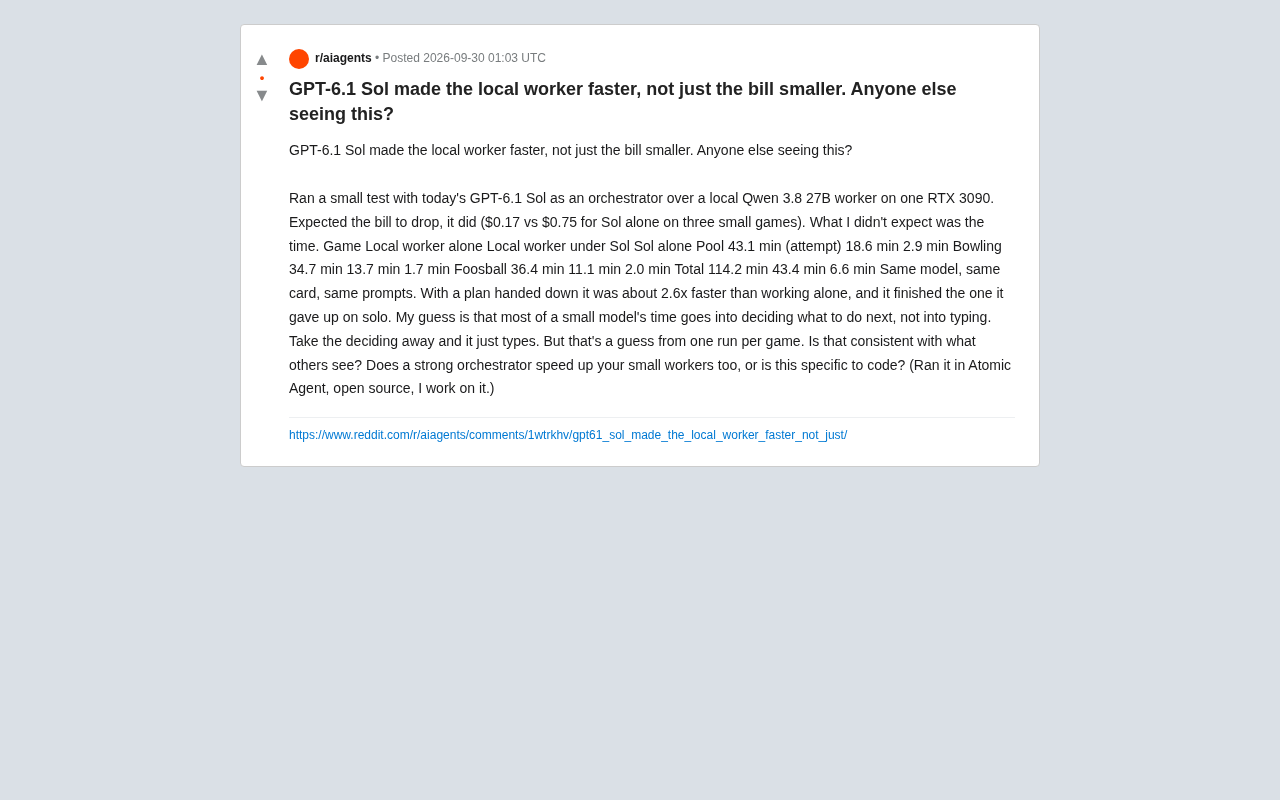
A developer shared an interesting set of experimental data on Reddit: when he used GPT-4.1 Sol as an "orchestrator" to direct a local Qwen 3.8 27B model running on a single RTX 3090 to complete tasks, he originally only expected a cheaper bill — and indeed it was cheaper (three small game tasks dropped from $0.75 with Sol alone to $0.17).
What truly surprised him was the speed. Same model, same GPU, same prompts — but with a "top-down" execution plan in place, the local small model finished tasks in barely half the original time.
This observation touches on an often-overlooked question: where does a small model actually spend its time?
GPT-4.1 Sol (referred to as GPT-6.1 Sol in the original post, possibly the author's shorthand for the model series) is OpenAI's cloud-based reasoning model aimed at developers, known for strong instruction-following and planning capabilities, but billed per token at relatively high cost. The Qwen 3 series are open-source multi-scale language models from Alibaba Cloud. The 8B/27B parameter versions can run locally on consumer-grade GPUs (such as the RTX 3090 with 24GB VRAM) at near-zero inference cost, but lag behind top-tier cloud models on complex planning tasks. This "cloud large model + local small model" hybrid approach has grown increasingly popular in recent years as open-source model quality improves and local inference frameworks (llama.cpp, vLLM, etc.) mature.
What the Data Shows
The author ran three small programming game tasks inside the open-source framework Atomic Agent (which he helped develop), comparing three configurations: local small model working alone, local small model orchestrated by Sol, and Sol working alone. Results:
| Task | Local Model Alone | Local Model + Sol Orchestration | Sol Alone |
|---|---|---|---|
| Pool (Billiards) | 43.1 min (attempt) | 18.6 min | 2.9 min |
| Bowling | 34.7 min | 13.7 min | 1.7 min |
| Foosball | 36.4 min | 11.1 min | 2.0 min |
| Total | 114.2 min | 43.4 min | 6.6 min |
The data shows the local model under orchestration was approximately 2.6x faster than working alone. Even more notable is the Pool task — the local model running solo is marked as "attempt," meaning it failed to complete it independently. With Sol providing a plan, it successfully finished a task it had previously given up on.
A Key Hypothesis: Small Models Spend Their Time on "Decision-Making"
The author offers an insightful conjecture:
Most of the small model's time is probably spent "deciding what to do next" rather than "typing" (i.e., generating code) itself. Remove the decision-making step, and it just has to faithfully produce output.
If this hypothesis holds, it would change how we understand the performance bottleneck of small models. We traditionally tend to think small models are slow because they "compute slowly" or "lack capability." But this data suggests the bottleneck may lie more in planning and reasoning confusion — without a clear path, small models repeatedly waver, trial-and-error, and reconsider, consuming enormous amounts of tokens and time.
Once a more powerful model breaks the task into clear steps, the small model's role degrades from "think and do" to "just do," and efficiency naturally improves dramatically. This also explains why it can complete tasks it previously abandoned: it's not that the model suddenly became smarter, but that it's no longer stuck in a decision-making loop.
To understand this hypothesis from a token generation perspective: a language model's inference time consists mainly of two phases — "prefill" (processing the input prompt) and "decode" (generating tokens one at a time). Without a clear plan, a small model often needs to re-evaluate the current state, revisit context, and generate large amounts of intermediate reasoning text at every step — all of which extends the decode phase and increases total token count. Once the orchestrator has pre-generated structured execution steps, each call to the small model has a shorter input and clearer task boundaries, dramatically reducing the tokens needed in the decode phase and manifesting as an overall speed improvement. This mirrors the inverse perspective of Chain-of-Thought (CoT) prompting: CoT has the model generate its own reasoning steps to improve accuracy, while the orchestration pattern has an external strong model handle the reasoning steps, allowing the weaker model to skip that overhead.
The Value of Orchestration Architecture: More Than Just Saving Money
This type of "strong model orchestration + weak model execution" architecture has become increasingly common in recent years, typically viewed as a cost optimization strategy — using cheap local models to handle most of the compute while only calling expensive cloud models at critical decision points.
But this real-world test introduces a new perspective: the value of orchestration may go beyond cost savings and simultaneously improve execution speed and success rate. If the strong orchestrator's planning capability can significantly reduce the weak executor's wasteful exploration, then this architecture becomes a triple win — faster, cheaper, and more reliable — rather than a trade-off between cost and quality.
For developers deploying LLMs locally, this means small models on a single consumer-grade GPU (like an RTX 3090), paired with a good cloud-based orchestration layer, may be capable of handling far more complex tasks than previously imagined.
"Strong model orchestration + weak model execution" is typically referred to in academic and engineering contexts as LLM-as-Orchestrator or Multi-Agent architecture. The core idea is to decompose a complex task into two layers — "planning" and "execution": the orchestration layer (Orchestrator) handles task understanding, decomposition, and step assignment, while the execution layer (Worker/Executor) only needs to sequentially produce results for clearly defined subtasks. The theoretical basis comes from the concept of "working memory load" in cognitive science — when an agent simultaneously handles both planning and execution, the two types of cognitive load compound and reduce efficiency; splitting them allows each layer to focus on a single responsibility, significantly improving overall throughput. Atomic Agent is the open-source framework the author developed, providing a standardized interface for defining orchestrator and executor roles and managing message passing between them.
Reasons for Caution
The author himself is quite restrained in emphasizing the limitations of this test:
- Extremely small sample: Each game was run only once, lacking repeated experiments to rule out randomness.
- Narrow task scope: All three were small programming games; conclusions may not generalize to other domains.
- Conflict of interest: He is the developer of the Atomic Agent framework, and the test environment may carry inherent bias toward his conclusions.
He therefore proactively asked the community to verify: is this phenomenon of a "strong orchestrator accelerating a small model" consistent with others' experiences? Is it specific to programming tasks, or a more universal pattern?
Conclusion: A Question Worth Reproducing
This single data point from Reddit is fundamentally a hypothesis awaiting validation, not a definitive conclusion. Its value lies not in those specific numbers (2.6x, $0.17 vs. $0.75), but in how it brings a typically overlooked question to the surface:
When we have strong models "assign work" to weak models, what exactly are we optimizing — cost, speed, or task success rate?
If you're working on a local model + cloud orchestration architecture, consider running more rigorous repeated experiments to verify this phenomenon. If it can be reliably reproduced, its implications for edge deployment and cost-sensitive AI applications would far exceed the significance of one accidental test.
Related articles

ProTok: A Unified Protein Tokenizer via Multi-Codebook Quantization
ProTok introduces a unified protein tokenizer using modular multi-codebook quantization and modality dropout to map sequence, structure, and function into one discrete vocabulary. It ranks 1.4 on average in StructTokenBench, reaches 0.939 lDDT on CATH, and generates 52% designable backbones.

Membership Inference Attacks on Tabular Data: An SoK Reexamination of Privacy Evaluation
An SoK paper systematically examines membership inference attacks in tabular machine learning, revealing how class granularity and majority class proportion affect vulnerability, and noting that single-out records remain highly exposed under common defenses. It calls for rethinking the privacy evaluation paradigm.

ReTerm: Teaching Terminal Agents to Recover from Their Own Mistakes
ReTerm proposes a self-recovery training method for terminal agents: SFT cold start with ReTerm-10K, then ReTerm-GRPO branching from failure states. ReTerm-9B built on Qwen3.5-9B reaches 34.8% Pass@1 on Terminal-Bench 2.0, a 14.6-point gain over the base model. Code and data are open-sourced.