Study Reveals 29.8% of AI Overview Citations Come from Sources Not on Google's First Page

Study shows nearly 30% of AI Overview cited pages are not on Google's first page, as rankings and AI citations rapidly decouple.
A peer-reviewed study from Washington University in St. Louis covering 55,000 searches reveals that 29.8% of AI Overview cited domains did not appear in the same search's first-page results. This stems from Google's "query fan-out" mechanism, which splits the original query into sub-queries and retrieves them separately, giving non-ranking pages a chance to be cited. The study also found AI Overview trigger rates depend heavily on query form—64.7% for interrogative queries versus 9.5% for non-interrogative ones. Cited sources scored higher on credibility than traditional first-page results, showing AI values credibility over markup density. Accuracy issues remain notable: only 41.9% of overviews were fully grounded, and 4% of claims directly contradicted their cited sources. The overlap between organic rankings and AI citations has fallen from 76% to 38%, pushing content strategy from single-position ranking toward broad coverage and credibility building.
Traditional SEO assumes that the pages cited by AI Overview are the same pages ranking at the top of organic search. A peer-reviewed study from Washington University in St. Louis overturns that assumption—the gap between the two is far larger than most SEO practitioners imagine.
A Large-Scale Study Covering 55,000 Searches
Published at the ACM Internet Measurement Conference, the study analyzed 55,393 Google searches over a 40-day period (March 13 to April 21, 2026). The research team collected every AI Overview, its cited sources, the first-page search results shown at the same time, and the full content of every cited webpage.
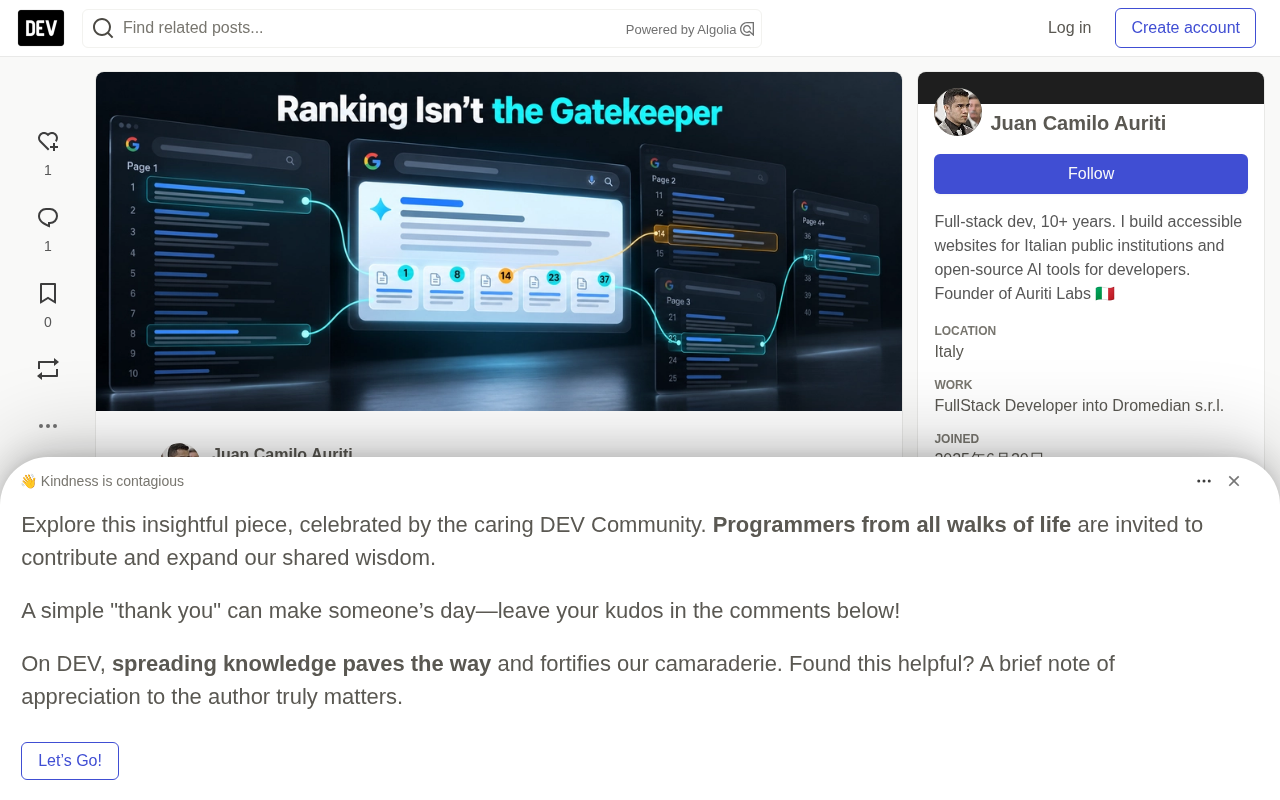
The core finding is concise and striking: 29.8% of cited domains did not appear in the first-page search results at all.
This means Google runs a source-selection mechanism for AI Overview that is independent of the traditional ranking system. Cited pages are not simply equivalent to top-ranking pages—they are retrieved through a different mechanism from a broader pool.
How Query Fan-Out Changes Citation Logic
Google's official documentation partially explains this phenomenon. AI Overview uses a "query fan-out" mechanism: the model splits the original query into multiple related sub-queries, retrieves pages for each sub-query separately, and then assembles an answer from the merged results. A page may still be cited even if it doesn't rank for the main query, as long as it answers one of the fan-out sub-queries.
This finding is cross-validated by independent data. According to Ahrefs' analysis of 863,000 keywords and 4 million AI Overview URLs, only 38% of cited pages appeared in the top 10 organic results—down from 76% in July 2025. Another analysis by BrightEdge pegged the overlap rate at 17%.
Multiple sources point to the same trend: the relationship between organic rankings and AI citations is steadily weakening.
Query Fan-out is a retrieval architecture Google introduced in AI Overview, drawing its core ideas from "Query Expansion" and "Multi-hop Retrieval" in the information retrieval field. Traditional search follows a single-round retrieval path: the user enters a query, the search engine returns a batch of matching pages sorted by relevance. Query fan-out, by contrast, breaks a single user input into several semantically related sub-queries—for example, "how to choose running shoes" might be split into "running shoe cushioning comparison," "running shoe sizing advice," and "running shoe brand reputation"—then retrieves and merges results for each sub-query, and finally hands the multi-path results to a large model to assemble into a synthesized answer.
The implication for content strategy is this: whether a page gets cited depends on whether it hits a fan-out sub-query, not on its ranking for the original main query. This explains why many non-head pages still appear in AI Overview citation lists—they answer long-tail sub-questions rather than the main keyword.
AI Overview Trigger Patterns
The WashU study also measured the frequency of AI Overview appearances, revealing a clear pattern:
- 13.7% of all searches triggered an AI Overview
- Interrogative queries triggered it 64.7% of the time, versus just 9.5% for non-interrogative queries
- Among non-interrogative searches, single-word queries triggered it 9.9% of the time, rising to 38.7% for queries of six words or more
- Topic type matters significantly: hobby and leisure searches triggered it 46.1% of the time, science 39.9%, while politics triggered it only 7.5%, and law and government 9.6%
Users who ask questions in natural language are the most likely to encounter AI-generated answers. Keyword-stuffing strategies that work in traditional SEO are actually less likely to trigger an AI Overview.
AI Overview triggering and citation are two separate stages, and understanding this distinction is critical for optimization strategy. Triggering refers to Google determining whether a given search warrants generating an AI summary; citation refers to selecting which pages from the retrieval results to use as sources after the summary is generated. A query may trigger an overview without your page being cited; alternatively, an overview may not trigger, yet your page still occupies a traditional ranking.
Research shows that trigger rates depend heavily on query form: 64.7% for interrogative queries versus 9.5% for non-interrogative ones, indicating that Google's triggering logic is essentially looking for "questions that can be answered synthetically." Interrogative pronouns (who, what, how, why) and clear intent signals make the system more inclined to launch an AI Overview. This also explains the lower trigger rates for politics (7.5%) and law and government (9.6%)—answers on these topics often require timeliness, authority, and disclaimers, so Google prefers to let users view the original sources directly rather than have the model synthesize on their behalf.
Credibility Is the Core Signal
The study rated domain credibility for 61,212 citations. The results showed that domains cited by AIO had higher average credibility scores than the traditional first-page results shown in the same search.
In other words, AI isn't picking the most heavily marked-up pages—it's picking the most credible pages. In the study, credibility was measured by a composite metric (PC1) covering domain authority, content quality, and trust signals—not a single factor that can be optimized through a particular file or tag.
Each overview cites roughly eight sources on average, with a long-tail citation distribution: the top 5 hostnames account for 20% of citations, the top 50 for 48.3%, and the remaining 43% are spread across 7,379 hostnames. There is still room in the tail for sites that aren't YouTube or Reddit, but the content must be credible and specific enough to surface through fan-out retrieval.
PC1 (first principal component) as mentioned in the study is a composite dimension extracted from multiple relevance indicators through Principal Component Analysis (PCA). The research team collected several variables—domain authority, content quality, trust signals, and others—and after dimensionality reduction via PCA found that these indicators were highly collinear on the first principal component. In other words, they all point to the same underlying factor: the domain's overall credibility. A higher PC1 score indicates stronger performance on this composite dimension.
It's important to emphasize that PC1 is not a ranking factor Google actually uses, but rather an analytical tool constructed by the researchers to quantify the abstract concept of "credibility." Its significance lies in demonstrating that AIO's source selection statistically favors high-credibility domains rather than pages with denser structured markup. For content creators, this means that "optimizable" surface-level signals like Schema markup and keyword density may carry far less weight in AI citations than deep signals that are hard to fake quickly—originality, expertise, and first-hand experience.
Accuracy Issues Cannot Be Ignored
The study broke down AI Overview answers into 98,020 atomic claims and verified each one against its cited source:
- 89% of claims were explicitly or approximately supported
- 7% were not mentioned in the cited text
- 4% directly contradicted the cited source
- Only 41.9% of overviews were fully grounded (every claim supported)
The researchers caution that the 11% error rate is an upper bound, because their analysis pipeline could not fully capture dynamic content such as Reddit posts and YouTube videos. But the finding is still noteworthy: in a significant proportion of cases, the cited sources do not support the claims being made.
Atomic claim is a decomposition method adopted by the research team to evaluate AI Overview accuracy: splitting an AI-generated answer into the smallest verifiable factual units, with each claim independently verified against its cited source. This approach draws on "claim decomposition" practices in the fact-checking field and avoids the problem of an entire passage being broadly correct while containing local errors that get glossed over.
In the study, 98,020 atomic claims were classified into three categories: explicitly or approximately supported by the source (89%), not mentioned in the cited text (7%), and directly contradicting the cited source (4%). The "not mentioned" category deserves particular attention—it means the AI may have attached content from the model's own knowledge or cross-source inference to a cited page that does not actually support the claim, creating a form of "false attribution." The researchers also note that the 11% error rate is an upper bound, because the analysis pipeline could not fully capture dynamic content from Reddit posts and YouTube videos—information in such sources may exist in reality but go uncaught. This methodological limitation suggests that AI Overview's true accuracy rate may be slightly higher than the surface number, but the problem of "cited sources not fully supporting the claims" still genuinely exists.
Three Implications for AI Search Optimization
If you're optimizing for AI search, the data points in three directions.
Ranking for the main keyword is no longer sufficient. Nearly one-third of cited pages are not in the top 10. Covering multiple related angles and sub-questions around a topic is more important than holding a single ranking position.
Interrogative queries are the main entry point. Interrogative queries have a 64.7% chance of triggering an AI Overview, versus just 9.5% for non-interrogative ones. Content that clearly answers specific questions is more likely to be retrieved through fan-out.
Credibility is the signal, not markup. Domains cited by AIO score higher on credibility, not on Schema density. Original research, first-hand experience, and expert analysis are what drive this metric. Google's own guidelines say the same thing: "non-commodity content" with a "unique perspective."
The era of optimizing for a single keyword and a single ranking position is coming to an end. The data doesn't say rankings don't matter—it says rankings are no longer the only path to a citation. The second path—through fan-out retrieval—rewards breadth and specificity rather than ranking position.
One-line Summary
Research shows nearly 30% of AI Overview cited pages are not on Google's first page, and the link between rankings and AI citations is rapidly decoupling.
Paragraph Summary
A peer-reviewed study from Washington University in St. Louis covering 55,000 searches reveals that 29.8% of domains cited by AI Overview did not appear in the first-page search results shown at the same time. This stems from Google's "query fan-out" mechanism—the model splits the original query into multiple sub-queries and retrieves them separately, giving non-ranking pages a chance to be cited. The study also found that AI Overview trigger rates depend heavily on query form, with interrogative queries triggering at 64.7% versus just 9.5% for non-interrogative ones. Cited sources scored higher on credibility than traditional first-page results, indicating that AI values credibility over markup density. But accuracy issues are pronounced: only 41.9% of overviews were fully grounded, and 4% of claims directly contradicted their cited sources. The overlap rate between organic rankings and AI citations has dropped from 76% to 38%, and content strategy needs to shift from single-position ranking toward broad coverage and credibility building.
Related articles

Full Analysis of DeepSeek's Open-Source Inference Framework DeepInfer: Inside LLM Inference Optimization
DeepSeek open-sources its inference framework DeepSeek-Infer. This analysis covers its core optimizations—speculative decoding, one-step scheduling, batch invariance, structured output—and the open-source scope.

Open-Source Models Outperform Closed-Source Flagships? GPT-5.6 Faces Open-Source Challenge
Bilibili creator discusses open-source models challenging the closed-source flagship GPT-5.6: Meta's open-source model self-reports surpassing Opus, DeepSeek's update shows impressive 3D generation, but scores lack third-party verification and local deployment barriers remain high.

One Diary Gives AI Persistent Memory: A Semantic Retrieval Solution Tested
A Bilibili creator open-sources an AI persistent memory solution: a lean persona stays in context, while dynamic info is written to a diary and retrieved semantically on demand. Hybrid vector and keyword retrieval, tested with BGE model pitfalls and fixes. Install on GitHub with one command.