SUBIT-INK v26: How a Four-Valued Belnap Bilattice Is Revolutionizing Herculaneum Papyrus Ink Detection

SUBIT-INK v26 models Herculaneum papyrus ink detection with a four-valued Belnap bilattice, improving uncertainty handling.
SUBIT-INK v26 is a recently released Reddit method for Herculaneum papyrus ink detection whose core innovation is applying a four-valued Belnap bilattice to image processing. The bilattice's four truth values — true, false, contradictory, and unknown — allow each pixel's classification to fall into one of four quadrants rather than a simple ink/non-ink binary. The article analyzes the likely technical pipeline, including evidence mapping, logical aggregation, and decision rules, and notes that its potential value lies in providing an interpretable uncertainty measure useful for human review in artifact restoration. However, the release lacks code, datasets, and quantitative results, so its actual effectiveness still requires independent verification.
When Ancient Text Restoration Meets Non-Classical Logic: The Breakthrough of SUBIT-INK v26
The Herculaneum papyri are an ancient library carbonized during the eruption of Mount Vesuvius in 79 AD. Hundreds of scrolls were turned into fragile carbon blocks by the intense heat, leaving the ink nearly indistinguishable from the papyrus substrate. Traditional imaging techniques struggle to read these texts, and SUBIT-INK v26, recently released on Reddit, proposes a new ink detection method based on a four-valued Belnap bilattice. This approach introduces non-classical logic into image processing, attempting to model four states — "ink," "papyrus," "uncertain," and "contradictory" — in order to separate ink signals more precisely.
Why a Belnap Bilattice?
The Belnap bilattice is a logical structure for handling incomplete and inconsistent information, originally developed for knowledge representation in computer science. It contains four truth values: true (T), false (F), both (B, both true and false), and neither (N, neither true nor false). In ink detection, each pixel's classification is no longer a simple binary decision (ink/non-ink) but can fall into one of four quadrants: "definite ink," "definite background," "contradictory region," or "unknown region." SUBIT-INK v26 uses this framework to upgrade pixel-level classification from threshold-based judgment to logical inference, which in theory handles ambiguous regions where ink and substrate signals overlap more effectively.
According to the original Reddit post, version v26 refines the bilattice operation rules and may introduce more sophisticated evidence combination methods. Although the post provides no specific performance figures, this line of thinking aligns with the recent trend toward "uncertainty modeling" — in fields such as medical imaging and remote sensing, four-valued logic has already been used to improve classification robustness.
Formal Background of the Belnap Bilattice
The Belnap bilattice was proposed by American logician Nuel Belnap in 1977, originally for handling potentially incomplete or mutually contradictory information in databases and knowledge bases. Its four truth values are usually denoted T (true only), F (false only), B (both true and false, i.e., contradiction), and N (neither true nor false, i.e., unknown). The bilattice structure contains two partial orders simultaneously: one captures "degree of truth" (F ≤ N/B ≤ T), and the other captures "amount of information" (N ≤ T/F ≤ B), allowing uncertainty and contradiction to be modeled separately. In image processing, each pixel can be regarded as a proposition — "this pixel belongs to ink" — with evidence potentially coming from multiple bands or modalities; the Belnap bilattice provides a formal way to combine evidence from different sources into a four-valued state, preserving contradiction and unknown information rather than forcing binarization.
Key Conjectures About the Technical Implementation
Since the original post is brief, we can only infer its technical approach from the version number and naming. Version v26 likely includes iterations in the following areas:
- Evidence mapping: Mapping multispectral or high-resolution scan data to the four bilattice values requires defining the strength of evidence that each pixel belongs to ink.
- Logical aggregation: Using the bilattice's meet/join operations to fuse multi-source information, such as results from different spectral bands or different imaging modalities.
- Decision rules: The final binarized output may be based on specific region partitions on the bilattice rather than a simple threshold.
Similar steps have been attempted in published Herculaneum papyrus research — for example, using machine learning to separate ink — but introducing a Belnap bilattice remains uncommon. The contribution of SUBIT-INK v26 may lie in engineering this logical framework and open-sourcing a reproducible pipeline.
The Meaning of Meet/Join Operations in Evidence Fusion
In the Belnap bilattice, the meet (intersection) and join (union) operations correspond to the greatest lower bound and least upper bound on the two partial-order lattices. Intuitively, meet can represent "simultaneously satisfied" or "information merging," while join can represent "either one" or "information aggregation." In ink detection, if different spectral bands or imaging modalities are treated as independent evidence sources, meet operations can fuse "ink" judgments from multiple sources: when both sources judge ink, the result is T; when both judge non-ink, it is F; when one judges ink and the other non-ink, a contradiction B arises; and when evidence is missing, the result is N. This operation rule allows the system to explicitly record evidence conflicts rather than simply averaging or voting, providing interpretable grounds for subsequent human review.
Potential Impact on the Digital Humanities Field
Reading the Herculaneum papyri is a landmark challenge in the digital humanities. Competitions such as the Vesuvius Challenge have driven the application of machine learning methods to this task. If SUBIT-INK v26 can genuinely improve ink detection accuracy — especially in low-contrast regions — it would directly benefit scrolls that have not yet been read. More importantly, four-valued logic provides an interpretable measure of uncertainty: researchers can know which pixels are "certain" and which require human review, which has practical value in artifact restoration scenarios.
However, the release currently appears only in the Reddit community, lacking peer review and benchmark data. Its actual effectiveness awaits independent verification. For researchers interested in AI applications in cultural heritage, SUBIT-INK v26 is an open-source project worth following.
Limitations and Open Questions
The original post provides no code repository link, dataset, or quantitative results, making reproduction and evaluation difficult. Whether the theoretical advantages of the Belnap bilattice translate into improved detection accuracy depends on the quality of evidence mapping and parameter tuning. In addition, ink detection for the Herculaneum papyri faces the problem of large variations in imaging conditions across different scrolls, raising doubts about the generalization ability of a single model.
Overall, SUBIT-INK v26 represents an interesting interdisciplinary attempt: using logical tools to solve image processing challenges. Its value lies not only in possible performance improvements but also in introducing a new modeling paradigm for ink detection. We look forward to more detailed technical reports and benchmark comparisons in the future.
Background
The Herculaneum Papyri and the Vesuvius Challenge
The Herculaneum papyri were excavated from a villa library in the ancient city of Herculaneum, Italy. During the eruption of Mount Vesuvius in 79 AD, they were carbonized by intense heat, becoming hundreds of tightly curled, carbonized scrolls. Because the ink and the carbonized papyrus substrate have similar chemical compositions, traditional visible-light imaging can barely distinguish between them. In recent years, researchers have used non-destructive techniques such as X-ray phase-contrast imaging (XPCI) to capture the internal structure of the papyri, and have employed machine learning to separate ink signals from high-dimensional scan data. Launched in 2023, the Vesuvius Challenge is an open competition that provides high-resolution scan data and prize money to encourage teams worldwide to develop ink detection algorithms, and it has already spurred the emergence of multiple open-source models and toolchains. SUBIT-INK v26 is a new attempt proposed against this backdrop.
Related articles
Ollama+RAG Local Knowledge Base Setup: A Step-by-Step AnythingLLM Tutorial
Based on a Bilibili tutorial, this guide details building a local RAG knowledge base with Ollama + AnythingLLM: from general LLM knowledge limits and RAG principles to document upload, vector storage, and verification.
The Ultimate Ollama Tutorial: A Beginner's Guide to Running Large Models Locally for Free
Ollama is an open-source local large model management tool supporting free download and deployment of models like DeepSeek, with command-line and Web UI, cross-platform, automatic GPU/CPU scheduling — ideal for AI beginners and private deployment.
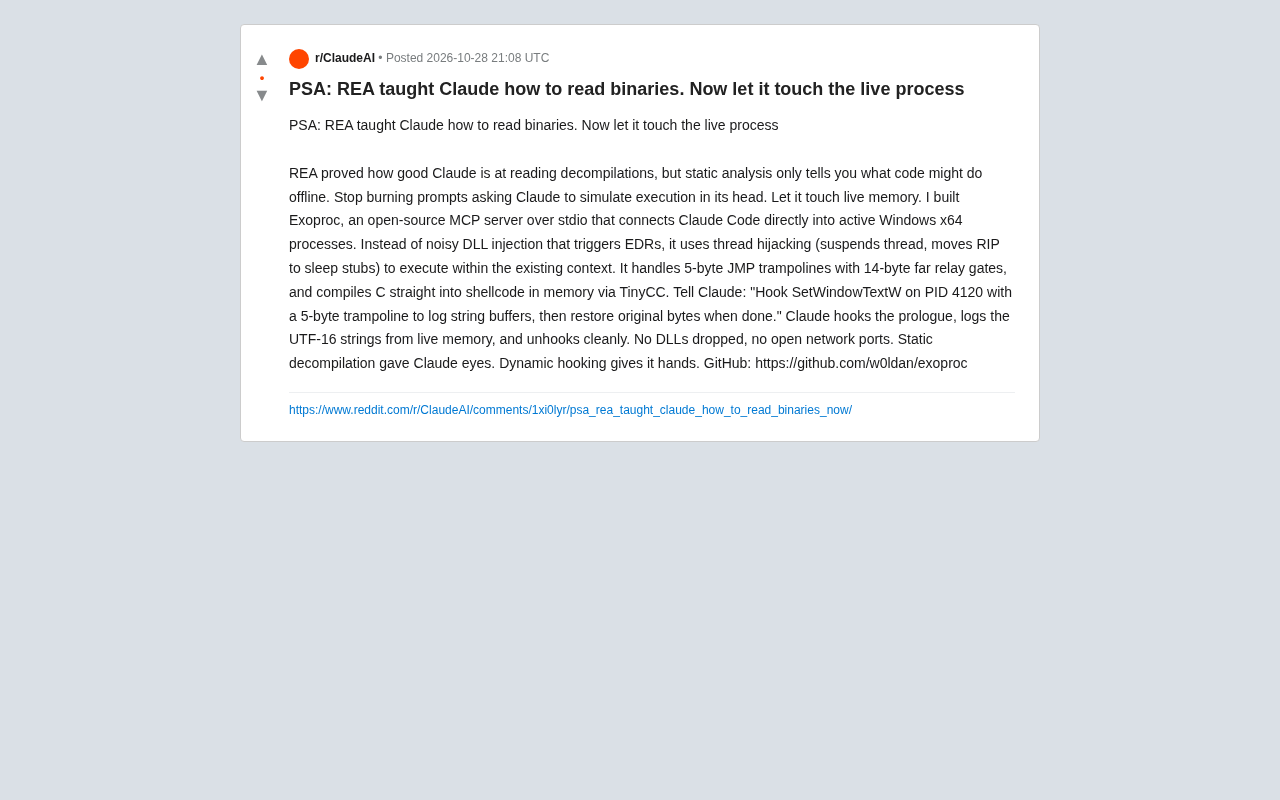
Giving Claude "Hands": Exoproc Open-Source MCP Server Enables Live Process Hooking
Exoproc is an open-source MCP server enabling Claude Code to hook live Windows x64 processes via thread hijacking, bypassing EDR for dynamic analysis. Static decompilation gave Claude eyes; dynamic hooking gives it hands.