SuperCMO AI: An Open-Source Skill That Turns Claude into an AI CMO

Open-source Agent Skill SuperCMO turns coding assistants into full-stack marketers, with human checkpoints to control rendering costs.
SuperCMO AI is the #6 open-source Agent Skill on Product Hunt, licensed under Apache-2.0, that can be injected into coding assistants like Claude Code, Cursor, and Codex to give them Chief Marketing Officer capabilities. Users provide a website URL, and the Agent learns brand tone, visual style, and selling points, then researches competitors' ads, ranks creative concepts, writes multi-platform copy, and generates UGC videos, product ads, and more. Human checkpoints prevent costly rendering, and it offers both BYOK and pay-as-you-go access.
In an era where AI coding assistants are everywhere, what would it be like to have tools like Claude Code, Cursor, or Codex step directly into the role of "Chief Marketing Officer"? SuperCMO AI, ranked #6 on Product Hunt, offers an answer: an open-source Agent Skill under the Apache-2.0 license that instantly turns your AI coding assistant into a full-stack marketing powerhouse. It's not a standalone app — instead, it injects capabilities through a "skill," enabling a general-purpose Agent to acquire end-to-end abilities in brand understanding, competitive analysis, ad ideation, and asset production.
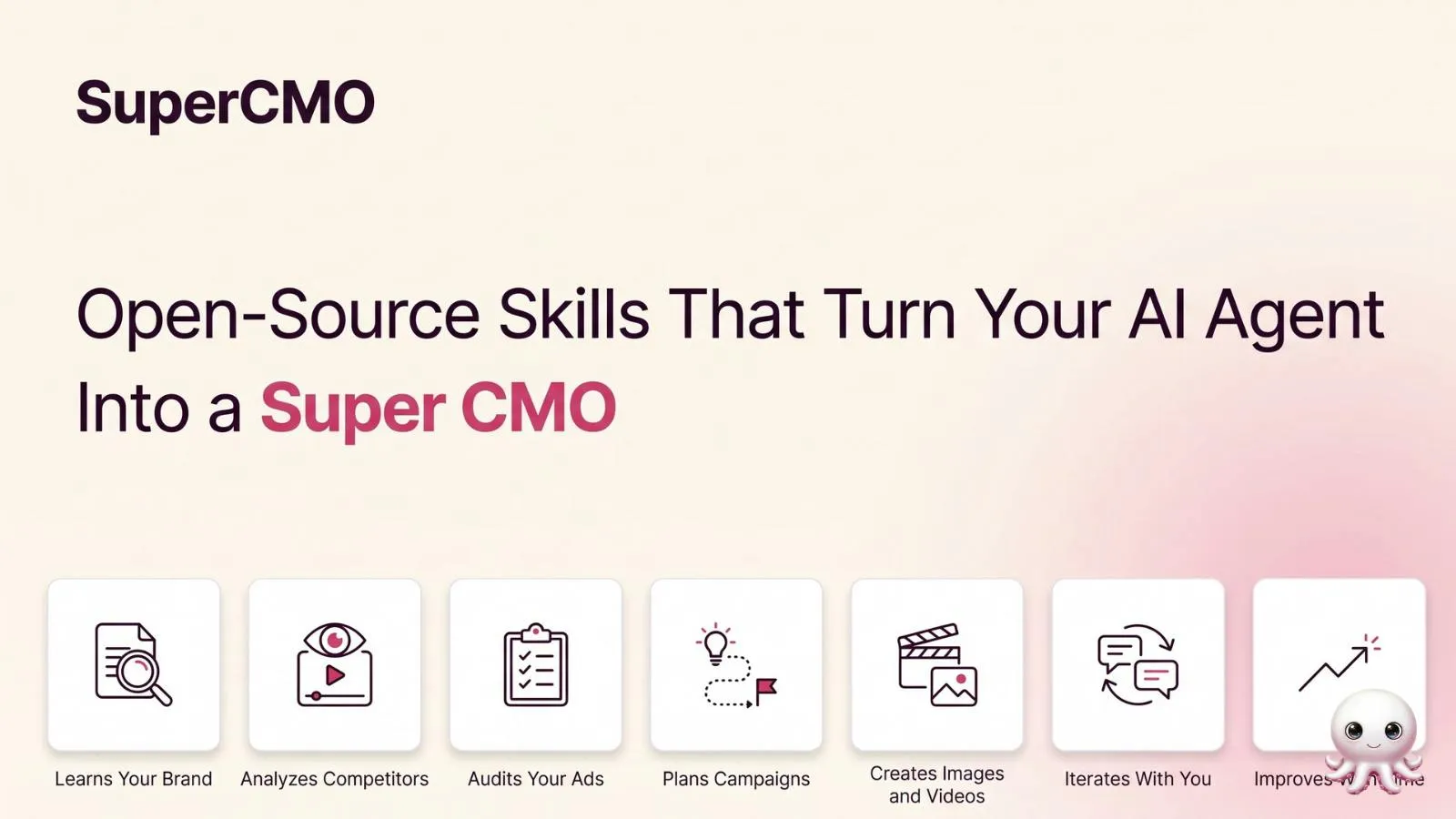
From coding assistant to marketing core: how SuperCMO works
According to its Product Hunt page, SuperCMO's core philosophy is to "teach the Agent to understand your brand." You simply hand the Agent your website URL, and it proactively learns your brand tone, visual style, and product selling points. This open-source skill guides the Agent to think like a CMO: first research competitors' ads, then rank testable ad concepts based on brand DNA, then write copy for each platform, and finally generate UGC videos, product ads, cartoon ads, image ads, and other assets directly. The entire workflow includes human checkpoints at every step, and "no expensive rendering happens until you approve" — solving the biggest pain point of AI marketing tools: runaway costs.
Agent Skills are the key mechanism here. This isn't standalone software but a "capability package" composed of natural-language instructions, tool-calling conventions, and workflow definitions that general-purpose Agents like Claude Code and Cursor can load at runtime. Once loaded, the Agent gains the role definition, workflow steps, and external tool interfaces (such as web scraping and image/video generation APIs) described by the skill, on top of its existing coding abilities. The value of this design lies in reuse: users can switch from writing code to doing marketing within the same conversational workflow without changing apps. The Agent Skills specification proposed by Anthropic is often used alongside MCP (Model Context Protocol) — the former defines "how to do it," while the latter handles "what tools to connect to." SuperCMO is precisely the application of this combined approach in the marketing domain.
Open source, flexibility, and cost control
SuperCMO AI uses the Apache-2.0 license, meaning developers can freely modify, integrate, and even commercialize it. For model access, it offers two modes — "bring your own model key" or "pay-as-you-go" — accommodating both enterprises with privacy requirements and individuals looking to try it out quickly. This design aligns with the current trend of AI tools evolving from "black-box SaaS" to "composable open-source skills."
The Apache-2.0 license is a permissive open-source license that allows users to freely use, modify, and distribute code, including in commercial closed-source products, without requiring derivative works to be open-sourced under the same license (unlike copyleft licenses such as GPL). It also includes explicit patent grant clauses, reducing legal risks for large companies integrating it commercially. For an Agent Skill like SuperCMO, Apache-2.0 means marketing teams can embed it into internal systems, modify brand analysis logic, or even package it as a paid service without disclosing their changes. The trade-off is that community contributions are not mandatory, and long-term maintenance depends on investment from the initiator or a commercial entity.
"Bring Your Own Key" (BYOK) and "pay-as-you-go" are the two mainstream billing approaches for AI tools today. BYOK means users enter their own API keys for OpenAI, Anthropic, or video generation providers, with costs settled directly with the model vendor — the tool itself doesn't take a margin. The advantage is controllable data flow, making it suitable for enterprises with compliance requirements. Pay-as-you-go means the platform procures compute centrally and resells it per-use or per-volume, removing configuration barriers but typically at a higher unit price, with data passing through the platform. By offering both, SuperCMO essentially hands the choice between "cost control" and "ease of onboarding" to the user — which is also the economic logic behind the human confirmation checkpoint in the rendering stage: video generation is billed by the second, and a single erroneous render can incur considerable expense.
Core features breakdown and use cases
- Brand learning: Analyzes website content and extracts brand identity characteristics.
- Competitive ad research: Automatically scrapes and analyzes competitors' advertising strategies.
- Creative ranking: Prioritizes creative concepts based on brand fit and expected performance.
- Multi-platform copy generation: Adapts copy style for different advertising platforms.
- Ad production: Outputs UGC videos, product ads, cartoon ads, image ads, and more.
- Human checkpoints: Each step requires user confirmation to avoid wasted rendering.
Who needs SuperCMO AI most
For indie developers, small marketing teams, or growth hackers, SuperCMO acts like an on-demand CMO consultant that significantly lowers the barrier to launching ad tests. It's especially suited for users already accustomed to using Claude Code or Cursor for daily development who want to bring marketing tasks into the same workflow. However, the product is still in its early stages, and the official description is fairly general. The actual quality of generated assets, depth of platform adaptation, and accuracy of competitive analysis still need to be validated through more user testing.
Summary
SuperCMO AI attempts to encapsulate the "marketing director" thought process into a reusable Agent Skill — a more imaginative approach than single-function AI ad tools. Its open-source nature and cost-control considerations are commendable, but whether it can produce usable ad assets in real marketing scenarios will determine whether it can move from Product Hunt's trending list to long-term retention.
One-line Summary
Open-source Agent Skill SuperCMO turns coding assistants into full-stack marketers, with human checkpoints to control rendering costs.
Paragraph Summary
SuperCMO AI is the #6 open-source Agent Skill on Product Hunt, licensed under Apache-2.0, that can be injected into coding assistants like Claude Code, Cursor, and Codex to give them Chief Marketing Officer capabilities. Users simply provide a website URL, and the Agent learns brand tone, visual style, and selling points, then researches competitors' ads, ranks creative concepts by brand fit, writes multi-platform copy, and generates UGC videos, product ads, cartoon ads, and other assets. The entire workflow includes human checkpoints — no expensive rendering occurs before approval — and offers both bring-your-own-key and pay-as-you-go access. It suits indie developers, small marketing teams, and growth hackers looking to lower the barrier to ad testing, but the product is still early-stage, and asset quality and competitive analysis accuracy remain to be validated through real-world testing.
Related articles

A New Paradigm for Text Editing in Compose: TextFieldState Replaces the Old API
Jetpack Compose introduces the TextFieldState API to fix dropped characters and cursor jumps from async input. The old value/onValueChange callbacks will be deprecated in 1.13. This article covers InputTransformation, OutputTransformation, four state hoisting patterns, and new formatted text editing capabilities.

Remote Compose: A New Document-Driven Paradigm for Cross-Platform UI on Android
Remote Compose transmits compact binary documents instead of screen pixels, enabling efficient UI rendering on remote surfaces like Wear OS and widgets. This article covers its document creation API, expression animations, size optimization techniques, and Wear OS progress.

How Crashlytics Eliminates Android Memory and Responsiveness Issues
Through the Chroma Clip case study, this article explains how Firebase Crashlytics uses Application Exit Info, Profiling Manager, GWP ASAN, and ARM MTE to pinpoint ANRs, OOMs, memory limit terminations, and native memory corruption—solving the challenge of stack traces that don't point to the real culprit.