Superhuman Go: The AI Assistant That Works Where You Do

Superhuman Go embeds AI directly into Gmail, Slack, and more — eliminating context switching as its core differentiator.
Superhuman Go is an embedded AI assistant from Rahul Vohra's Superhuman team, built on the idea that AI should work inside your existing tools — Gmail, Slack, documents, and the browser — rather than pulling you into a new interface. It offers three core capabilities: real-time phrasing suggestions, personalized draft generation that mirrors your writing style, and proactive meeting preparation. Go also introduces no-code agents that run on their own schedule to automate repetitive tasks. Debuting at #3 on Product Hunt with a free-to-start model, it marks Superhuman's strategic evolution from premium email client to AI work platform — though its ability to carve out a moat against Microsoft Copilot and Google Gemini remains to be proven.
In a crowded AI assistant landscape, Superhuman Go has taken a differentiated path — rather than building yet another standalone chat interface, it embeds AI capabilities directly into the tools you already use every day. The product debuted on Product Hunt with 121 upvotes, landing at #3 for the day, from the team behind Superhuman, led by founder Rahul Vohra.
Core Philosophy: AI Should Work Where You Work
Superhuman Go's tagline is "The AI assistant that works where you do" — a line that captures its fundamental difference from most AI tools on the market.
Most AI assistants require users to switch to a new interface: open ChatGPT, jump to a webpage, copy and paste context. That "context switching" is itself a drain on productivity. Go flips the model: instead of pulling you toward AI, it brings AI into your existing work environment — Gmail, Slack, documents, and the browser.
This embedded design philosophy is fundamentally about lowering the barrier to using AI. When a suggestion appears right next to the email you're drafting, acting on it takes no extra effort. There's no need to carve out dedicated time to "use AI."
Three Core Capabilities: Phrasing, Personalized Drafts, and Meeting Prep
According to the official product description, Go's core features are built around three high-frequency work scenarios:
Better Phrasing
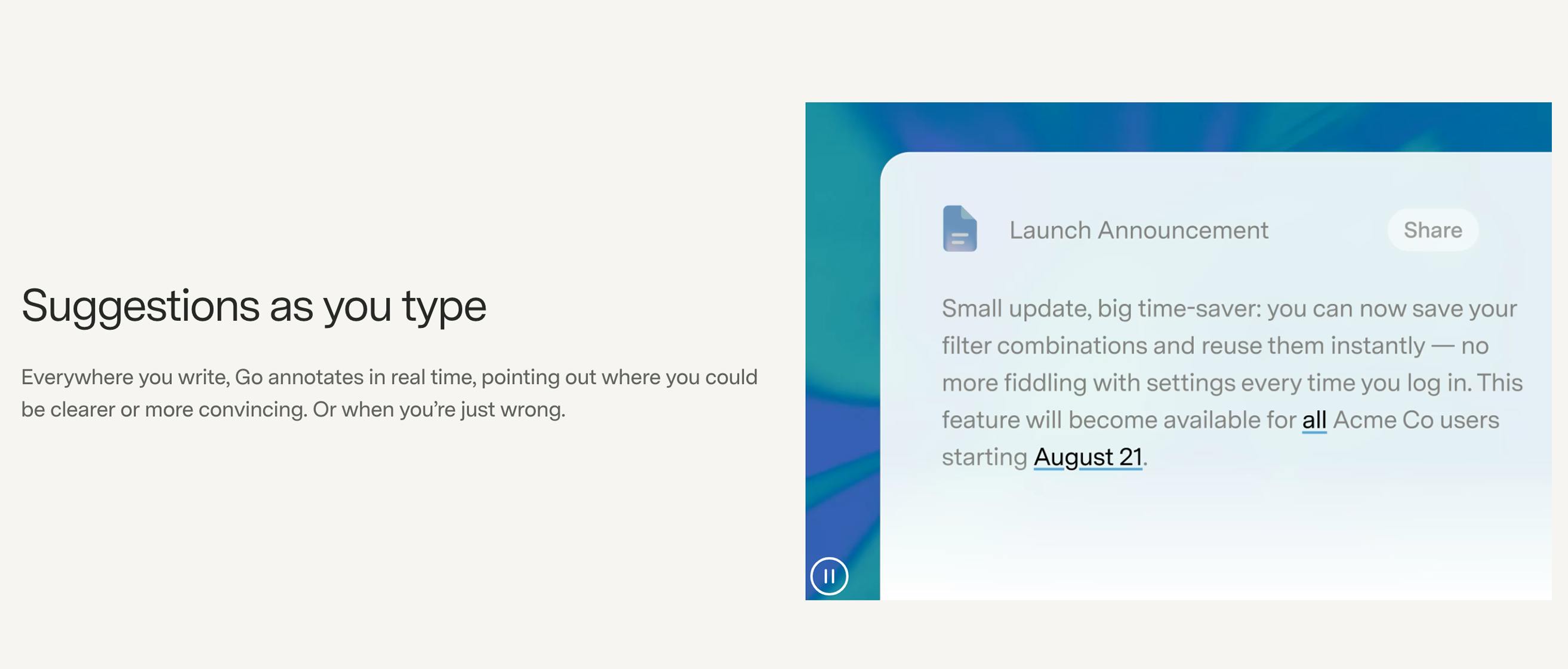
Go offers improved wording suggestions as you write. This is reminiscent of Grammarly, but backed by an LLM's contextual understanding — going beyond grammar correction to genuinely elevate the quality of your expression.
Drafts That Sound Like You
This is one of Go's key differentiators: drafted replies that actually sound like you. The biggest problem with AI-generated writing is often its generic, robotic tone. Go attempts to learn your personal writing style, producing content that feels more natural and distinctly yours. For anyone managing a high volume of emails and messages daily, this addresses a very real pain point.
Prepping Meetings
Go prepares for meetings before you even think to. That means proactively gathering relevant background, pulling up past correspondence, and ensuring you walk into every meeting with the context you need.
No-Code Agents: Automation That Runs on Its Own
Beyond its assistive features, Go introduces the concept of no-code agents — autonomous workflows that run on their own schedule.
This signals a shift from "passive assistance" to "proactive automation." Traditional AI assistants require you to initiate every request. Agents that run on a schedule mean certain repetitive tasks can be fully delegated to AI, with no human trigger required. For workflows that involve regularly consolidating information, sending updates, or following up on open items, this kind of automation offers substantial value.
The no-code framing is equally important — it means ordinary users can configure their own automated workflows without any programming knowledge, dramatically expanding the potential user base.
The concept of no-code agents draws from the broader "AI Agent" wave. Unlike traditional question-and-answer AI, agents can perceive their environment, make plans, invoke tools, and execute multi-step tasks. Go's "run on their own schedule" means these agents continuously monitor specific signals in the background — new emails, upcoming calendar events — and automatically trigger actions when conditions are met. This is similar in logic to Zapier or IFTTT, but powered by LLMs capable of handling more complex semantic reasoning. The "no-code" aspect replaces scripting with natural language or visual interfaces, enabling non-technical users to define rules like "every Monday morning, compile last week's unanswered emails and generate a summary." This pattern is also a major area of exploration for products like Microsoft Copilot Studio and Notion AI.
From Email Client to AI Work Platform
Superhuman first made its name as a premium email client — celebrated for its blazing speed and keyboard-driven experience — attracting a loyal base of productivity-obsessed professionals. The launch of Go can be read as Superhuman's strategic expansion from a single-purpose email tool to a broader AI work assistant platform.
Starting with Gmail and extending to Slack, documents, and the browser, Superhuman is bringing its philosophy of "efficiency" to cover a user's entire digital workflow. The "Free to start" pricing strategy lowers the barrier to entry and aligns with the freemium model widely adopted across today's AI tools.
Since its founding in 2017, Superhuman has long positioned itself as "the Ferrari of email" — charging $30 per month and maintaining an exclusive, invite-only model. Its core appeal has been millisecond-level responsiveness, extensive keyboard shortcuts, and a workflow designed to help users achieve Inbox Zero. This base of high-paying, efficiency-focused professionals — largely founders, investors, and tech workers — forms Go's natural seed user community. The shift from a closed, premium email client to a "free to start" cross-platform AI assistant reflects both an ambition to reach broader markets and a deliberate adaptation to the changing dynamics of user acquisition in the AI era.
What to Watch
In an increasingly crowded AI assistant space, whether Superhuman Go's embedded approach can build a durable moat remains to be seen. Its competitors include both entrenched giants like Microsoft Copilot and Google Gemini — deeply integrated into enterprise productivity suites — and a long tail of independent AI writing and automation tools.
Go's potential edge lies in its emphasis on personal voice and proactivity, combined with the Superhuman team's finely tuned product sensibility in the productivity space. Whether these principles translate into a meaningfully better user experience will ultimately determine where Go stands in this race.
Related articles

Why Does the Tesla Roadster Need to Fly? A Deep Dive into Musk's Wild Demo
Tesla's Roadster launch showed wall-climbing, upside-down driving, and flying stunts—but The Vergecast notes the demo car may lack a battery, the Rocket version is invite-only and not street-legal, and the website terms don't guarantee delivery. After nine years of delays, why does this car still need to exist?

AI Is Not a Replacement: Human-AI Collaboration Through the Lens of Factory Root Cause Analysis
Starting from factory root cause analysis, this article explains how AI accelerates evidence chain construction rather than replacing human experts, exploring the pragmatic implementation logic and business value of 'AI supporting people rather than replacing them.'

AI Agent Decision Auditing: Building an Evidence Chain in Regulated Workflows
Starting from a Reddit discussion, this article analyzes three core issues in AI agent decision auditing within regulated workflows: what fields audit records should contain, how to handle feedback latency for erroneous decisions, and how to continuously calibrate LLM judge consistency with human judgment.