SuperIntern 2.0: An AI Email & Meeting Automation Assistant Embedded in Your Chat App

AI assistant embedded in chat apps that auto-drafts emails, manages meetings, and tracks follow-ups.
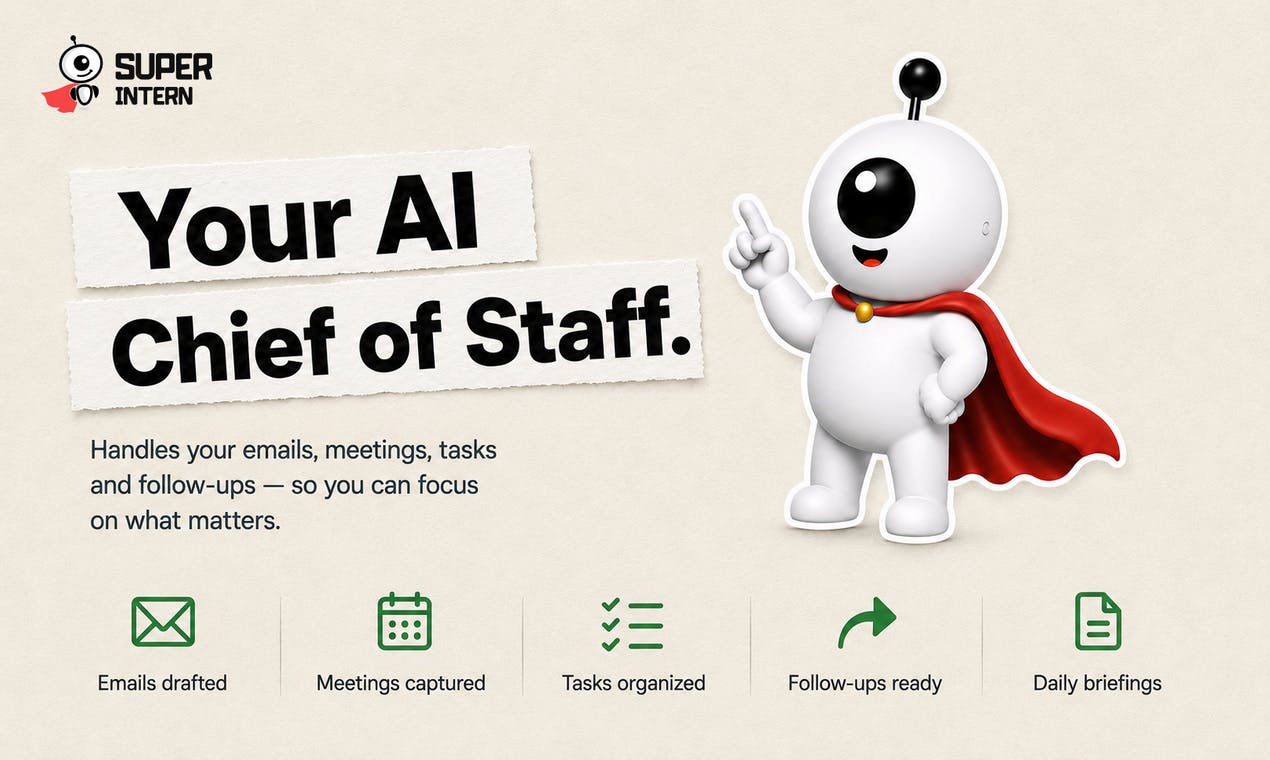
SuperIntern 2.0 is an AI assistant designed for client-facing professionals like salespeople, consultants, and freelancers. Embedded directly into chat apps, it auto-drafts emails in your personal tone, schedules and summarizes meetings, and tracks follow-ups — all while keeping humans in the loop with approval required before any message is sent.
For client-facing professionals drowning in emails, meetings, and follow-ups every day, time is always a scarce resource. SuperIntern 2.0, recently launched on Product Hunt, aims to solve this pain point with an AI assistant embedded directly into your chat app. The product received 111 upvotes and ranked #12 on its launch day, with a clear positioning: automating the tedious work of email replies, meeting scheduling, and follow-up tracking for client-facing professionals.
What Problem Does SuperIntern 2.0 Actually Solve?
SuperIntern's core audience is client-facing professionals — salespeople, customer success managers, consultants, freelancers, and anyone who communicates with a high volume of clients daily. These roles share a common trait: the work that truly creates value gets buried under mountains of repetitive communication tasks. Writing emails, scheduling meetings, taking notes after calls, remembering to follow up — none of these are individually complex, but stacked together they become a massive efficiency drain.
The official value proposition is refreshingly direct: scale your client capacity 10x without losing control. The key phrase here is "without losing control" — as we'll see, this is a deliberate product design choice.
Three Core Features: Email Drafting, Meeting Management & Follow-Up Tracking
According to the official introduction, SuperIntern 2.0 focuses on three key capabilities:
- Auto-drafting email replies in your tone: The product learns your writing style and generates email drafts that match your personal "voice," rather than producing generic, templated responses.
- Meeting scheduling and automatic summaries: It helps coordinate meeting times and automatically generates meeting summaries afterward, eliminating the burden of manual note-taking.
- Never missing a follow-up: It automatically tracks client communication items that require follow-up, preventing important conversations from falling through the cracks.
Embedded in Chat Apps: Reducing Context Switching
The biggest difference between SuperIntern and many other AI assistants lies in its interaction medium. Instead of asking users to open yet another standalone SaaS dashboard, it embeds directly into the chat apps users are already using daily. This design decision may seem minor, but it's critical to whether a tool actually gets adopted long-term.
Professionals' attention and habits tend to be locked into a handful of high-frequency tools. Any product that requires "switching to a new interface" imposes additional cognitive overhead — and this is often the fundamental reason productivity tools eventually get abandoned. Placing an AI assistant inside the chat window means users can invoke it naturally while processing messages, with virtually zero context-switching friction.
Human in the Loop: AI Drafts, Humans Approve Every Message
At a time when there's widespread concern about AI automation "going rogue," SuperIntern explicitly emphasizes a core design principle: You approve every message before it sends.
This is a product philosophy worth paying attention to. In high-stakes scenarios like client communication, a single email with the wrong tone or incorrect information could directly damage a client relationship. SuperIntern lets AI handle the heavy lifting of "drafting" while keeping the "final say" in human hands — essentially positioning itself as a tool that augments human capability rather than replacing human judgment.
This human-in-the-loop design also alleviates users' trust anxiety about AI "speaking on their behalf" — after all, your tone and your judgment are still ultimately vetted by you.
Points of Interest and Questions Yet to Be Answered
As a newly launched product, there are several aspects of SuperIntern 2.0 that remain to be observed:
- How well does the AI tone-matching actually work? "Writing in your voice" is a common selling point among AI email tools today. Whether it performs well enough that recipients can't tell the difference requires more real-world user feedback to validate.
- How measurable is the efficiency improvement? Whether the claimed 10x client capacity is marketing rhetoric or a quantifiable real-world benefit depends on the depth of automation in follow-up tracking and meeting coordination.
- Data privacy and security boundaries: An AI assistant that needs to read your emails, meetings, and chat logs raises data processing and security concerns that are especially sensitive for client-facing users.
Conclusion: A Pragmatic Path for AI Assistant Adoption
SuperIntern 2.0 doesn't try to reinvent the concept of an AI assistant. Instead, it makes several pragmatic product choices for a well-defined niche — the communication burden of client-facing professionals: embedding into existing workflows, mimicking personal tone, and retaining human approval authority. Together, these design decisions point to a single philosophy: AI should be a lever that amplifies individual capability, not a black box that takes over human relationships.
For professionals exhausted by emails and meetings every day, tools that "quietly work in the background and hand the final call to you at critical moments" may well be one of the most practical forms of AI in workplace productivity today.
Related articles

Gemini 4 Argon Hands-On: AI Builds Board Games, Constructs Temples, and Trains Robots Autonomously
Gemini 4 Argon hands-on roundup: AI autonomously builds a desk racetrack and temple in Blender, writes a ray tracing engine, trains a humanoid robot to sink 7 shots, plus API pricing and developer access.

The Magic Octagonal Coin: Why Only 9% of People Can Predict Its Flip?
Only 9% of people can correctly predict the Magic Octagon coin flip. This article explains its spatial rotation mechanism, common cognitive pitfalls, and a new hypothesis based on Relevance Theory, exploring the limits of human spatial reasoning.

Sam Altman: AI Is Entering the Era of Scientific Discovery — Math Breakthroughs Will Replicate in Biology and Energy
Sam Altman says AI is entering the era of scientific discovery — math breakthroughs will replicate in biology, materials science, and energy to help develop new drugs and energy sources.