Superpowers Open-Source Framework: A Methodology for Making AI Coding Assistants Think Before They Code

Superpowers framework transforms AI coding from "write first" to "think first"
Superpowers is an open-source AI coding framework with 180K GitHub Stars that employs Spec First requirements clarification, TDD (Test-Driven Development), YAGNI minimal implementation principles, primary Agent–subAgent divide-and-conquer architecture, and a composable Skills system to upgrade AI from a mere code generator into an engineering partner that follows complete software engineering workflows, effectively solving the intent misunderstanding and over-engineering problems of traditional AI coding tools.
When you give an AI coding assistant a requirement, it often starts writing code without a second thought — only to produce something completely misaligned with your expectations. This isn't because the AI isn't smart enough; it's because most AI coding tools are missing a critical step from the very beginning — understanding the true intent.
Superpowers was created to solve exactly this pain point. With 180K Stars on GitHub, it's not just another code generation tool — it's a complete AI programming methodology that transforms AI from "code first, ask questions later" into "think first, then act."

Core Philosophy: Spec First — Clarify What Needs to Be Done
The biggest problem with traditional AI coding tools is that they equate "receiving instructions" with "understanding intent." When you say "build me a user login feature," the AI immediately starts generating code without knowing whether you want email or phone login, whether third-party OAuth is needed, or what the password policy should look like.
The first phase of Superpowers is Spec First — using a series of structured questions to clarify your true objectives. This isn't a simple back-and-forth Q&A; it's deep requirements elicitation. The framework guides the AI to proactively ask:
- What are the core user scenarios for this feature?
- What edge cases need to be handled?
- Where are the integration points with existing systems?
Only after requirements are fully clarified does the AI move to the next phase. This seemingly "redundant" step actually reduces rework costs dramatically down the line.
TDD + YAGNI: Enforcing Engineering Discipline on AI
Once requirements are clear, Superpowers doesn't let the AI jump straight into writing business code. Instead, it introduces two time-tested software engineering principles: TDD (Test-Driven Development) and YAGNI (You Aren't Gonna Need It).
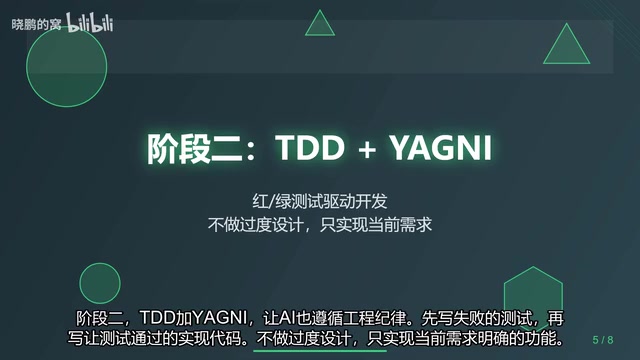
The specific workflow is:
- Write failing tests first: Based on the requirements clarified during the Spec phase, the AI first writes test cases that are guaranteed to fail in the current state
- Then write implementation code to make tests pass: The AI writes the minimal implementation needed to make the tests pass
- No over-engineering: Strictly following the YAGNI principle, only implement what current requirements explicitly demand — no preemptive "might need it later" features
The benefits are obvious. One of the most common problems with traditional AI coding assistants is "over-engineering" — you only need a simple CRUD endpoint, but it generates an entire microservices architecture. The TDD + YAGNI combination effectively curbs this tendency, ensuring AI-generated code is both verifiable and sufficiently lean.
Subagent-Driven: A Divide-and-Conquer Strategy for Complex Tasks
For complex engineering tasks, Superpowers employs a primary Agent–subAgent divide-and-conquer architecture. The primary Agent (composite Agent) breaks large tasks into multiple subtasks, then delegates them to specialized subAgents.

The elegance of this architecture lies in its review mechanism: after each subAgent completes its work, the primary Agent performs code review and validation, only proceeding to the next subtask after confirmation. This simulates the Code Review process in real teams, effectively reducing the risk of errors propagating through the task chain.
For example, when you ask the AI to implement a "file upload system with permission controls," the primary Agent might decompose it into:
- SubAgent A: Implement core file upload logic
- SubAgent B: Implement permission validation module
- SubAgent C: Implement the integration layer between both
Each subAgent works independently, and the primary Agent conducts a unified review upon completion, ensuring interface consistency between modules and overall quality.
Skills System: Composable Engineering Capabilities
Superpowers abstracts the entire development workflow into a series of composable Skills, which is the framework's most extensible design:
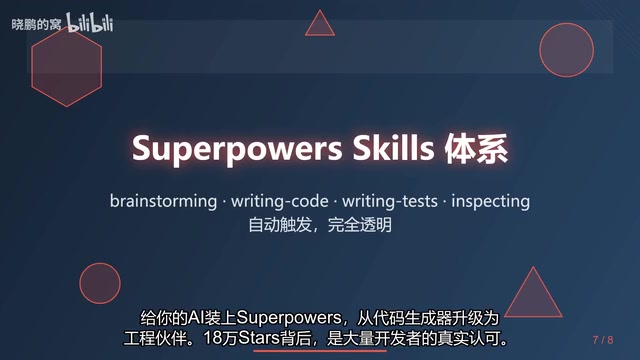
- Brainstorming: Clarify requirements before writing code, corresponding to the Spec First phase
- Writing Code: Write code following YAGNI and DRY (Don't Repeat Yourself) principles
- Writing Tests: Implement true test-driven development
- Inspecting: Trigger code review at any point
These skills can be freely combined based on project needs. For a simple script, you might only need Brainstorming + Writing Code; for a production-grade service, you can enable all skills for comprehensive engineering assurance.
From Code Generator to Engineering Partner
The core value of Superpowers isn't about making AI write more code — it's about making AI think and work like an experienced engineer. It addresses a fundamental flaw in current AI coding tools: focusing solely on code generation while ignoring the complete software engineering process.
Behind those 180K Stars is genuine recognition from a massive developer community for this philosophy. When an AI coding assistant evolves from "start coding the moment it receives instructions" to a complete workflow of "understand intent, plan the approach, test and verify, review and deliver," it truly upgrades from a code generator to a trustworthy engineering partner.
For developers already using AI coding tools like Cursor or Copilot, the methodology offered by Superpowers is worth exploring in depth — even if you don't use the framework directly, the Spec First and TDD approaches can significantly improve your efficiency when collaborating with AI.
Related articles
 Tech Frontiers
A Rare Quiet Day in AI: Recursive Self-Improvement Stirs Beneath the Surface
A rare quiet day in AI sees multiple sources go silent simultaneously. Behind the calm, Recursive Self-Improvement (RSI) research continues. What this means for the industry.
 Tech Frontiers
Reve 2 vs. Ideogram 4: A Deep Dive into Layout Control in AI Image Generation
A deep comparison of Reve 2 and Ideogram 4's layout control capabilities, covering technical approaches, real-world use cases, and industry trends for designers and creators.
 Tech Frontiers
In the Weights: Check Your Influence Score in the AI World
In the Weights is an AI influence search engine that quantifies your presence in the AI world with a score. Explore how it evaluates practitioners and what it means for digital identity.