Superset Mobile: A Practical Guide to Managing Parallel AI Coding Agents on Mobile
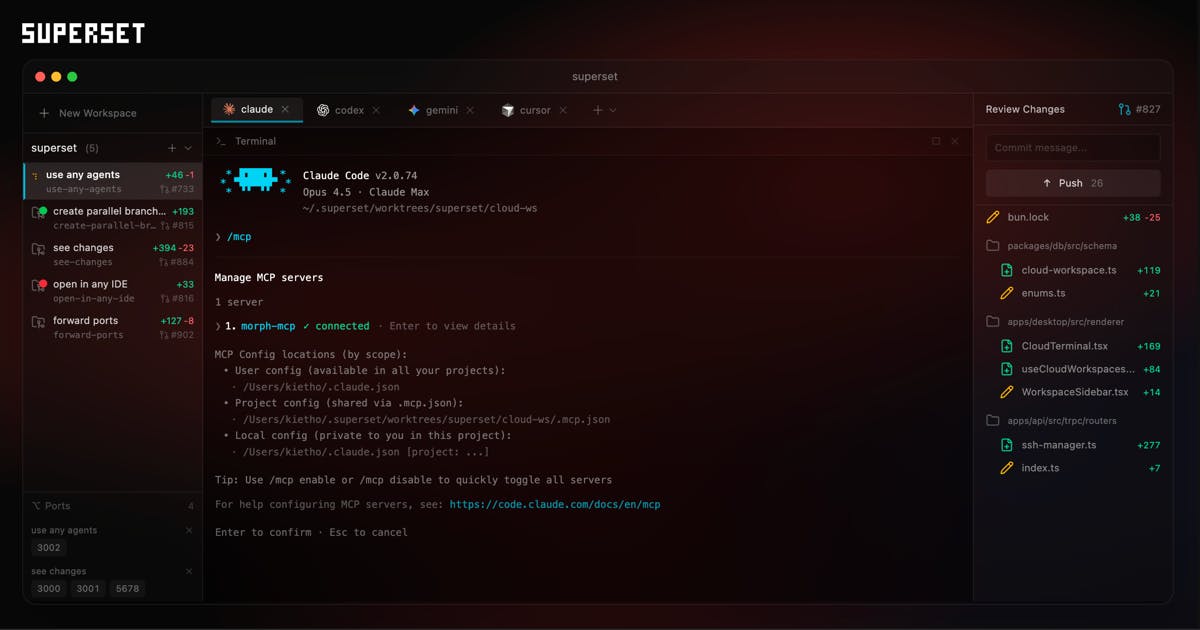
Mobile management tool for parallel AI coding agents with real-time monitoring and seamless desktop integration
Superset Mobile brings AI coding agent management to mobile devices, enabling developers to initiate tasks, monitor progress, review code diffs, and respond to agent requests on the go. By supporting parallel agent workflows and seamless desktop integration, it transforms developers into task orchestrators rather than line-by-line coders.
A New Paradigm for Mobile AI Programming Management
The rise of AI coding agents is reshaping developer workflows. A coding agent is a type of large language model application capable of autonomously understanding task objectives, planning execution steps, invoking tools (such as code editors, terminals, search engines), and iteratively completing complex programming work. Unlike early code completion tools (such as GitHub Copilot's inline suggestions), coding agents possess "goal-oriented" capabilities: given a vague requirement, they can decompose subtasks, write code, run tests, read errors, and autonomously fix issues, forming a complete closed loop. The maturity of this capability relies on breakthroughs in code reasoning and tool invocation by large models, as well as the practical implementation of reasoning frameworks like ReAct and Chain-of-Thought.
An increasing number of developers are running multiple parallel tasks simultaneously—letting agents handle time-consuming work like refactoring, testing, and documentation in the background while they focus on high-level decision-making. However, this workflow has long faced a pain point: agents can only be monitored from desktop, and once you leave your workstation, task progress becomes a black box.
Superset Mobile was born to solve this problem. As a mobile extension of the Superset workbench, it puts control of parallel coding agents directly in developers' hands, allowing you to perceive and intervene in running AI programming tasks in real-time—whether commuting, at a coffee shop, or anywhere else.
Core Features of Superset Mobile Breakdown
Task Initiation and Real-Time Monitoring
Superset Mobile allows users to initiate new coding tasks directly from their phone, without opening a computer. More critically, it provides a real-time status view of all running agents—what each agent is doing and which step it has reached, all at a glance.
For developers running multiple parallel agents, this capability's value goes far beyond "convenience." Parallel agent workflows borrow from the concurrent programming philosophy in software engineering: just as multi-threaded programs can handle multiple independent tasks simultaneously, developers can dispatch multiple agents to handle mutually independent coding tasks concurrently (e.g., Agent A refactors the authentication module, Agent B completes unit tests, Agent C writes API documentation). The core logic of this pattern is "bottleneck transfer"—in AI-assisted programming, the bottleneck is no longer code generation speed but human decision-making and quality control, so the optimal strategy is to maximize "effective decision density." In traditional workflows, developers often need to wait in front of the screen for a time-consuming task to complete or switch back to the terminal every few minutes to check logs. Mobile monitoring completely compresses this "waiting cost"—you can check the progress of three parallel tasks while waiting for the subway instead of staring at the screen.
Intelligent Notifications and Mobile Diff Review
When an agent requires human intervention, Superset Mobile proactively sends notifications. This design reflects a deep understanding of actual AI-assisted programming use cases: agents are not fully autonomous; at critical decision points (such as encountering ambiguous requirements, conflicts, or needing to confirm destructive changes), human judgment is still required.
Notably, notification strategy design is crucial in such tools. Notification fatigue is a classic problem in human-computer interaction—research shows that smartphone users receive numerous notifications daily, with many directly ignored, creating "notification blindness." For AI programming tools, finding balance between "timely notification of agent blockage" and "avoiding disruption of user flow" is essential. Common mitigation strategies include priority-based tiered notifications, aggregated similar notifications (batch notification), and predicting which blockages require immediate human intervention.
More noteworthy is the mobile Diff review feature. Diff is a core concept in version control systems: displaying file changes in a unified format, using - to mark deleted lines, + to mark added lines, and providing context lines to help locate changes. In AI programming workflows, the Diff view becomes the core interface for developers to quickly understand "what the agent did." Mobile Diff displays typically use a collapsible unified view with syntax highlighting to accommodate phone screen width limitations. Users can directly view code changes on their phone and send follow-up instructions. While complex code review on small screens has limitations, it's practical enough for quickly browsing change scope, confirming direction, and providing simple feedback. This compresses the "review-feedback" loop response latency from "waiting to get back to computer" to "anytime, anywhere in seconds."
Seamless Mobile and Desktop Integration
Superset Mobile's design philosophy is not to replace desktop development but to exist as a complementary entry point. Users can start and monitor tasks on their phone and seamlessly switch back to desktop for deeper involvement when needed. This "mobile light management + desktop deep operation" division of labor mode highly aligns with modern developers' actual work rhythm and is consistent with the mobile strategy of enterprise software platforms like Salesforce, Jira, and GitHub—core functionality positioned as "monitoring + light intervention" rather than "full-featured operation."
The product supports connecting to users' existing Superset workspaces on local machines or in the cloud, requiring no additional migration or reconfiguration—for teams already using Superset, mobile access is nearly zero-cost.
Deep Logic of Parallel Agent Programming Workflows
To understand Superset Mobile's value, you first need to understand what parallel agent programming patterns are changing.
Traditional AI-assisted programming (like Copilot-style code completion) is synchronous and single-threaded: the developer writes a line, AI completes a line, with human and machine alternating. Agent programming platforms like Superset advocate an asynchronous, multi-threaded working mode: developers issue multiple tasks at once, multiple agents execute in parallel, and developers become "task schedulers" and "quality gatekeepers" rather than line-by-line code producers. This role transformation is quite similar to the positioning of technical leads in traditional software teams—they don't personally write every line of code but are responsible for direction alignment, critical reviews, and risk decisions.
This pattern's efficiency ceiling is far higher than traditional methods, but it also brings new management complexity—how to maintain awareness and control of multiple parallel tasks without interrupting your own highly focused work? Superset Mobile's answer is: migrate the entry point for monitoring and light intervention to a portable device, keeping the desktop focused on deep work.
Product Positioning and Competitive Landscape Analysis
Superset Mobile received 87 votes on Product Hunt, ranking 6th, with categories covering iOS, artificial intelligence, and developer tools. This positioning reflects that the product targets professional developers already using AI agents for programming, not AI programming beginners.
From a competitive landscape perspective, products focused on mobile management of AI coding agents remain a blank area. Major players in the AI programming space—Cursor, Windsurf (formerly Codeium), GitHub Copilot, JetBrains AI Assistant—primarily deliver through desktop IDE plugins or web applications, with almost zero mobile support. Superset Mobile's emergence directly addresses this gap and, to some extent, bets on the trend that "parallel agent programming will become mainstream workflow"—if this judgment holds, mobile management capabilities will become an indispensable part of professional developer toolchains.
Current Limitations
Mobile programming management also has inherent constraints. Complex code reviews, architectural discussions, and decisions requiring extensive context are inherently limited on small screens. Superset Mobile itself doesn't attempt to solve these problems—its positioning has always been "complementary" rather than "replacement."
Another dimension worth observing is the notification fatigue problem. If multiple agents frequently require human intervention, mobile notifications may transform from an "efficiency tool" into a "distraction source." Intelligent management of notification frequency and priority—for example, distinguishing between "agent completely stuck" and "agent attempting self-repair" status differences, only pushing disruptive notifications for the former—will be one of the core directions for continuous product refinement.
Conclusion: Redefining AI Programming Management
Superset Mobile's core value lies in liberating AI coding agent management from desktop, enabling developers to maintain awareness and control of parallel tasks in an "asynchronous, mobile" manner. As agent programming workflows continue to penetrate among professional developers, demand for such mobile management tools will become increasingly real. It's not about changing how you write code, but about changing how you manage AI writing code for you.
Key Takeaways
Related articles

Gemini Omni 1.1 Hands-On Review: 40-Second Long Video Generation Compared with Seedance 2.5
Hands-on review of Google's Gemini Omni 1.1 Flash video model: 40-second scene extension, keyframe control, 360p draft workflow, and side-by-side comparison with Seedance 2.5.
The Pearl Club: An Anti-Efficiency Haven on the Internet
The Pearl Club is a healing app emphasizing 'slowing down,' offering journaling, mini-games, and marine life collection. This article analyzes its anti-efficiency design philosophy, market performance, and opportunities in the emotional product space.
SheerID Verification Stuck? Solutions for Failed AI Student Discount Claims
SheerID verification stuck when claiming AI student discounts? This guide explains why verification gets stuck, how student IDs show as already used, and provides practical solutions including browser troubleshooting and customer service contact for verification reset.