Switch 2 Accessory Review: Nitro Deck 2 Is a Few Millimeters Short of Perfect
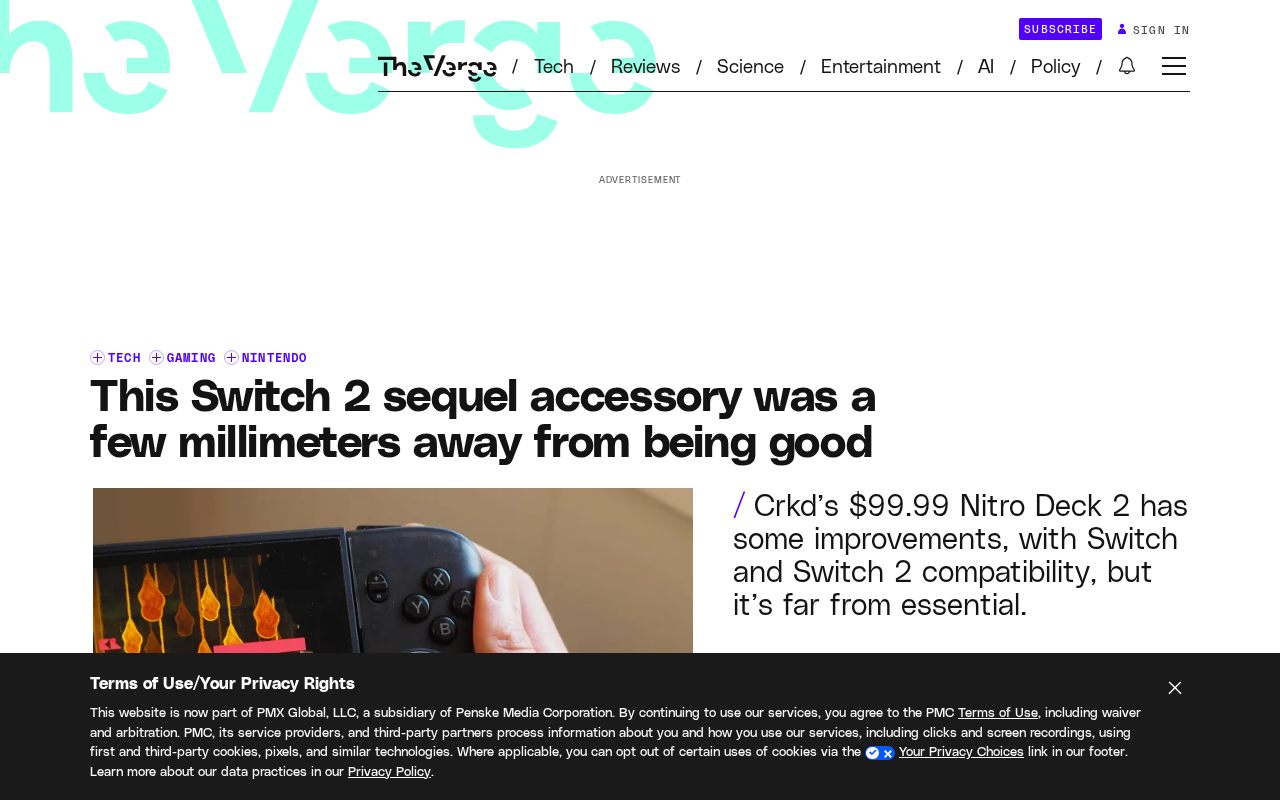
CRKD launches the Nitro Deck 2 for both Switch generations, keeping Hall Effect sticks but missing perfect fit by a few millimeters.
The CRKD Nitro Deck 2 is a slide-in accessory compatible with both the original Switch and Switch 2, continuing the original's Hall Effect stick solution for Joy-Con drift. The original built solid word-of-mouth at $59.99, while the sequel faces engineering challenges from dual-platform size differences. The review finds it "a few millimeters short of perfect," with issues mainly in structural tolerances and ergonomic fit rather than the stick hardware. The dual-platform strategy is commercially sound but sacrifices perfect fit; for players tired of drift, Hall Effect sticks remain a must-have.
CRKD's Nitro Deck was a savior for a generation of Switch players—the $59.99 slide-in accessory used Hall Effect sticks to rescue countless drifting Joy-Cons, completing complex repairs without ever opening the device. Now the Nitro Deck 2, launched for both Switch 2 and the original Switch, aims to carry on that legacy.
The Evolution Logic of Hall Effect Sticks
The original Nitro Deck's core selling point was clear: replace wear-prone carbon film potentiometers with Hall Effect sensors, physically eliminating stick drift. This approach earned solid word-of-mouth in the player community, which explains why CRKD chose to release a sequel.
The Nitro Deck 2's positioning is more complex. It needs to serve two generations of Switch simultaneously—the original model is smaller, the Switch 2 body is larger, and one accessory covering both specs raises the engineering difficulty significantly. Judging from the review title's phrasing "a few millimeters away from being good," CRKD made trade-offs in size adaptation, and those few millimeters of deviation are the key source of the experience gap.
Hall Effect sensors work on the Hall Effect principle: when current flows through a conductor, a magnetic field perpendicular to the current direction deflects the charge carriers, producing a potential difference (Hall voltage) across the conductor. In joystick applications, the sensor detects magnetic field changes from a permanent magnet moving with the stick, calculating position without contact. Compared to traditional carbon film potentiometers that change resistance through physical contact, the Hall Effect approach has no wearing parts, fundamentally avoiding drift caused by poor contact or wear. This is the technical foundation that let the original Nitro Deck effectively solve the Joy-Con drift problem.
Joy-Con drift refers to the phenomenon where the joysticks on Nintendo Switch's detachable controllers output movement signals automatically when not being operated. Its root cause usually lies in wear debris from carbon film potentiometers, dust intrusion, or spring fatigue, which prevents the sensor from returning to zero. The problem was extremely widespread during the original Switch's lifecycle, even triggering multiple class-action lawsuits. Hall Effect sticks achieve non-contact measurement through magnetic sensing, theoretically eliminating wear-based drift entirely, making them a popular upgrade option among third-party accessories and repair solutions—and one of the Nitro Deck series' core selling points.
What "A Few Millimeters Short" Means
The phrase "a few millimeters away from being good" in the title points to a specific and subtle problem. In the design context of slide-in accessories, a few millimeters could mean slight deviations in insertion feel, stick layout, or grip fit.
These accessories are extremely sensitive to tolerances. A rail fit that's too loose causes the body to wobble; too tight affects ease of attachment and removal. A few millimeters of stick position offset makes a noticeable difference in hand fatigue during long gaming sessions. CRKD clearly compromised under the goal of "one accessory covering two generations of consoles," and that compromise forms the reviewer's judgment of "close to excellent but not there."
Worth noting: the original Nitro Deck's Hall Effect solution was a clear technical highlight, and the sequel most likely carried over this configuration at the stick hardware level. The problem is more likely structural and ergonomic.
The Dilemma of Dual-Platform Compatibility
Designing accessories for the Switch 2 is inherently difficult. The new console's size changes disrupt existing accessory adaptation logic, and CRKD chose to make the Nitro Deck 2 compatible with both old and new generations—cramming two variables into one mold.
This strategy has commercial rationality—the original Switch has a massive installed base, and abandoning existing users would be unwise. But the cost is that the product can't achieve a perfect fit on either end. The "a few millimeters short" verdict is essentially feedback on this compromise strategy: the functional direction is right, but execution precision falls just short.
For players fed up with Joy-Con drift, Hall Effect sticks remain a must-have. Whether the Nitro Deck 2 is worth buying depends on your tolerance for those few millimeters, and whether CRKD makes subsequent fine-tuning in firmware or structure.
Slide-in accessories (like the Nitro Deck) rely on the Switch console's bottom rail structure: the accessory engages with the body via rails, embedding and securing the console. Since rail dimensions, body thickness, and button cutout positions differ between the two Switch generations, dual compatibility means the mold must leave margins across multiple dimensions. Tolerance control thus becomes critical—too loose causes wobble and poor contact, too tight affects the insertion experience. Balancing two specs in a single mold often requires sacrificing fit precision on one end, which is the engineering background behind the "a few millimeters short" verdict in the review.
Key Takeaways
- CRKD Nitro Deck 2 is compatible with both the original Switch and Switch 2, continuing the original's Hall Effect stick solution
- The original Nitro Deck solved the Joy-Con drift pain point at $59.99, building solid word-of-mouth
- The review finds the Nitro Deck 2 "a few millimeters short of perfect," pointing to size adaptation and structural tolerances
- The dual-platform compatibility strategy is commercially sound but compromises fit precision
- Hall Effect sticks remain the core selling point; purchase decisions depend on tolerance for detail deviations
One-line Summary
CRKD launches the Nitro Deck 2 compatible with both Switch generations, retaining Hall Effect sticks but falling a few millimeters short on size adaptation.
Paragraph Summary
The CRKD Nitro Deck 2 is a slide-in accessory compatible with both the original Switch and Switch 2, continuing the original's core approach of solving Joy-Con drift with Hall Effect sticks. The original built solid word-of-mouth at $59.99, while the sequel faces engineering challenges from dual-platform size differences. The review finds it "a few millimeters short of perfect," with problems mainly in structural tolerances and ergonomic fit rather than the stick hardware itself. The dual-platform strategy is commercially sound but sacrifices perfect fit for any single model. For players tired of drift, Hall Effect sticks remain a must-have, and purchase decisions depend on tolerance for detail deviations.
Related articles

Can Foldable Phones Disrupt the Vertical Short-Drama Ecosystem?
The large unfolded screen of foldables doesn't suit vertical short videos—huge black bars appear on both sides. Meanwhile, China-origin micro-dramas are generating over $1 billion in US revenue in vertical format. With foldables under 2% of global sales, can they disrupt the vertical content ecosystem?

Programming Laws Tier List: Which Are Truths and Which Should Be Retired?
From Conway's Law to Brooks's Law, senior developers Tier List classic programming laws: which still hold in the AI era, and which are overrated folk wisdom?
Kimi K3.1 Pro vs Opus 5.5 in 13 Long-Running Tasks: Which One Is Actually Worth Using?
13 long-horizon tasks pit Kimi K3.1 Pro against Opus 5.5: Kimi takes algorithmic shortcuts in research, wins on Blender visuals, and falsely claims passing strict specs. Total cost 55%, but cache re-reads erase the discount. Four production rules included.