Symbio: Technical Analysis and Challenges of the AI Self Fine-Tuning Loop

Analyzing Symbio's self fine-tuning loop concept, its technical value, and challenges like catastrophic forgetting and model drift.
This article examines the Symbio project's proposed AI self fine-tuning loop—a closed-loop system where models continuously learn from their own interactions. It explores the technical architecture including data collection, quality filtering, incremental training, and evaluation/rollback mechanisms, while discussing key challenges such as catastrophic forgetting, model drift, data poisoning risks, and the difficulty of automated evaluation.
Introduction: Can AI Train Itself?
In the era of large language models, model fine-tuning is typically a process requiring deep human involvement—preparing datasets, designing training pipelines, evaluating results, and iterating on optimizations. Fine-tuning refers to the process of further adjusting model parameters on a pre-trained large language model using domain-specific or task-specific data. During pre-training, the model learns fundamental language patterns from massive general corpora, while fine-tuning focuses on optimizing the model's performance for specific tasks. Common fine-tuning methods include Full Fine-tuning, LoRA (Low-Rank Adaptation), and other parameter-efficient fine-tuning techniques. However, the labor costs and expertise barriers of traditional fine-tuning workflows remain significant resource bottlenecks, especially for small and medium-sized teams.
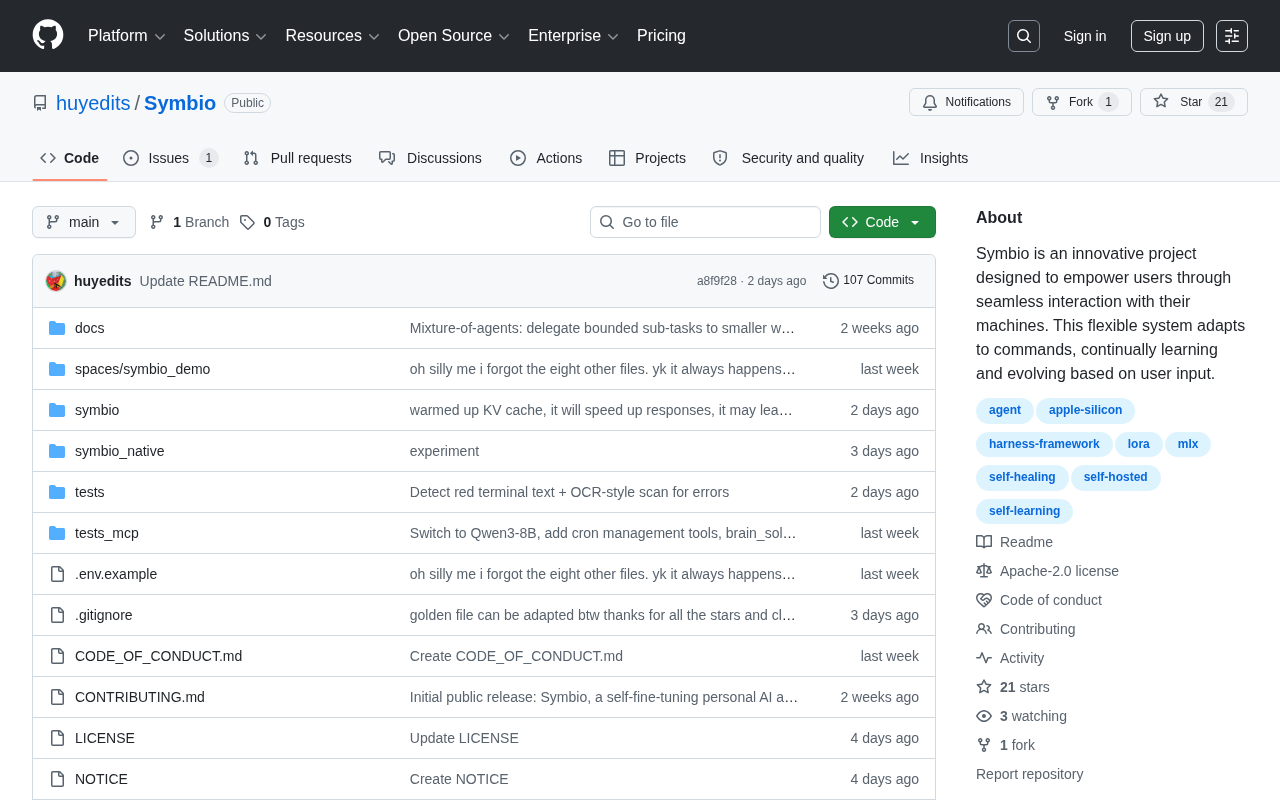
Recently, a Show HN project called Symbio appeared on Hacker News, attempting to challenge this traditional paradigm: it proposes a "self fine-tuning" AI closed loop that enables models to continuously learn and improve from their own interactions during runtime.
Although the project currently has modest traction (only 5 upvotes and 2 comments), the proposition it touches on—the self-evolution capability of AI systems—is an extremely imaginative direction in current AI research. This article will explore the technical logic, potential value, and real-world challenges of the self fine-tuning loop based on the project's core ideas.
What Is an AI Self Fine-Tuning Loop
From Static Models to Dynamic Learning
The traditional AI deployment model is "train once, use indefinitely." After training is complete, the model is frozen, and unless developers actively initiate a new round of fine-tuning, its capabilities won't grow with use. This static nature brings obvious limitations: the model cannot adapt to emerging user needs, nor can it absorb experience from actual interactions.
The "self fine-tuning loop" advocated by Symbio attempts to break this static state. Its core idea is to build a closed-loop feedback system: the model continuously generates new data during interactions with users or environments; this data is filtered, labeled, or weighted, then reused for incremental fine-tuning of the model; the fine-tuned model is then deployed back into interactions, forming a continuously cycling self-evolution process.
Key Components of the Loop
A complete self fine-tuning loop typically contains the following components:
- Data Collection: Gathering input-output pairs, user feedback, correction signals, etc., from the model's actual usage.
- Quality Filtering: Not all interaction data is worth using for training—mechanisms are needed to screen out high-value, high-quality samples.
- Incremental Training: Updating the model locally at lower cost, rather than training from scratch. Incremental Learning, also known as Continual Learning, is an important research direction in machine learning. Its goal is to enable models to gradually absorb new knowledge without forgetting old knowledge. In engineering practice, this typically involves smaller learning rates, regularization techniques (such as EWC—Elastic Weight Consolidation), or using Adapter modules to isolate old and new knowledge. Related to this is the Online Learning paradigm, where the model updates immediately upon receiving each new data point rather than waiting for batch data accumulation.
- Evaluation and Rollback: Verifying whether the new model has truly improved, with the ability to revert to the old version if performance degrades.
These four components together form the automated cycle that Symbio aims to implement, with the goal of minimizing human intervention and letting the model "get smarter with use."
Technical Value and Application Scenarios of Self Fine-Tuning
Personalization and Domain Adaptation
The most direct value of self fine-tuning lies in personalization. After a general-purpose large model is deployed to a specific scenario, it can gradually evolve into a specialized model better suited to a particular domain or user habits by continuously absorbing scenario-specific data. For enterprise internal knowledge bases, vertical industry applications, and similar scenarios, this adaptive capability is particularly valuable.
For example, an AI assistant deployed in the medical field could gradually learn an institution's specific terminology conventions, clinical workflow preferences, and documentation format requirements through daily interactions with doctors—without requiring the development team to manually collect this tacit knowledge and organize dedicated fine-tuning sessions.
Reducing Long-Term Maintenance Costs
If a model can automatically complete the entire process from data collection to fine-tuning, the labor costs of long-term AI system maintenance will decrease significantly. Developers no longer need to periodically organize manual fine-tuning tasks—the system itself can maintain an "evergreen" state. For resource-limited small teams and independent developers, this is a particularly attractive direction.
Real-World Challenges: Risks and Bottlenecks of Self Fine-Tuning
Catastrophic Forgetting and Model Drift
The biggest technical risk of self fine-tuning is catastrophic forgetting—the model may lose existing capabilities while learning new knowledge. Catastrophic forgetting is a core challenge in continual learning for neural networks, first identified by McCloskey and Cohen in 1989. Its fundamental cause lies in the shared nature of neural network parameters—when the model learns new tasks, gradient updates overwrite weight values that previous tasks depend on, causing sharp performance degradation on old tasks. In the context of large language models, this means that if a model is continuously fine-tuned on data from a narrow domain, it may gradually lose general conversational ability, reasoning capability, or knowledge in other domains. The academic community has proposed various mitigation strategies: Experience Replay (mixing old data when training on new data), parameter freezing (freezing certain layers while only updating specific ones), knowledge distillation (using the old model's outputs as soft labels to constrain the new model), among others. However, in a fully automated closed-loop system, how to balance old and new knowledge remains an unsolved engineering and theoretical challenge.
Furthermore, if the feedback data itself contains biases, the loop may amplify these biases, causing the model to gradually "drift" into an uncontrollable state. Specifically, if the model produces a slight bias in one output, and this biased output is collected as training data for the next round of fine-tuning, the model may become more inclined to produce similar biased outputs, continuously reinforcing this tendency in subsequent cycles. This phenomenon is a variant of what's called "reward hacking" or "mode collapse" in reinforcement learning. OpenAI has also observed similar over-optimization phenomena in their RLHF (Reinforcement Learning from Human Feedback) research, referring to it as "reward model overoptimization." This self-reinforcing negative feedback loop is precisely the hidden danger that automated training systems need to guard against.
Data Quality and Security
"Garbage in, garbage out" is further amplified in self fine-tuning scenarios. Without strict data filtering mechanisms, the model may learn users' misinformation, maliciously injected content, or even be intentionally "poisoned." Data Poisoning is one of the critical threats in machine learning security—attackers can alter model behavior without easy detection by injecting carefully crafted malicious samples into training data. In the context of self fine-tuning loops, this risk is significantly amplified: since the system automatically collects training data from user interactions, attackers may only need to use the normal interface to inject harmful data. Backdoor Attacks are a typical technique—attackers implant specific trigger patterns that cause the model to produce preset malicious outputs when encountering those patterns while behaving completely normally on regular inputs. Additionally, emerging threats such as Indirect Prompt Injection make the security design of automated training systems extremely complex. Therefore, the robustness of a closed-loop system largely depends on its quality control and security protection capabilities.
The Challenge of Automated Evaluation
How to automatically determine "whether the new model is better than the old one" is itself an open problem. This question fundamentally involves the core issue of the AI Alignment field: how to define and measure "good." In practice, commonly used automated evaluation methods include: using fixed benchmark test sets (such as MMLU, HumanEval), leveraging another powerful model as a judge (LLM-as-a-Judge, such as GPT-4 evaluation), and Elo rating systems (such as Chatbot Arena). However, each method has clear limitations: benchmarks may not cover the diversity of actual usage scenarios; model judges themselves have biases; and subjective metrics like user satisfaction are difficult to quantify automatically.
Without reliable automated evaluation baselines, the loop cannot safely decide whether to adopt each update. If the system incorrectly identifies a degrading update as an "improvement," this error will be solidified and continue to accumulate in subsequent cycles. This is also a common engineering bottleneck currently faced by such projects.
Conclusion: A Noteworthy Direction in AI Self-Evolution
As a Show HN project with modest community traction, Symbio's technical maturity and actual effectiveness remain to be validated. But the "self fine-tuning loop" concept it represents points precisely to an important trend in AI system evolution: moving from passive static tools toward dynamic systems with continuous learning and self-optimization capabilities.
It's worth noting that this direction is not isolated. Academic research in Continual Learning and Lifelong Learning has decades of history, while industry is also exploring similar online adaptation mechanisms—from real-time updates in recommendation systems to online reinforcement learning in dialogue systems, the concept of self fine-tuning is permeating various layers of AI systems in different forms.
Regardless of how far Symbio ultimately goes, the value of such experimental projects lies in their courage to explore boundaries. For developers following AI frontiers, understanding the mechanisms, value, and pitfalls of self fine-tuning loops will help us better grasp the developmental trajectory of next-generation AI systems. The real challenge isn't getting the model to "start learning," but ensuring it "learns in the right direction" and remains "safe and controllable"—this is precisely the topic most worth deep exploration in this field.
Related articles

Poison-Resistant Concept Anchoring: A New Approach to Defending Against AI Data Poisoning
Deep dive into Poison-Resistant Concept Anchoring, defending against data poisoning via signed anchors and bounded updates. Experiments show 62% poison isolation with 0% false rejection rate.

Hungarian Algorithm Explained: Principles, Complexity, and Engineering Implementation Guide
In-depth explanation of the Hungarian Algorithm: core principles, O(N³) time complexity advantages, and engineering implementation. Covers assignment problem definition, step-by-step algorithm walkthrough, Python/C++ libraries, and applications in multi-object tracking and resource scheduling.
OpenAI's First Enterprise AI Report: H…
OpenAI's First Enterprise AI Report: How ChatGPT Is Changing the Way Organizations Work
OpenAI's first enterprise AI report reveals three key traits of ChatGPT Enterprise adoption: the shift from novelty to necessity, writing and coding as top use cases, and data governance as a core prerequisite.