Synopsys Unified GitHub Action v6.0.0 Released: Key Upgrade Notes and Migration Guide

Synopsys Unified GitHub Action releases major v6.0.0 update with integrated security scanning capabilities.
GitHub Action "Synopsys Unified" has released its v6.0.0 major version update, consolidating SAST, SCA, and DAST security scanning capabilities into GitHub CI/CD pipelines to realize the shift-left security DevSecOps philosophy. As a major version upgrade, it may contain non-backward-compatible changes, and users should review the migration guide and validate in test environments first.
Overview
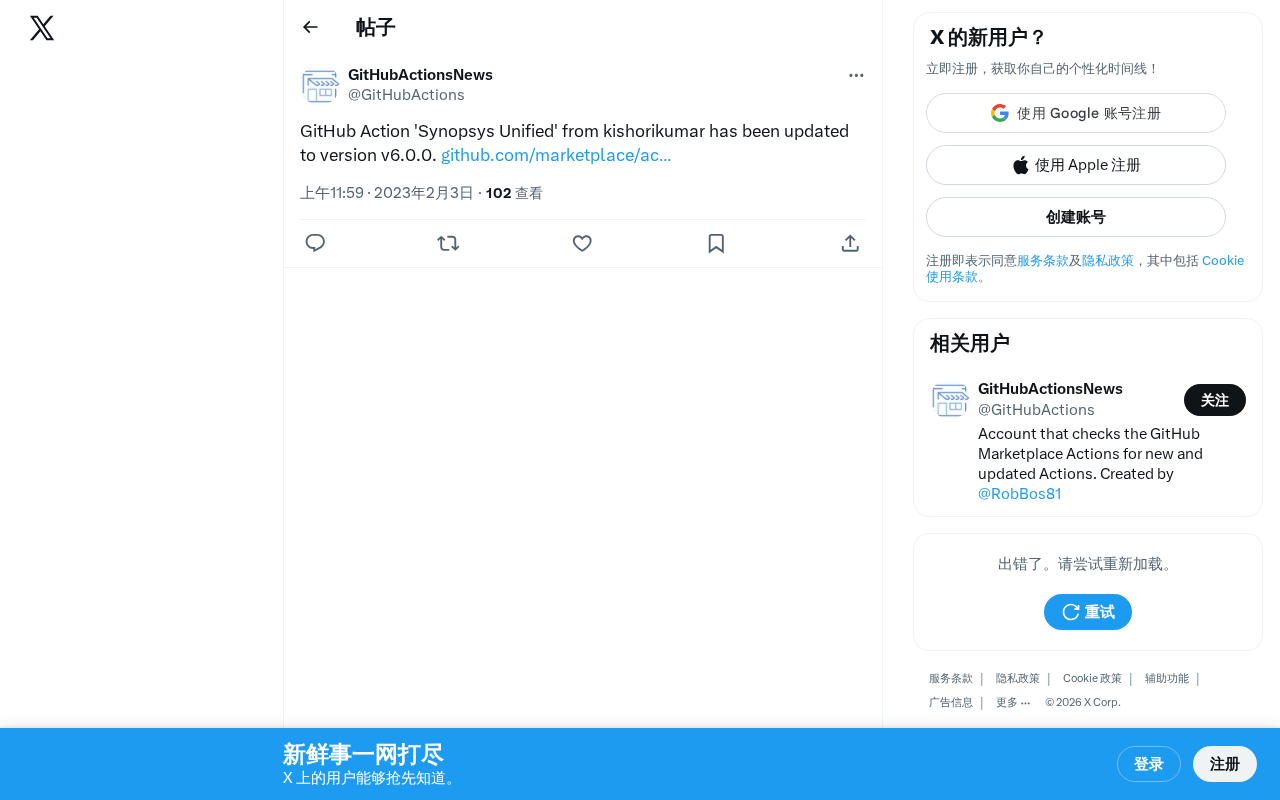
The GitHub Action "Synopsys Unified" has recently released a major version update, v6.0.0. Maintained by developer kishorikumar, this Action is designed to integrate Synopsys security scanning tools into GitHub CI/CD pipelines, helping development teams automatically perform Application Security Testing (AST) at the code commit stage.
What Is Synopsys Unified Action?
Tool Positioning and Core Capabilities
Synopsys Unified Action is a GitHub Action that consolidates multiple Synopsys security analysis tools, providing developers with a unified entry point for security scanning. It integrates the following core capabilities:
-
Static Application Security Testing (SAST): Uses tools like Coverity to perform source-code-level vulnerability detection, identifying potential risks before compilation. SAST is a white-box testing technique that analyzes source code, bytecode, or binary code to discover security vulnerabilities without actually running the program. Coverity originated from static analysis research at Stanford University and can detect hundreds of defect types including null pointer dereferences, buffer overflows, SQL injection, and Cross-Site Scripting (XSS). According to NIST research data, fixing a vulnerability during the design phase costs only 1/30th of fixing it in production — this is precisely the core value of SAST tools.
-
Software Composition Analysis (SCA): Uses tools like Black Duck to identify known vulnerabilities and license compliance risks in open-source components. SCA focuses on cross-referencing a project's third-party open-source dependencies against the CVE (Common Vulnerabilities and Exposures) database and the NVD (National Vulnerability Database). Black Duck maintains one of the world's largest open-source knowledge bases, covering over 5 million open-source components. With the emergence of major supply chain vulnerabilities like Log4Shell (CVE-2021-44228), the importance of SCA tools has surged dramatically. The 2021 U.S. Presidential Executive Order (EO 14028) explicitly required federal software vendors to provide a Software Bill of Materials (SBOM), further accelerating SCA adoption across enterprises.
-
Dynamic Application Security Testing (DAST): Simulates attacks in runtime environments to detect security issues after deployment.
DevSecOps Integration Value
Embedding security scanning into GitHub Actions workflows means that every code push or Pull Request can automatically trigger security checks, truly realizing the "shift-left security" DevSecOps philosophy. DevSecOps embeds Security into the entire software development lifecycle, with the core idea of moving security testing from the traditional pre-release stage to the development, coding, and even requirements stages. Research from the IBM System Sciences Institute shows that fixing vulnerabilities during the coding stage costs less than 6 times compared to production, while production-stage fixes can cost up to 100 times more than during the design stage. As a CI/CD tool natively integrated into the code hosting platform, GitHub Actions naturally has the ability to trigger security scans at key points such as code pushes and Pull Requests, making it an ideal vehicle for practicing the shift-left security philosophy. Gartner predicts that by 2027, more than 70% of enterprises will mandate security scanning tool integration in their CI/CD pipelines. Developers can receive security feedback without leaving the GitHub platform, reducing remediation costs by orders of magnitude compared to discovering issues after deployment.
Key Upgrade Notes for v6.0.0
From the version number, v6.0.0 is a Major Version upgrade. According to Semantic Versioning (SemVer), this typically means:
- It may contain non-backward-compatible API or configuration parameter changes
- It introduces significant new features or underlying architectural adjustments
- Users on older versions should review the official migration guide when upgrading
Semantic Versioning (SemVer), proposed by Tom Preston-Werner, uses a MAJOR.MINOR.PATCH three-segment version number format: a MAJOR version increment indicates non-backward-compatible (Breaking Change) API changes; a MINOR increment indicates new backward-compatible features; and a PATCH increment indicates backward-compatible bug fixes. In the GitHub Actions ecosystem, SemVer is particularly critical — many teams reference Actions using floating major version tags like @v5, which typically point to the latest stable release of that major version. Therefore, during a major version upgrade, maintainers usually update the major version tag simultaneously, which may cause workflows using floating tags to automatically switch to new version behavior without adequate testing, leading to unexpected build failures.
For teams already using this Action in their CI/CD pipelines, it is recommended to carefully read the official Release Notes before upgrading and assess item by item whether existing workflow configuration files need adjustments.
Developer Upgrade Recommendations and Best Practices
Upgrade Migration Considerations
- Check Configuration Compatibility: Verify against the Release Notes that the input parameters and environment variables in your current workflows are compatible with v6.0.0
- Validate in Test Environments First: It is recommended to verify the new version's behavior in non-production branches or dedicated test repositories first
- Version Pinning Strategy: If you cannot upgrade immediately, explicitly pin the old version number in your workflow files (e.g.,
@v5) to avoid automatic pulls of the new version causing build failures
Best Practices for Security Scanning in GitHub Actions
Integrating security scanning tools into GitHub Actions has become standard practice in modern software development. Whether using Synopsys Unified or other security tools, the following practices are worth considering:
- Link scan results with the PR review process to block merge requests containing high-severity vulnerabilities. The Synopsys toolchain supports uploading scan results in SARIF (Static Analysis Results Interchange Format) format to the GitHub Security tab and can display security issues directly in the PR interface through GitHub's Code Scanning Alerts feature. Combined with Branch Protection Rules, this enables automatic blocking of PRs with high-severity vulnerabilities, creating a complete Quality Gate feedback loop.
- Set reasonable quality gate thresholds, typically configured based on vulnerability severity (Critical/High/Medium/Low), CVSS scores, or license compliance status, balancing security requirements with development efficiency
- Regularly update scanning tool versions to obtain the latest vulnerability rule databases and detection capabilities
- Archive scan reports for security audits and compliance traceability, while meeting regulatory requirements such as SBOM
Conclusion
The release of Synopsys Unified Action v6.0.0 reflects the ongoing evolution of application security testing tools within the CI/CD ecosystem. As software supply chain security issues draw increasing industry attention — from the Log4Shell vulnerability to government mandates for SBOM across multiple countries — seamlessly integrating professional-grade security scanning capabilities into GitHub development workflows has become an indispensable part of enterprise software delivery. Teams are advised to evaluate their upgrade plans early to ensure their security defenses stay in sync with tool version updates.
Key Takeaways
- Synopsys Unified GitHub Action releases major version update v6.0.0
- The tool consolidates multiple security scanning capabilities including SAST and SCA into GitHub CI/CD pipelines
- The major version upgrade follows SemVer conventions and may contain non-backward-compatible changes; users should review the migration guide
- The shift-left security philosophy drives deep integration of security scanning tools into development workflows, potentially reducing remediation costs by orders of magnitude
- SBOM compliance requirements and growing supply chain security awareness further highlight the strategic value of SCA tools
Related articles
 Tech Frontiers
A Rare Quiet Day in AI: Recursive Self-Improvement Stirs Beneath the Surface
A rare quiet day in AI sees multiple sources go silent simultaneously. Behind the calm, Recursive Self-Improvement (RSI) research continues. What this means for the industry.
 Tech Frontiers
Reve 2 vs. Ideogram 4: A Deep Dive into Layout Control in AI Image Generation
A deep comparison of Reve 2 and Ideogram 4's layout control capabilities, covering technical approaches, real-world use cases, and industry trends for designers and creators.
 Tech Frontiers
In the Weights: Check Your Influence Score in the AI World
In the Weights is an AI influence search engine that quantifies your presence in the AI world with a score. Explore how it evaluates practitioners and what it means for digital identity.