Tabby: A Former Accountant Using AI to Reinvent Bookkeeping — Will the Accounting Profession Disappear?

A former accountant's AI tool Tabby delivers real-time bookkeeping, targeting the lag that plagues small business finances.
A former accountant is developing Tabby, an AI bookkeeping tool positioned as a real-time interface that automatically processes invoices and delivers up-to-the-minute profit and loss data — eliminating the weeks-long lag of traditional financial reporting. The article argues that while Tabby meaningfully disrupts the standardized, repetitive layer of bookkeeping, higher-value accounting functions like tax planning and audit judgment remain hard to fully automate. The likely outcome: reduced reliance on dedicated bookkeeping staff for SMBs, with accountants gradually shifting toward advisory and decision-support roles.
A Former Accountant's Self-Disruption
A story with a delightful irony is playing out in the AI application space: a former accountant is building an AI tool called Tabby, aimed at making traditional accounting work obsolete. This isn't an outsider's disruptive charge — it's an efficiency revolution launched from within, by someone who deeply understands financial workflows.
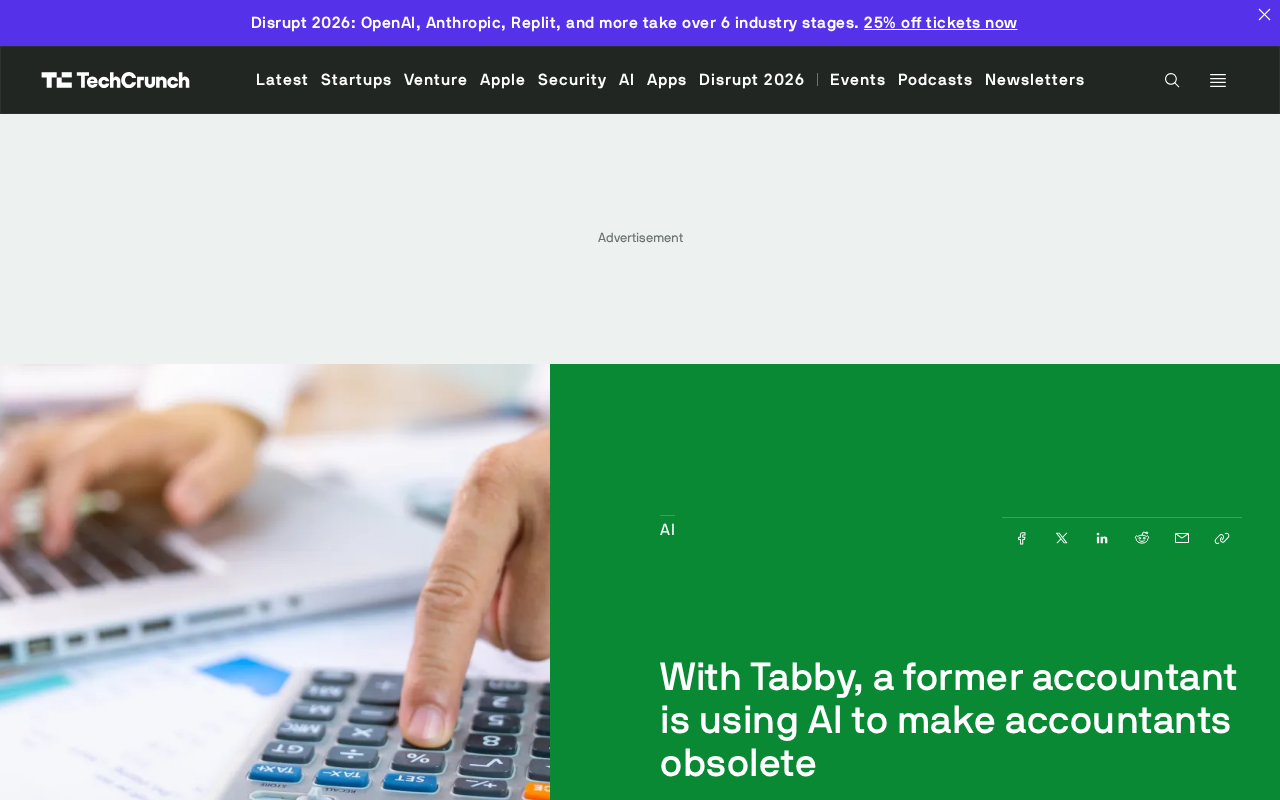
For small business owners who have long relied on manual invoice processing, reconciliation, and reporting, this product logic is familiar — the person who truly understands the pain points always knows best which steps can be replaced by automation.
What Problem Does Tabby Actually Solve
According to its product positioning, Tabby is designed as a real-time bookkeeping interface. Its core capabilities center on two things:
- Automated processing of client invoices and paperwork: Handing off paper and digital receipts — previously requiring manual entry, classification, and filing — to AI.
- Real-time business data: Giving business owners an up-to-the-minute view of their Profit and Loss status, rather than waiting until month-end or quarter-end for financial reports.
The core pain point of traditional bookkeeping is precisely this lag. By the time a small business owner receives a financial report, the data is often a snapshot from weeks ago — too stale to support timely operational decisions. Tabby's "up-to-the-minute" positioning is squarely aimed at this gap.
The distinction between Bookkeeping and Accounting is worth clarifying here. Bookkeeping refers to the day-to-day entry of transactions, categorization of receipts, and account reconciliation — the repetitive "data entry layer" of financial work. Accounting, by contrast, encompasses financial statement preparation, tax filing, internal compliance, and analytical advice for management. Tabby targets the former — a layer that consumes enormous hours for small business finance teams yet requires almost no high-level judgment, making it the first target of AI automation. For micro-businesses with monthly revenue below a certain threshold, hiring a full-time accountant is typically out of reach, so they rely on outsourced bookkeeping firms to process accounts monthly. This is the structural root cause of "waiting weeks for a report" — and exactly the market gap Tabby is trying to fill.
Why "Real-Time" Is the Core Selling Point
The value of financial data is highly dependent on timeliness. For business operators, a lagging ledger is useful only for compliance and retrospective review. Real-time profit and loss data, however, can directly inform immediate decisions around pricing, procurement, and cash flow management.
Tabby transforms bookkeeping from a "clean-up-after-the-fact" task into a continuously running data interface. This approach aligns with the broader trend of financial software evolving toward automation and intelligence: AI is no longer just about calculating faster — it's about restructuring how financial information is produced and consumed.
From a technical implementation standpoint, "real-time bookkeeping" typically relies on a combination of key capabilities: OCR (Optical Character Recognition) to convert paper receipts or invoice images into structured data; natural language processing or rule engines to automatically categorize transactions into the correct accounts (e.g., a restaurant expense filed under "business entertainment"); and API integrations with bank accounts or payment platforms to automatically sync transaction data. This technology stack has matured considerably in recent years — established accounting software like QuickBooks and Xero already incorporate automated bookkeeping features, but their product complexity still poses a learning curve for micro-business owners. If Tabby can package these capabilities into a simpler, more intuitive interface, its differentiation lies in ease of use rather than any unique technical innovation.
Will AI Make Accountants "Obsolete"?
The framing of making accountants "redundant" is attention-grabbing, but deserves a measured look. Based on publicly available information, Tabby primarily targets bookkeeping — the relatively standardized, highly repetitive layer of financial work — rather than the full scope of what accountants do.
Tax planning, audit judgment, financial strategy consulting, and other functions that require professional judgment and accountability are unlikely to be fully automated anytime soon. A more realistic picture might look like this:
- Entry-level bookkeeping roles will face pressure from AI tools compressing demand;
- Accountants' roles shift toward higher-value advisory and decision-support functions;
- Small and medium-sized businesses become less dependent on dedicated bookkeeping staff.
In other words, tools like Tabby are more likely to change the composition of work within the accounting profession than to eliminate it entirely in the near term.
Closing Thoughts: Industry Insiders Make the Most Dangerous AI Products
The Tabby story is a reminder that the most threatening disruptors often come from within an industry. A former accountant knows better than anyone which steps in the bookkeeping process are redundant and which data gets manually transferred over and over again — which makes Tabby's product focus unusually sharp.
For practitioners watching AI adoption, cases like this — where someone uses AI to automate their own former profession — are excellent examples of how AI is gradually penetrating professional services, layer by layer. That said, given the limited public information available about the product, Tabby's actual user experience, data accuracy, and compliance capabilities still remain to be verified.
Related articles

Reinforcement Learning Takes On Getting Over It: Distributed Training Strategies Behind 63% Progress
A developer uses deep reinforcement learning to tackle Getting Over It. The agent climbs from the bottom to 63% progress but gets stuck at the anvil. The project is open-sourced, using divide-and-conquer training and CPU-only training, seeking community collaboration to break the bottleneck.

Sigma FP2 Released: The World's Smallest Full-Frame Camera Gets Sensor and Screen Upgrades
Sigma launches the FP2 full-frame camera, retaining its smallest-and-lightest design with three key upgrades: improved sensor, articulating LCD screen, and longer battery life—built for portable video creators.

AAAI 2027 Phase 2 Decisions Imminent: Community Debates Review Fairness and Submission Ecosystem
AAAI 2027 phase 2 review results are imminent, with the Reddit community debating reviewer consistency and process transparency. This article examines pre-decision sentiment, structural tensions in top conference review, and practical strategies for authors.