tabsh: Collaborate with IDE and AI Agents in Browser Tabs

tabsh moves AI coding sessions into browser tabs, using a Kanban board to unify parallel multi-agent tasks.
tabsh is an open-source tool by Blaise Tiong that flips the script—moving coding sessions into browser tabs instead of stuffing the browser into the IDE. A Rust daemon manages AI agent sessions across all projects and auto-updates statuses via agent hooks on a Kanban/list view. It supports Claude Code, Codex, Cursor CLI, OpenCode, is MIT-licensed, and supports macOS/Linux. Its philosophy: "sessions revolve around work, not work around sessions." It earned 84 votes and ranked 9th on Product Hunt.
Most ADEs (AI Development Environments) try to stuff the browser into the IDE, but tabsh does the opposite: it moves your coding sessions into browser tabs—the very place where you already work. This open-source project, developed by Blaise Tiong, earned 84 votes and ranked 9th on Product Hunt. It uses a small Rust daemon to aggregate sessions from all projects into a single Kanban/list view and automatically updates statuses via agent hooks.
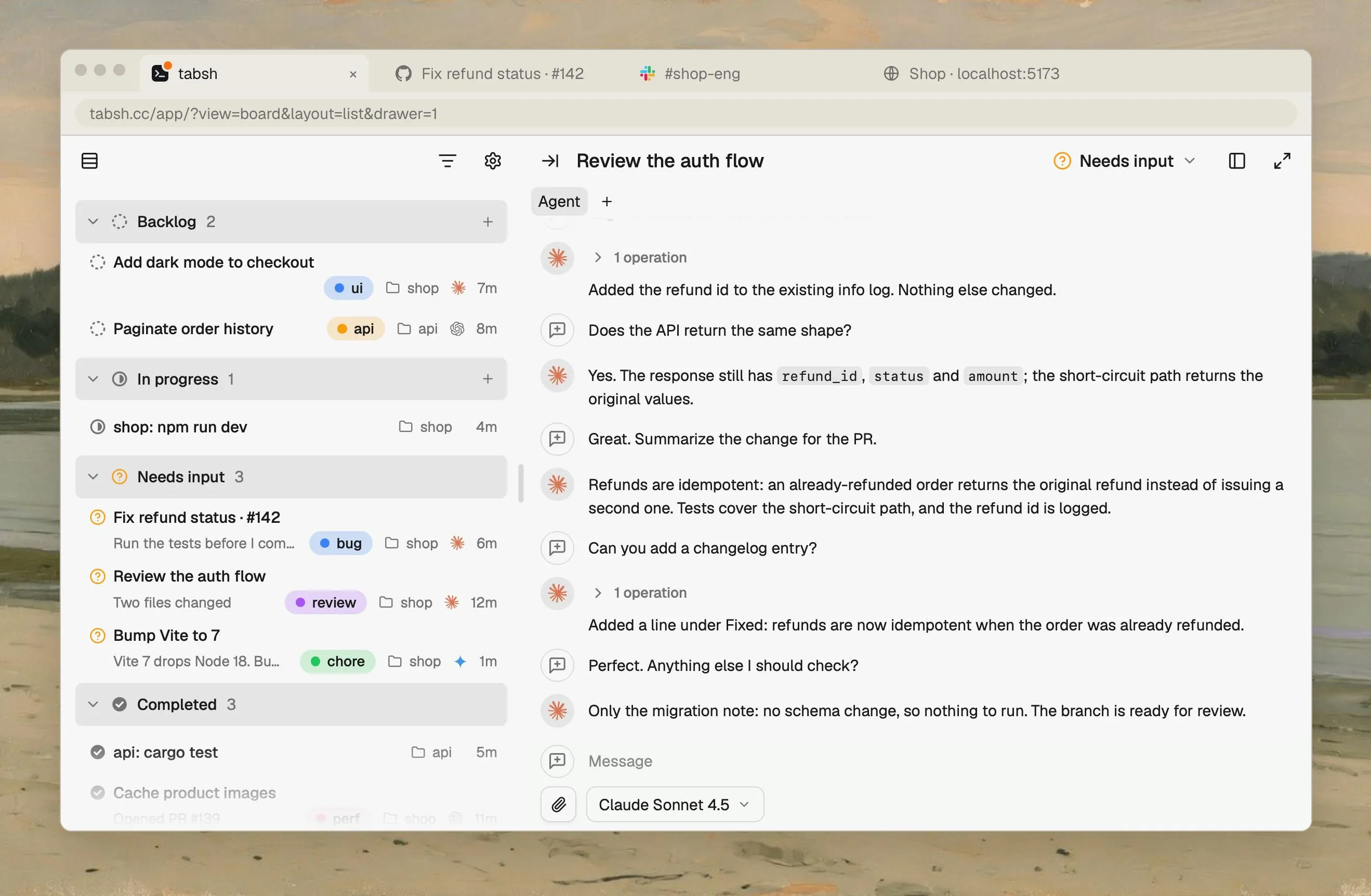
Browser-first AI coding workflow
tabsh's core philosophy is "sessions revolve around work, not work around sessions." Instead of opening a clunky IDE window just to chat with Claude Code or Codex, you operate directly in the browser: interact with multiple AI agents using a real terminal or chat panel. Supported backends include major coding agents such as Claude Code, Codex, Cursor CLI, and OpenCode.
The Rust daemon manages the session lifecycle for all projects, turning scattered terminal conversations into a unified Kanban board. For developers running multiple AI tasks simultaneously, this means no more jumping back and forth between a dozen tabs and terminal windows.
AI Coding Agents refer to AI systems capable of understanding natural language instructions, autonomously planning, and executing code modification tasks. Typical examples include Claude Code, Codex, and Cursor CLI. Unlike traditional code completion tools, coding agents typically operate in "sessions": they continuously receive user instructions, invoke tools (such as reading/writing files or running commands), observe results, and iterate within a terminal or dedicated interface. Each session has its own context window and task state. What tabsh manages is precisely the lifecycle of these sessions—creation, running, waiting for input, completion—making "session management" a core issue in multi-agent collaboration.
Kanban-style session management
tabsh visualizes session states: each agent session appears as a card on a Kanban board, and agent hooks automatically push updates when states change. You can see at a glance which tasks are running, which are waiting for input, and which are completed.
This design borrows from project management tools but embeds it directly into the coding context. Compared to the tree-like session lists in IDEs, a Kanban board aligns more closely with human intuition for parallel tasks.
Agent Hooks are callback mechanisms triggered by coding agents at key events (such as session start, task completion, waiting for user confirmation, or errors). tabsh leverages these hooks to listen for state changes across backend agents, then forwards events to the browser board via the daemon, enabling automatic card status updates. There are typically two integration approaches for hooks: one is the agent's native event subscription interface, and the other is lightweight scripts injected via wrapper commands or environment variables. Compared to polling, the hook mechanism offers lower latency and less overhead—this is also the technical prerequisite that allows tabsh to achieve a real-time board with a thin orchestration layer.
Lightweight architecture and open-source ecosystem
tabsh is open-sourced under the MIT license and supports macOS and Linux. The Rust daemon means low resource usage and the convenience of single-binary deployment. It doesn't try to replace your terminal or editor; instead, it serves as a thin orchestration layer.
For developers already accustomed to checking documentation, browsing GitHub, and running CI in the browser, tabsh brings coding agents into the same interface, reducing context-switching costs. This "browser as workbench" positioning forms an interesting contrast with the current trend of IDE vendors cramming every feature into the IDE.
Rust daemon refers to a resident background service written in Rust. Rust's ownership model and no-garbage-collection design give it outstanding performance in memory usage and startup speed. The compiled output is a single static binary, requiring no additional runtime dependencies during deployment. For an orchestration layer like tabsh that needs to stay resident long-term, manage multiple sessions, and forward events, Rust's low resource overhead and cross-platform consistency are the main reasons for choosing it. The daemon communicates with the browser frontend via a local port or Unix socket, and all project session states are maintained centrally within this process.
Positioning from multiple perspectives
Judging from Product Hunt rankings and developer community discussions, tabsh addresses the pain point of "session management chaos as AI agents multiply." A single source (the maker's own description) emphasizes browser-first and Kanban management; community feedback focuses more on the actual experience of running multiple agents in parallel. One consensus is that when tools like Claude Code and Codex each operate independently, a unified session view is indeed valuable. The disagreement is whether the browser is suitable for heavy terminal interaction—this depends on personal habits and project complexity.
One-line Summary
tabsh moves AI coding sessions into browser tabs, using a Kanban board to unify management of parallel multi-agent tasks.
Paragraph Summary
tabsh is an open-source tool developed by Blaise Tiong that flips the script—instead of stuffing the browser into the IDE, it moves coding sessions into browser tabs. It uses a Rust daemon to manage AI agent sessions across all projects and automatically updates statuses via agent hooks, presenting them centrally on a Kanban/list view. It supports major backends including Claude Code, Codex, Cursor CLI, and OpenCode, is open-sourced under the MIT license, and supports macOS and Linux. Its core philosophy is "sessions revolve around work, not work around sessions," reducing context switching for developers who are used to working in the browser. The product earned 84 votes and ranked 9th on Product Hunt, hitting the pain point of session management chaos during parallel multi-agent work.
Related articles
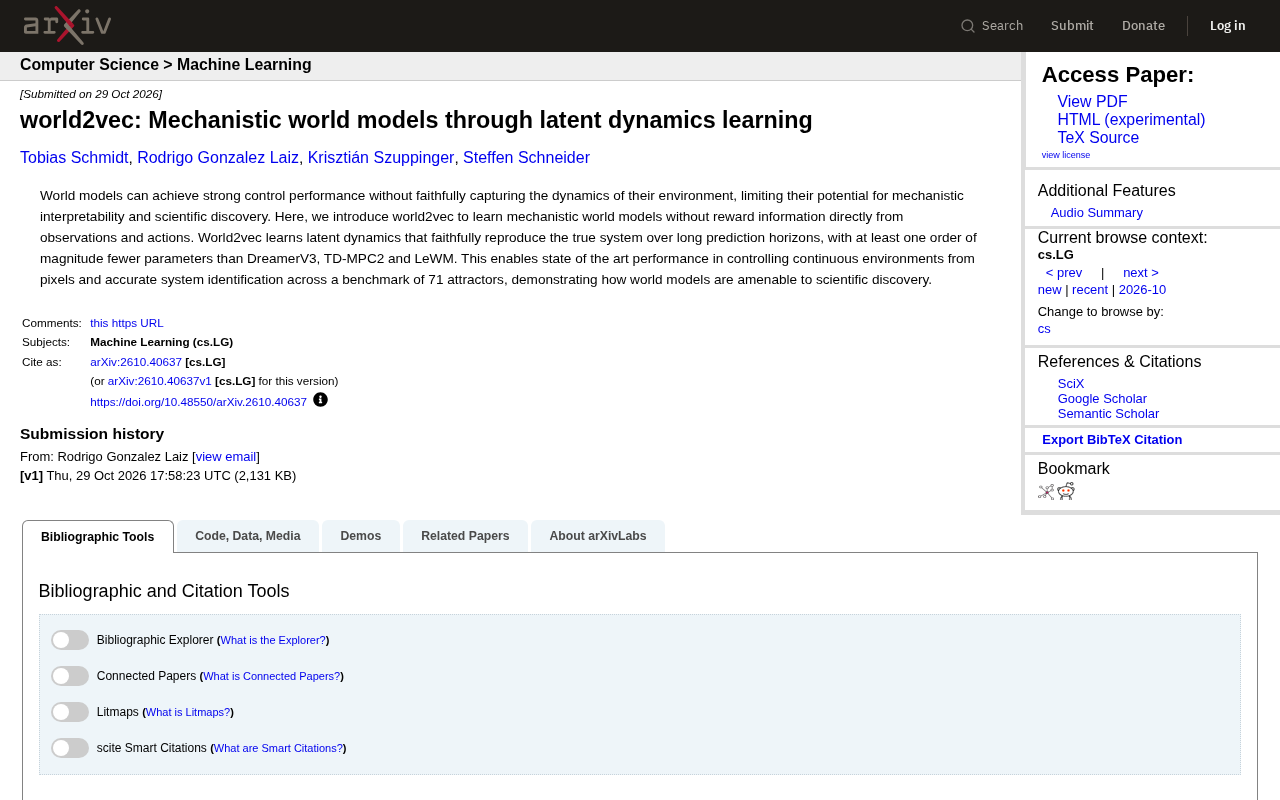
world2vec: Building Mechanistic World Models with Latent Dynamics Learning
world2vec proposes a reward-free method for learning mechanistic world models via latent dynamics, faithfully reproducing systems over long horizons with at least an order of magnitude fewer parameters than DreamerV3, TD-MPC2, and LeWM, and achieving accurate system identification on 71 attractor benchmarks.

A New KL-DRO Paradigm: Adaptive Scenario Generation Around a Learned Density Model
KL-DRO research proposes centering the KL ball on a learned density model instead of the empirical distribution, with adaptive scenario generation guiding sampling toward the worst case. Experiments show lower cost under distribution shift when records are scarce and the model can extrapolate, with comparable in-distribution cost.

ODE Samplers for Discrete Diffusion Models: Exponential Residual Flows Accelerate Generation
Discrete diffusion models lack deterministic ODE sampling? This article introduces Exponential Residual Flows (ERFs), which introduce continuous residual variables per token to construct piecewise ODEs for deterministic sampling and support consistency distillation acceleration. Superior to prior methods on code and text generation tasks.